

Audio By Carbonatix
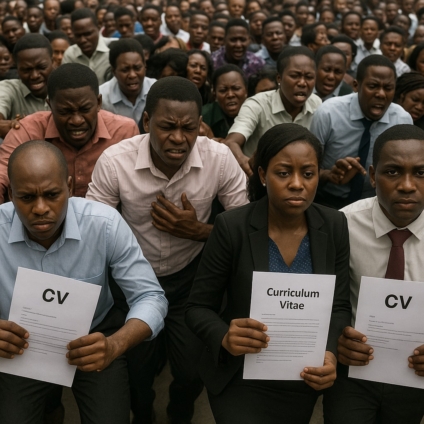
Six young people died today at El Wak Stadium, not in battle but in a queue for jobs. They came before sunrise, clutching their certificates and dreams, hoping to join the army. By nightfall, Ghana had turned their ambition into tragedy.
This is what unemployment looks like in a country where every youth depends on government postings for survival. Each year, Ghana produces over 350,000 job seekers, yet the formal economy can barely absorb 50,000. Because we have no functional secondary industries, the rest are left to drift. We mine gold but import jewellery. We grow cocoa, but buy chocolate. We harvest pineapples yet import juice. Our economy exports effort and imports everything else.
As the industry collapses, universities continue to train minds without hands. They teach theories, not skills. Students graduate fluent in definitions but unprepared for production. With no serious partnerships between government and industry, classrooms remain detached from factory floors. Because the state has failed to build a bridge between education and employment, every graduate ends up waiting, not for innovation but for a posting.
While families mourn at El Wak, soldiers in another region have arrested over 150 villagers for blocking anti-galamsey operations. Different scenes, same story. Both are about livelihood. When people cannot find decent work, survival itself becomes a crime. The young man who queues for recruitment and the miner who digs for gold are driven by the same hunger to live with dignity.
Yet our leaders seem deaf to that cry. They attend investment forums abroad while our youth die at home. They preach job creation while factories exist only in our dreams. They fly over the same communities whose only export is frustration.
If we truly want change, we must rebuild Ghana’s productive base. We need industries that can absorb skills, universities that teach practice, and policies that connect education to enterprise. We need leaders who build opportunities instead of reading condolences.
Until then, our youth will keep queuing for enlistment, for visas, for hope. And when hope dies in that queue, it is not only six lives we lose; it is Ghana’s promise that perishes with them.
Latest Stories
-
‘FA President has four clubs; what do you think he would do?’ – Nana Baffour Awuah fires back
9 minutes -
Kurt Okraku doesn’t like criticism, but Ghana football is beyond him – Nana Baffour Awuah
23 minutes -
Ghana’s Liquidity Paradox: Why capital is not reaching productive businesses
31 minutes -
Ghana football has collapsed under Kurt Okraku – Manhyia South MP
39 minutes -
Mr John Blankson Adu Otu
1 hour -
Prof. D. K. Yeboah-Amankwah
1 hour -
AFCON 2027Q: Queiroz ‘proud’ of Black Stars performance despite defeat to Cote d’Ivoire
1 hour -
Your next home could be here: 3rd JoyNews Republic Bank Habitat Clinic opens at Junction Mall today
2 hours -
GCAA assures safety won’t be sacrificed to attract more airlines
2 hours -
AFCON 2027Q: Queiroz furious with ‘joke’ penalty awarded Cote d’Ivoire in Black Stars defeat
2 hours -
GCAA backs more domestic airlines to drive down airfares
2 hours -
SHC launches nationwide audit, gives occupants 21 days to regularise property interests
2 hours -
Manhyia South MP describes EOCO arrest attempt as ‘provocation’
2 hours -
Appiagyei appeals to Lordina Mahama, Jane Naana over detention of Ghana Jollof accused
2 hours -
New regional hospitals will bring specialist care closer to Oti, Savannah and Western North – Health Ministry
2 hours