

Audio By Carbonatix
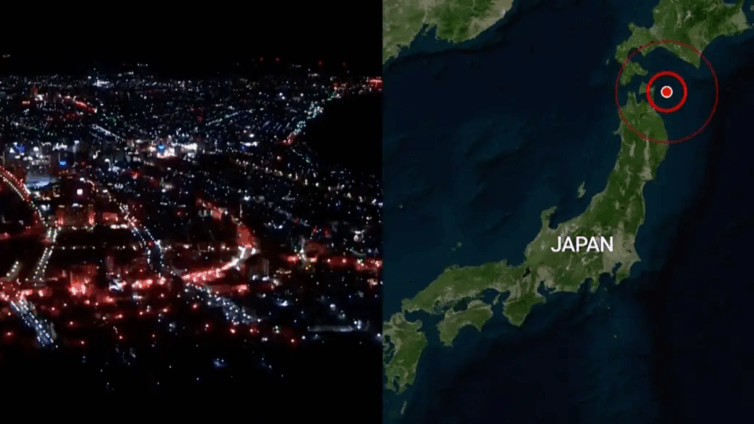
At least 30 people were injured after a magnitude 7.5 earthquake hit north-eastern Japan on Monday night, forcing thousands of people to evacuate their homes.
The quake occurred at 23:15 (14:15 GMT) at a depth of 50km (31mi), about 80km off the coast of the Aomori region, the Japan Meteorological Agency said. It prompted tsunami warnings which have now been lifted, while waves of 70cm (27in) were seen.
Some train services have been suspended and thousands of homes have been left without power as a result.
Authorities have also warned that a stronger tremor could occur in the coming days - urging the public to remain on high alert for at least a week, according to local media reports.
Addressing citizens affected by the earthquake, Japanese Prime Minister Sanae Takaichi said: "Reconfirm your daily earthquake preparedness, such as ensuring that you secure furniture, and prepare to evacuate immediately if you feel shaking."
Orders were issued for about 90,000 residents to evacuate, according to Reuters news agency.
The Aomori prefectural government said around 2,700 homes have been left without power. East Japan Railway has also suspended some services along the north-eastern coast.
The Japanese government has set up a response office within the prime minister's crisis management centre and convened an emergency team, chief cabinet secretary Minoru Kihara has said.
"We are making every effort to assess the damage and implement emergency disaster response measures, including rescue and relief operations," he added.
Following the tremors, Japanese electric company Tohoku Electric Power said no irregularities were reported at its Higashidori and Onagawa nuclear power plants as a result of the quake, Tohoku Electric Power said.
None were detected either at the disabled Fukushima nuclear power station site, the Japanese authorities told the International Atomic Energy Agency.
Fukushima was damaged when a magnitude 9.0 quake struck off the country's eastern coast on 11 March 2011.
That quake, the most powerful ever recorded in Japan, triggered a tsunami which swept over the main island of Honshu, killing more than 18,000 people and wiping entire towns off the map.

Japan is one of the world's most earthquake-prone countries.
It sits on the Ring of Fire and, as a result, experiences about 1,500 earthquakes a year.
Earlier this year, Japan's earthquake investigation panel said there was a 60-90% chance that a megaquake would occur in the Nankai Trough within the next 30 years, with worst-case scenarios suggesting it would cause trillions in damage, and potentially kill hundreds of thousands.
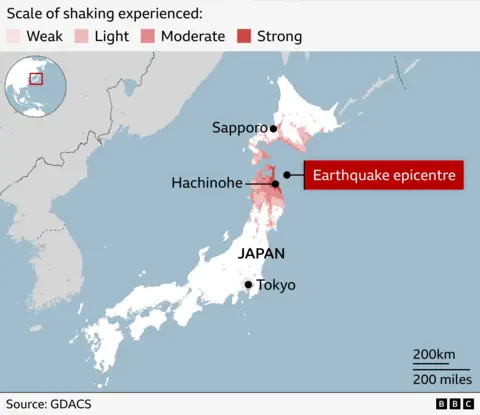
Earthquakes along the Nankai Trough - an area of seismic activity which stretches along Japan's Pacific coast - have already been responsible for thousands of deaths.
Latest Stories
-
Trump administration moves to impose more than $100,000 fee for H-1B worker visas
1 hour -
Oil prices steady as investors weigh impact of expanded US sanctions against Iran
3 hours -
Trump administration plans to revoke visas of foreigners seeking asylum
3 hours -
US appeals court considers reassigning case from judge over AI use
3 hours -
Trump bought shares in Elon Musk’s SpaceX in June, financial disclosure shows
3 hours -
MTN approves $375 million share buyback after profit rise
4 hours -
Ghana gold buyers went weeks without funds, sources say
4 hours -
Nevada sues to block Trump administration’s Colorado River plan
4 hours -
Tunisian hospital receives 19 bodies after migrant boat sinks
4 hours -
Oil drops more than $2 despite new US sanctions on Iran
4 hours -
Dangote refinery drives seven-fold rise in Nigeria petroleum product exports, EIA says
5 hours -
Zambia closes courts on last day to file election challenge
5 hours -
Nearly three million Teslas recalled in China over hidden door handles
5 hours -
China probes use of formaldehyde to keep cabbages fresh
5 hours -
Veteran Nollywood actor Taiwo Hassan ‘Ogogo’ dies at 65
5 hours