

Audio By Carbonatix
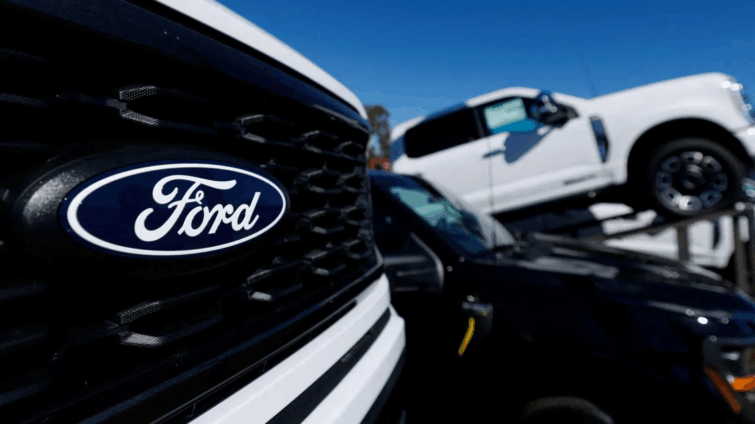
Ford is backing away from plans to manufacture large electric vehicles, the US carmaker said on Monday, citing lacklustre demand and recent regulatory changes under US President Donald Trump.
The company will instead invest in producing profitable hybrid and gas-powered vehicles and smaller, more affordable EV models.
Ford said it expects its profits to take a $19.5bn (£14.6bn) hit as a result of the strategic shift, which comes as the Trump administration eases fuel economy rules.
The business case for leaning heavily into EV production, specifically large-sized EV models, has "eroded", Ford said in a statement, "due to lower-than-expected demand, high costs and regulatory changes".
"This is a customer-driven shift to create a stronger, more resilient and more profitable Ford," Jim Farley, Ford's chief executive, said in a statement.
"The operating reality has changed, and we are redeploying capital into higher-return growth opportunities," Mr Farley added, pointing to trucks, vans, hybrid vehicles and the company's energy storage business.
As part of Ford's changes to its EV plans, the company said it will no longer produce a purely electric version of its popular F-150 pickup truck. The F-150 Lightening will instead be redesigned as a hybrid vehicle, with a gas-powered generator.
Ford also said it will cancel its new electric van to focus on manufacturing gas and hybrid models.
The carmaker's decision to alter its EV plans follows a similar announcement from General Motors in October. General Motors said it would take a $1.6bn hit as it rolls back its EV ambitions amid weakening demand.
EV adoption in the US has lagged behind the industry in places such as China, the UK and Europe. Analysts point to comparatively weak government support for the sector.
The Trump administration has taken steps in recent months to roll back incentives and regulations that had been expected to lead to increased take-up of electric cars.
A government subsidy previously helped knock as much as $7,500 (£5,608) off the price of certain battery electric, plug-in hybrid or fuel cell vehicles. But that tax credit ended in September.
Carmakers had expected EV momentum to slow with the end of the tax credit. At the time, Mr Farley said the EV industry would be "smaller, way smaller than we thought".
And earlier this month, Trump announced plans to loosen fuel economy rules, reversing another Biden-era policy that had raised hopes of an EV boom. The Biden administration's standards were expected to prevent more than 700 million metric tons of carbon dioxide emissions by 2050.
Farley celebrated the loosened rules alongside other car industry leaders. He called the change a "victory of common sense", through environmental groups criticised it as a step backwards for the industry and public health.
The new fuel economy standards, he added, were "aligned with customer demand".
The US changes come as the European Union is expected to water down its plan to ban new combustion-engine cars by 2035 effectively.
Germany has lobbied on behalf of its car manufacturers for changes to the plan, arguing they were facing stiff competition from rivals in China.
The European Commission it set to make an announcement on the scheme on Tuesday.
Latest Stories
-
MamaCare CEO warns unresolved conflicts among health workers could undermine maternal and neonatal care
2 minutes -
Health professionals urged to translate medical knowledge into practice to save mothers
9 minutes -
Conflicts among care providers linked to maternal, neonatal deaths – Expert
2 hours -
GIS marks 10th TIME conference, champions improved teaching practices
2 hours -
BRICS Or Balance? What Ghana’s bid really means
2 hours -
GPRTU wants full TRAFFITECH-GH implementation to start in 2027
3 hours -
Mahama announces plans to import electric wheelchairs for PWDs
3 hours -
KGL U17 Colts 2026: Western beat Prempeh Elite Academy to set up final final with Greater Accra Region
3 hours -
Late Solanke strike salvages 10-man Spurs draw at Man United
3 hours -
Gender Ministry to monitor welfare of Nana Akua Addo’s children amid domestic violence case
3 hours -
Benedict Okyere Yeboah: Ghana’s football problem goes beyond sacking a coach
3 hours -
GPL 2026/27: Darkwah Wiafe’s winner sees All Blacks beat Kotoko
3 hours -
ITF World Tour : Patel Wins Boys’ Singles Final at J100 Accra
4 hours -
Ghana must pursue BRICS partnership if it brings economic benefits – Kpebu
4 hours -
Success and Wright Claims J100 Accra Girls’ Doubles Championship
4 hours