

Audio By Carbonatix
In Ghana, our beloved country, religion has never been a private affair. It sings in trotro sermons, debates on morning radio, and dominates billboards that promise miracles before month’s end.
Faith occupies public space with confidence and often with beauty. Once again, during the just ended internal elections of the New Patriotic Party (NPP), another beautiful crafted spectacle unfolded-as usual a parade of prophetic proclamations that bore uncanny resemblance to theatrical rehearsals complete with scripts, suspense, climactic declarations, and, ultimately, an anticlimax.
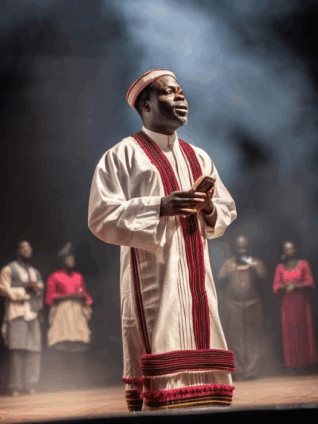
As a Theatre Artist, I watched these predictions with professional curiosity. There were opening monologues delivered in grave tones, symbolic gestures meant to signify divine transmission, and carefully timed media releases. The prophets named victors, they announced celestial verdicts. some even offered figures, as though heaven itself had issued a production schedule.
Then election day arrived, 31st January, 2026.
And the curtain fell.
When the votes started trickling in, several prophecies collapsed beneath empirical reality. Among the most widely discussed is the case involving my good friend Bernadino Azumah Eshunto…the Gobɛ Prophet whose confident pronouncements which circulated vigorously online were woefully contradicted by the outcomes themselves.
What followed was not apology but dramaturgy of a different kind: reinterpretations, spiritual footnotes, and post-performance discussion explaining that the prophecy was “conditional,” or that unseen forces had intervened backstage. In theatre, we call this improvisation after a missed cue.
The Bible itself warns against confusing certainty with authority: “When a prophet speaks in the name of the Lord and the thing does not come to pass… that is the thing which the Lord has not spoken.” Another text cautions, “By their fruits you shall know them.” These passages were not written to suppress spiritual speech but to tether it to accountability.
African wisdom concurs. The Akan proverb reminds us: “The drummer who beats loudly must keep to time.” Among the Yoruba one hears, “The masquerade that dances in daylight invites inspection.” In other words, public performance whether sacred or secular comes with public scrutiny and critical evaluation.
This is where the theatrical metaphor grows uncomfortably precise.
What many of these prophetic interventions displayed was not contemplative spirituality but dramaturgy where suspense built through social-media teasers, authority established through costume and ritual, credibility amplified by viral circulation.
The pulpit became a stage; the prophecy, a plot device; the electorate, an unwilling audience drafted into a drama not of their choosing-invisible theatre.
To be clear, this is not an indictment of religion itself. Ghana is sustained by countless clergy whose work in education, welfare, and moral formation is both quiet and indispensable.
Nor is it an argument that spiritual leaders should remain silent on national affairs. Historically, prophets both biblical and African tales alike spoke truth to power, challenged injustice, and unsettled corrupt systems.
What is under scrutiny here is something else entirely, thus, the transformation of prophecy into political punditry, delivered with the aesthetic force of revelation but lacking the epistemic humility of scholarship, common sense or the ethical courage of self-correction.
In academic terms, we might call this the performativization of prophecy where spiritual speech is crafted less for discernment than for circulation; less for moral interrogation than for audience capture. In theatrical language, it is the triumph of spectacle over substance.
The danger is not merely comedic. When prophets assign divine endorsement to political outcomes, they risk sacralizing partisanship. Followers may interpret electoral victory as heaven’s applause and defeat as spiritual illegitimacy. Ghanian democracy already fragile and polarized becomes entangled in supernatural dramaturgy. The ballot box is overshadowed by the pulpit.
Meanwhile, when these prophecies fail without acknowledgment, the damage is slow but corrosive. Faithful followers experience cognitive dissonance. Skeptics grow more cynical. Young people, watching the repeated cycle of certainty and retreat, begin to conflate religion with performance art except without the honesty that theatre at least admits- it is pretending,,a slice of life on stage.
Theatre, after all, is truthful about its fiction.
We rehearse.
We revise.
We accept reviews.
The prophet who refuses review after a failed prediction behaves less like a messenger and more like an impresario protecting a brand. African elders would shake their heads. One proverb puts it simply: “Wisdom does not shout in the marketplace unless it is ready for questions.”
If prophetic ministries insist on occupying national political discourse, then the ethical demand is straightforward; transparency when right, humility when wrong, and restraint when the temptation for spectacle outweighs the call to conscience. For politicians, too, a warning is necessary.
Courting prophetic endorsement in moments of ambition and abandoning it in moments of embarrassment reduces religion to campaign paraphernalia and empty slogans. Democracy is sustained by institutions and civic trust not by livestreamed heavenly revelations.
The New Patriotic Party elections are now concluded. A clear winner has emerged. Life in opposition continues. Yet what lingers in the cultural archive is not about who triumphed, but how easily prophecy slipped into pageantry and danced nakedly on the National Theatre stage.
In theatre, we know that a performance can thrill without enlightening, impress without transforming, dazzle without depth. When prophecy adopts those same priorities, it ceases to be revelation and becomes entertainment-komos ode-a drunken revelry.
The Cassock becomes costume…the Pulpit, the Proscenium and faith, something meant to illuminate conscience risks becoming collateral damage in a poorly reviewed production.
In an era where microphones are cheap and audiences are massive; the cassock alone cannot confer credibility. Truth, accountability, and consistency still matter.
Without them, Prophecy becomes Performance.
And faith becomes collateral damage.
Latest Stories
-
Legacy Leadership Africa Institute to host boardroom women’s leadership programme
12 minutes -
Ghana needs a law to sustain constitutional reforms – CDD-Ghana
3 hours -
COVID fumigation audit: Auditor-General has a lot of questions to answer – Akwatia MP
3 hours -
Stranded Ghanaian medical graduates in Cuba appeal to Mahama for immediate return
4 hours -
GNFS contains fire outbreak at Teshie Lekma Road near Lekma Hospital
10 hours -
Samia Nkrumah rejects the narrative that Ghanaians were happy after Nkrumah’s overthrow
11 hours -
A Mother’s pain: Tribute by Ivan Baidoo’s mother
11 hours -
‘Forgive us for staying away’ — Samia Nkrumah leads family back to Nkroful, pledges to preserve Nkrumah’s legacy
11 hours -
Ernest Nuamah scores twice as Lyon beat Rennes
11 hours -
‘My dear Ivan’ – A father’s tribute to a son tragically killed
11 hours -
GNPC Explorco advances Voltaian Basin drilling preparations with 13.5km access road
12 hours -
Cabinet approves facility manager for Borteyman Sports Complex – Kofi Adams
12 hours -
Sanitation is improving; critics may be ‘living in another world’ – Salaga South MP replies Bekwai MP
13 hours -
Government must do more to tackle sanitation crisis – Bekwai MP
13 hours -
World Cleanup Day: GFF begins sanitation education in local communities
13 hours