


Audio By Carbonatix
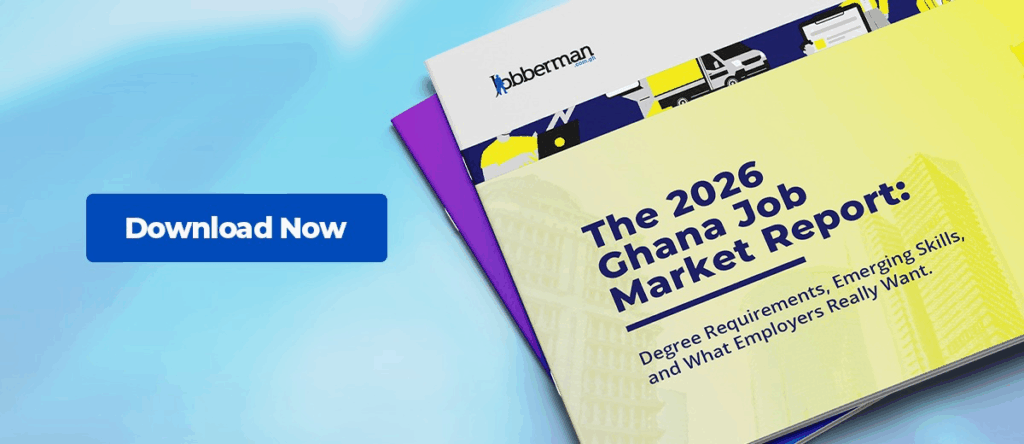
Ghana’s labour market is changing, quietly but decisively. For employers, this shift is no longer something to observe from a distance; it is something to respond to with intention, data, and strategy. The Jobberman 2026 Jobs Market Report offers one of the clearest lenses yet into how talent supply, employer expectations, and workforce realities are evolving and what this means for business sustainability.
At its core, the report positions recruitment not merely as a hiring function but as a strategic investment in productivity, competitiveness, and long-term growth.
Degrees as the New Entry Ticket
One of the most striking insights from the report is the growing centrality of formal education in hiring decisions. 55% of all jobs advertised in Ghana now require a Bachelor’s degree, signalling that degrees are no longer “nice to have” but baseline expectations. Even at the entry level, 37% of candidates already hold degrees, creating a structural disadvantage for non-degree holders from the outset.
For employers, this means the talent pool is becoming more credentialed and recruitment strategies must adapt accordingly. Screening processes, onboarding frameworks, and early-career development plans need to reflect this reality.
Early Career Acceleration Is Front-Loaded
The data also shows that career acceleration in Ghana happens earlier than many employers realise. 69% of candidates with 1–5 years’ experience already hold a Bachelor’s degree, indicating that employers use education as a proxy for potential long before seniority becomes a factor.
This has implications for succession planning. Employers who fail to identify and nurture high-potential talent early risk losing them to competitors who offer clearer growth pathways.
Business Skills Dominate Demand
Contrary to the belief that business degrees are “too generic,” the report reveals that over 65% of advertised roles fall within Sales, Marketing, Finance, and Operations, the very disciplines central to business education. These roles form the backbone of most organisations and remain consistently in demand across industries.
For employers, the takeaway is clear: business acumen is not optional. Workforce planning must prioritise versatile talent that can adapt across functions as business needs shift.
Salary Gaps Are Structural, Not Personal
Perhaps most telling are the earnings differentials. Degree holders earn 129% more than high school graduates, 88% more than diploma holders, and 39% more than HND holders. These gaps are not the result of individual effort alone; they are embedded in how roles are structured and valued.
Employers must therefore reflect on how compensation frameworks reinforce or challenge inequality in the labour market. Transparent pay structures and skills-based progression pathways will increasingly define employer brand credibility.
Talent Resilience in an Uncertain Market
While job listings fluctuate month to month, the report shows that business-related roles remain stable, averaging 758 listings per month. This stability underscores the importance of building a flexible, resilient workforce capable of moving across roles as market conditions change.
Degrees, particularly business-focused ones, offer that flexibility. For employers, investing in upskilling and continuous learning is no longer a retention perk; it is a risk management strategy.
From Hiring to Workforce Strategy
The 2026 Jobs Market Report makes one thing clear: Ghana’s talent market is not broken; it is evolving. Employers who succeed in this new landscape will be those who move beyond transactional hiring and embrace data-driven workforce planning.
The report is not just a reflection of where the market is today; it is a strategic guide for talent investment, skills development, and sustainable growth. In a competitive economy, the organisations that win will be those that understand the shift and act decisively on it.
For employers, the question is no longer whether the talent landscape is changing. The question is whether your hiring strategy is changing as a result.
Visit www.jobberman.com.gh/nexford-university.
This article was first published on the Jobberman Ghana website.
Latest Stories
-
They came to UENR for a degree, they are leaving with skills for the real world
2 minutes -
AFCON 2027Q: ‘Semenyo’s leg is swollen’ – Kurt Okraku
6 minutes -
E.P. Church honours former GOIL CEO, Togbe Adza Nye IV for his philanthropy
6 minutes -
EducationUSA College Fair 2026 to offer Ghanaian students first-hand guide to U.S university admissions
18 minutes -
PBL welcomes new UCC Vice Chancellor, strengthening lasting partnership
26 minutes -
Global pressures weigh on cedi as US dollar strengthens – BoG
27 minutes -
BoG flags external-sector pressures ahead of MPC decision
35 minutes -
EducationUSA urges students to look beyond academic scholarships
41 minutes -
White House to roll out the red carpet for historic Xi Jinping visit
47 minutes -
Reports of violence against women in Gaza surge, UN agency finds
48 minutes -
Banks should mobilise $10bn for medium and large-scale farming – Kojo Akoto Boateng
49 minutes -
Trump administration accuses banned media outlets of ‘falsehoods’ ahead of court hearing
1 hour -
US and Iran hold first talks since June after Trump’s ‘annihilation’ threat at UN
1 hour -
More than 170,000 respiratory cases recorded in haze-choked Indonesia
1 hour -
UK to review Chagos Islands deal over lack of US support, Streeting tells BBC
1 hour