

Audio By Carbonatix
A sharp ideological divide erupted on the floor of Parliament on Friday, March 27, as the Minority and majority leadership clashed over the growing global movement for reparatory justice for the Transatlantic Slave Trade.
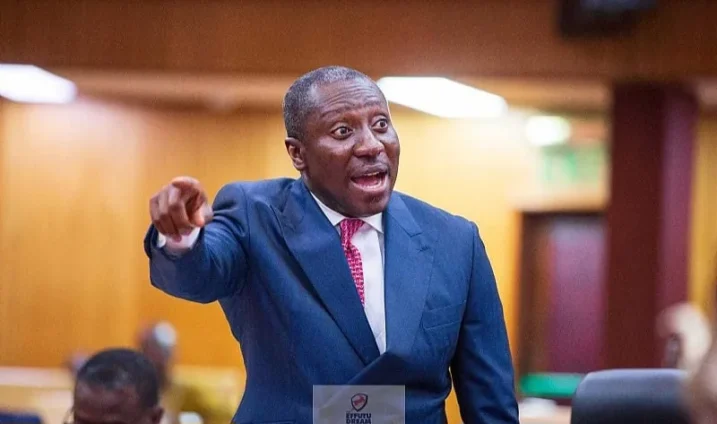
The debate, which touched on historical trauma and economic justice, saw the Minority Leader, Alexander Afenyo-Markin, challenge the current narrative of reparations. He argued that any conversation regarding compensation must confront the uncomfortable reality of domestic participation in the trade.
The Member of Parliament for Effutu cautioned against a one-sided historical account, suggesting that the role of some indigenous people in hunting and selling their own kin cannot be overlooked when discussing who bears the responsibility for compensation.
“When somebody berths a vessel at Cape Coast, and you decide to go to the North, Bono area, get to the Ashanti area, and to the Assin area, and you are chasing your strongest among your own people, then after 100 years, you say, ‘I should be compensated’," Mr Afenyo-Markin stated.
While acknowledging the brutality of the era, he questioned the logic of modern-day demands for financial redress without acknowledging internal culpability: “Who should compensate whom? We maltreated our own and told the whiteman that he should also maltreat our own. The story must be told and must be put in its proper context.”
Despite his stance on reparations, the Minority Leader was firm in his condemnation of the human rights violations of the period: “It is also a fact that the inhumane treatment, the unfortunate humiliation, the marginalisation, injustice and abuse of our ancestors who became victims of this slave trade must be condemned.”
In a swift rebuttal, the Majority Leader and MP for Bawku Central, Mahama Ayariga, defended the necessity of reparations. He argued that the current economic disparity between the Global North and South is a direct result of the capital accumulated through centuries of free, forced labour.
Mr. Ayariga maintained that modern capitalist nations owe their prosperity to the foundations laid by enslaved Africans on Western plantations.
“Many of those countries that have wealth can trace their wealth to slavery. Many of the capitalist countries that have become rich started from plantations that were worked on by slaves. It is the labour of these slaves that helped them to build capital,” Mr Ayariga argued.
He concluded that the demand for compensation is a demand for the fair distribution of that accumulated wealth: “As a result, there is the need to share that wealth in recognition of those who have been the foundation of the creation of that wealth.”
The Parliamentary clash mirrors a broader debate within the African Union and the Caribbean Community (CARICOM), where leaders are increasingly calling for formal apologies and financial settlements from former colonial powers.
This domestic friction comes just as President Mahama and Foreign Minister Samuel Okudzeto Ablakwa have been advocating for "reparatory justice" on the international stage at the United Nations.
Latest Stories
-
This is an attempt to break the Minority caucus – Patricia Appiagyei on alleged GH¢70k payment
45 minutes -
‘OSP hasn’t contacted me’ – Patricia Appiagyei assures cooporation if invited
59 minutes -
I find it strange that this memo was purportedly written by me – Patricia Appiagyei
1 hour -
Ayariga calls for stronger church partnership to tackle sanitation, environmental challenges
1 hour -
I don’t think we have an industry – Patchbay Band manager
2 hours -
Patchbay Band questions recognition of live bands in Ghana’s music industry
2 hours -
Newsfile to discuss SOEs’ GH¢19.8bn profit, dissolution of 9 boards, CJ’s visits to SOEs, GH¢70k gift rejection
2 hours -
BoG warns against spraying, defacing and using cedi notes for decorations
2 hours -
Adwumawura: Selected applicants to receive notifications from today – NEIP CEO
2 hours -
‘Fake memo’ fabricated to smear me – Patricia Appiagyei
2 hours -
ATLF2026: Culture, investment and tourism take centre stage as Africa’s tourism leaders gather in Polokwane
3 hours -
TI-Ghana and GACC demand full disclosure over alleged GH¢70,000 Appointments Committee payment
3 hours -
UN approves resolution in support of map that shows Africa’s true size
3 hours -
Spring Agro Industries urges Ghanaians to choose local rice as imports dominate market
3 hours -
Youths in Oti push for stronger policies on SRHR and gender-based violence
4 hours