

Audio By Carbonatix
Students of the University of Environment and Sustainable Development (UESD) have been urged to take a frontline role in driving Ghana’s climate adaptation agenda, with youth advocates stressing that the country’s National Adaptation Plan (NAP) cannot succeed without active student involvement.
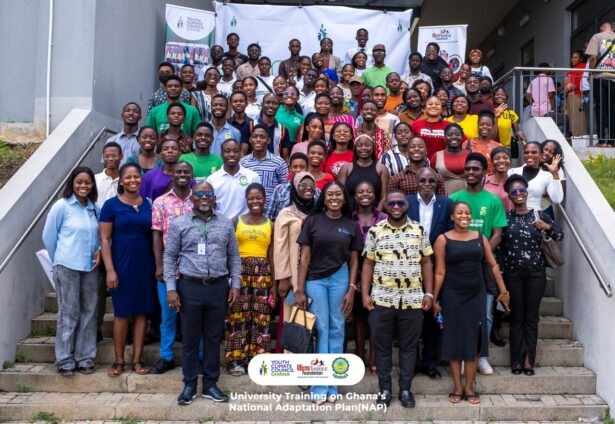
The call was made by the Research and Policy Officer of the Youth Climate Council Ghana (YCCG), Emmanuella Manchaya Kalari, during a training session on Ghana’s NAP held on April 1, 2026, at the UESD campus. The programme, organised by YCCG in partnership with the Youth Bridge Foundation (YBF), aimed to empower university students to translate national climate policies into tangible community action.
Ms Kalari said the NAP is not a technical document reserved for policymakers, but a framework that depends on youth leadership to take shape at the local level.
“Young people are key drivers of climate policies, and the NAP creates real opportunities for us to engage, influence decisions, and lead action in our communities,” she said. “The responsibility now is for us to step forward and take up that space.”
She noted that universities are among the most strategic platforms for nurturing climate action, adding that students must move beyond general awareness and engage directly with adaptation priorities such as water resources, health, food systems and biodiversity.
Dean of Students at UESD, Prof. Daniella Delali Sedega, described the training as timely, given the rising climate risks facing the country. She encouraged students to position themselves as essential partners in implementing the NAP across communities and sectors.
According to her, the plan presents several avenues for youth participation, especially in agriculture, ecosystem protection, health resilience and climate-smart infrastructure. She emphasised that the country’s ability to build long-term resilience will depend partly on the commitment and innovation of young people.
The session offered students an in-depth understanding of Ghana’s NAP — a national framework designed to strengthen resilience across districts and guide long-term planning for climate impacts. Discussions explored practical solutions for key priority areas, including food security, water management and ecosystem conservation.
Organisers said bridging the gap between policy and impact requires an informed and empowered youth base, adding that sustained engagement on university campuses will be essential as Ghana works toward a climate-resilient future.
Latest Stories
-
Spain battles to contain one of its deadliest wildfires as at least 12 killed
36 minutes -
Commuters pay over three times transport fare amid vehicle shortage on Nungua-Accra route
39 minutes -
Investigation into fatal Sayerano police shooting postponed over security concerns
40 minutes -
US wants Iran to pledge to stop shooting at ships in Strait of Hormuz
43 minutes -
Spike in homosexual HIV infections sparks grave concern from Ghana AIDS Commission
43 minutes -
GES announces July 20 to August 7 for 2026 BECE school selection
1 hour -
How a fake presidential council ended up with a budget of almost $1m in Nigeria
1 hour -
Parliament must complete the Equal Citizenship journey begun in 1996
2 hours -
‘I just want one person as a scapegoat’ — Linda Ocloo warns MMDCEs over illegal building permits
2 hours -
Nkoko Nkitinkiti and the shortest agricultural value chain…
2 hours -
High court stops NPP constituency executive elections in Bibiani
2 hours -
Xenophobic attacks in South Africa: Much Ado About the Wrong Threat?
2 hours -
Chaos and confusion reign as Harry loses media battle
2 hours -
Rex Omar advocates permanent sanitation culture, calls floods a national wake-up call
2 hours -
New era for Ghana’s 5G as MTN, Telecel prepare to compete for licences
3 hours