

Audio By Carbonatix
President Donald Trump has set deadlines, made demands and issued threats over the course of the five-week joint US-Israeli war against Iran. But seldom have they been this explicit.
The new round of strikes against Iran will be devastating. They will begin at 20:00, Washington DC time on Tuesday (00:00 GMT on Wednesday) . Within four hours, every bridge and power plant in the nation will be "decimated".
"Very little is off-limits," Trump said on Monday.
To avoid this fate, according to the president, Iran has to make a deal "that's acceptable to me". A component of the agreement should include "free traffic of oil" through the Strait of Hormuz.
As the final hours tick down, there has been little indication that Iran is ready to agree to Trump's ultimatum. They've rejected a temporary ceasefire and issued their own list of demands, which a US official described as "maximalist".
This places the American president in a delicate position. If there is no agreement, Trump could extend his deadline – for the fourth time in the past three weeks.
But backing away after such detailed threats, punctuated with expletives and dire warnings, could undercut his credibility as the war grinds on.
It's possible Iran, and the rest of the world, could conclude that despite America's military might and tactical skill – readily displayed in this weekend's intricate operation to rescue two downed airmen deep in Iran – it is not negotiating from a clear position of strength.
"We won," Trump insisted during his press conference on Monday afternoon. "They are militarily defeated. The only thing they have is the psychology of: 'Oh, we're going to drop a couple of mines in the water'."
That "psychology" – the ability to deter oil tankers from transiting the Strait of Hormuz with drones, missiles and mines – may be a more potent Iranian asset than the US has been willing to acknowledge.
During Monday's press conference, Trump marvelled at American military precision on display in last year's "Midnight Hammer" bombing raid on Iran's nuclear sites, the capture of Venezuelan President Nicolas Maduro in January and this weekend's rescue mission.
He and his national security team celebrated that most recent effort, which included coordinating hundreds of aircraft and elite military personnel and employing misdirection and technological wizardry. But the effort, while remarkable, was to avoid what Defence Secretary Pete Hegseth acknowledged was a "potential tragedy".
Even if that tragedy was averted, the triumphant rescue underlined the risk American forces still face in Iran. And the president may be learning that American military power has its limits.
"We can bomb the hell out of them," he said. "We can knock them for a loop. But to close the Strait, all you need is one terrorist."
The other option is for Trump to follow through with his threats. On multiple occasions on Monday, he said that was a course he did not want to pursue.
While Trump said that the Iranian people were willing to endure the ongoing US military campaign – and, in fact, welcomed the bombs falling on their cities – he also acknowledged that anything the US destroys now would eventually have to be rebuilt and that the US might ultimately contribute to that rebuilding effort.
"Do I want to destroy their infrastructure? No," he said. "Right now, if we leave today, it will take them 20 years to rebuild their country."
He added that if he followed through with his bombing threats, the rebuilding effort would take a century.
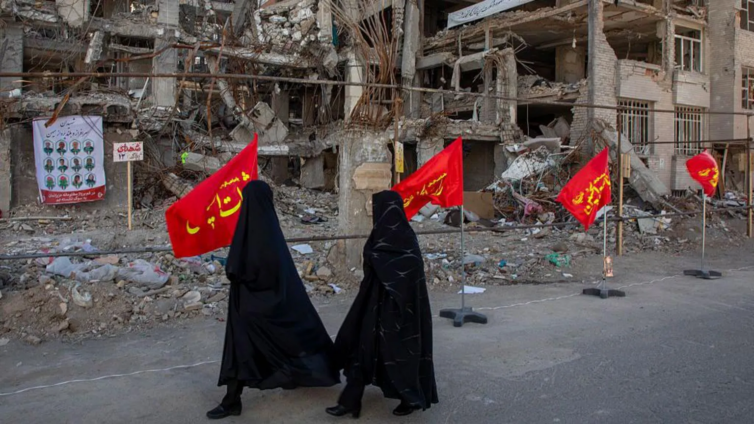
It's not exactly the "stone age" that he has warned Iran would be reduced to, but an ensuing humanitarian crisis – including the regional impact of the "crushing" retaliation that Iran has promised – could be devastating.
Even in this late hour, however, Trump continues to hold out hope of a breakthrough.
"We have an active, willing participant on the other side," he said. "They would like to be able to make a deal. I can't say any more than that."
Given the stakes, the president's opacity is notable. He has a plan – "every single thing has been thought out by all of us", he said on Monday - but he won't divulge it.
It could be an indication that, behind the scenes, negotiations are farther along than have been publicly acknowledged. Or it could be some combination of bluff and wishful thinking.
"They have till tomorrow," Trump said. "We'll see what happens. I believe they're negotiating in good faith. I guess we'll find out."
Latest Stories
-
Kojo Bamba, Henry Nana Boakye and Nana Akomea elected NPP Vice Chairmen
5 minutes -
From Delta Force to NPP First Vice Chairman – Kojo Bamba’s political journey
10 minutes -
Police restore calm at Larteh following Odwira festival disturbance
1 hour -
‘All the camps will dissolve’ – Bawumia demands one NPP for 2028
1 hour -
There is no time to waste – Bawumia orders NPP to begin 2028 work
1 hour -
Sarkodie visits MobileMoney Fintech LTD
1 hour -
John Boadu unveils new NPP strategy to win back youth and modernise party
1 hour -
Hawa Koomson elected NPP National Women’s Organiser
1 hour -
John Boadu begins NPP rebuild from grassroots ahead of 2028 election
1 hour -
Titus Glover wins NPP National Organiser race on second attempt
1 hour -
Winning 2028 election won’t be easy; we must work harder – Bawumia
1 hour -
You’ll be part of 2028 campaign; there’s enough work for all of us – Bawumia to NPP aspirants
2 hours -
John Boadu moves to unite NPP after heated leadership contest
2 hours -
Today is not a day of victory but a day of responsibility and great unity – John Boadu
2 hours -
Let us choose unity over division – John Boadu to NPP
2 hours