

Audio By Carbonatix
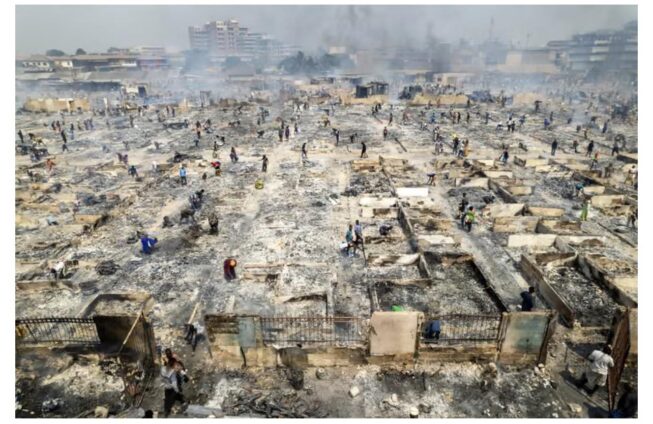
Ghana does not have a fire problem. It has a prevention problem. Each time a major market goes up in flames or a residential block is reduced to rubble, the public conversation follows a familiar script. Sympathy is extended. Committees are set up. Relief items are distributed. Investigations are promised. Then, quietly, we return to business as usual until the next fire reminds us that nothing fundamental has changed.
This cycle is not inevitable. It is the product of choices. Legal choices. Policy choices. Enforcement choices. And, perhaps most critically, the absence of consequences for ignoring what we already know.
The truth is uncomfortable but necessary. Most fires in Ghana are not acts of fate. They are acts of omission.
We know that electrical faults, unsafe wiring, and illegal connections are a leading cause. We know that congested urban design, especially in major markets, creates conditions where a small spark becomes a national disaster. We know that the use of gas cylinders in enclosed commercial spaces increases risk. We know that access routes for fire tenders are often blocked or non-existent.
We know that basic fire safety infrastructure, such as extinguishers, alarms, and sprinklers, is either absent or non-functional in many public buildings.
What we lack is not knowledge. It is enforcement.
Ghana’s legal framework is not silent on fire safety. The regime built around the Ghana National Fire Service gives the state the authority to inspect premises, enforce fire precautions, and advise on compliance. The building control framework, administered through local assemblies, is supposed to ensure that structures meet safety standards before occupation. The problem is not that the law is missing. The problem is that the law is not taken seriously.
In practice, fire certification is too often treated as a formality rather than a condition precedent to occupation. Buildings are occupied before inspection. Markets expand beyond approved layouts. Electrical systems are improvised. And when violations occur, enforcement is inconsistent at best and absent at worst.
No serious system operates like this. In functional jurisdictions, fire safety is not an advisory matter. It is a strict legal requirement backed by real consequences. A building that does not meet fire safety standards is not occupied. A business that fails inspection is shut down. A developer who ignores compliance faces sanctions that are financial, regulatory, and in some cases criminal.
Ghana must move in that direction.
The starting point is to recognise that fire safety is not merely a technical issue. It is a regulatory discipline. And like all regulatory disciplines, it works only when compliance is more costly to ignore than to observe.
This is where policy reform must be decisive.
First, Ghana should make automatic fire sprinkler systems mandatory for all high risk and high density structures. This includes markets, shopping centres, fuel stations, warehouses, hotels, and multi storey residential buildings. Sprinklers are not a luxury feature. They are the single most effective mechanism for controlling fires at their earliest stage. In many countries, the presence of a functioning sprinkler system means the difference between a contained incident and a catastrophic loss.
The objection is often cost. But this argument collapses under scrutiny. The cost of installing sprinklers is a fraction of the economic damage caused by a single major fire. When thousands of traders lose their capital overnight, the state ultimately bears part of the burden through relief, lost tax revenue, and economic disruption. The real question is not whether we can afford sprinklers. It is whether we can afford not to have them.
Second, compliance must be tied to occupancy and operation. No building should be occupied without a valid fire safety certification. No market should operate without periodic inspection and renewal of compliance status. This requires coordination between local assemblies, building inspectors, and the Ghana National Fire Service. It also requires political will to enforce closures where necessary.
Third, insurance must be used as a regulatory lever. Insurers should be required, as a matter of policy, to deny coverage to buildings and businesses that do not meet minimum fire safety standards. This immediately changes incentives. If a trader or developer knows that a fire will not be insured unless compliance is verified, behaviour will change faster than any public education campaign can achieve.
Fourth, Ghana must confront the design failure of its major markets. Many of our markets are economic engines operating in physical environments that are structurally unsafe. Narrow pathways, uncontrolled extensions, and unregulated electrical connections create conditions where firefighting becomes nearly impossible. Market redevelopment must therefore be approached not just as an infrastructure project but as a safety reform. Fire lanes must be preserved.
Electrical systems must be centralised and regulated. Water access points must be integrated into the design.
And critically, enforcement must ensure that the original layout is not gradually eroded over time.
Fifth, there must be personal accountability. When buildings collapse due to structural defects, we increasingly ask questions about the engineers, contractors, and regulators involved. Fire disasters should attract the same scrutiny. Where negligence can be established, whether by a landlord, developer, market association, or public official, there must be consequences. Without accountability, regulation becomes theatre.
Underlying all of this is a deeper issue of governance. Fires expose a pattern that extends beyond safety. They reveal how rules are negotiated rather than enforced. They show how compliance is often optional until disaster strikes. And they highlight the gap between policy intention and operational reality.
This is why the solution cannot be purely technical. It must be institutional.
Ghana needs a clear national fire prevention strategy that integrates law, policy, and enforcement. It must define mandatory standards, assign responsibility across agencies, and establish measurable compliance targets. It must be backed by data, transparency, and regular public reporting. And most importantly, it must be enforced consistently, not selectively.
There is also a cultural dimension. Fire safety must become part of everyday thinking. Households must treat electrical safety and gas handling with seriousness. Businesses must invest in basic protection measures. Market associations must take ownership of safety within their spaces. But culture follows structure. When the law is enforced, behaviour adapts.
At present, the signal is the opposite. The system communicates that non compliance carries little risk until a fire occurs. By then, it is too late.
The most striking thing about Ghana’s fire problem is how solvable it is. We are not dealing with unknown causes or untested solutions. The tools exist. The legal authority exists. The policy options are clear.
What is missing is the decision to act decisively.
Every major fire should force a national question. Not what happened. We already know that. The real question is why, knowing what we know, we continue to allow the same conditions to persist.
Until we answer that question honestly, we will keep rebuilding what we keep allowing to burn.
Latest Stories
-
GNFS contains fire outbreak at Teshie Lekma Road near Lekma Hospital
2 hours -
Samia Nkrumah rejects the narrative that Ghanaians were happy after Nkrumah’s overthrow
3 hours -
A Mother’s pain: Tribute by Ivan Baidoo’s mother
3 hours -
‘Forgive us for staying away’ — Samia Nkrumah leads family back to Nkroful, pledges to preserve Nkrumah’s legacy
3 hours -
Ernest Nuamah scores twice as Lyon beat Rennes
3 hours -
‘My dear Ivan’ – A father’s tribute to a son tragically killed
3 hours -
GNPC Explorco advances Voltaian Basin drilling preparations with 13.5km access road
3 hours -
Cabinet approves facility manager for Borteyman Sports Complex – Kofi Adams
4 hours -
Sanitation is improving; critics may be ‘living in another world’ – Salaga South MP replies Bekwai MP
4 hours -
Government must do more to tackle sanitation crisis – Bekwai MP
4 hours -
World Cleanup Day: GFF begins sanitation education in local communities
5 hours -
EU Ambassador, IGP discuss stronger cooperation on policing and security
5 hours -
Africa Nations Volleyball Championship: Ghana set up quarterfinal clash with Cameroon after beating Chad
5 hours -
Meet Dr Benjamin Appiah Osei — Ghana’s three-time tourism awards winner
6 hours -
UEFA & CONCACAF demand Fifa pays $10m to all 211 members
6 hours