

Audio By Carbonatix
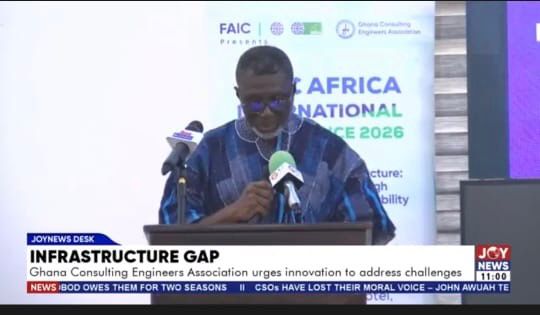
The President of the Ghana Consulting Engineers Association, Ing. Kwabena Bempong, is calling for stronger collaboration between consulting engineers and financial institutions to help address Ghana’s growing infrastructure deficit.
Speaking to Joy Business ahead of the upcoming FIDIC Africa Infrastructure Conference 2026, he emphasised that unlocking sustainable financing remains critical to closing the infrastructure gap and accelerating national development.
According to him, Africa continues to face a significant infrastructure funding challenge, with estimates from the African Development Bank putting the continent’s annual infrastructure needs between $130 billion and $170 billion, while the financing shortfall ranges between $68 billion and $108 billion.
He warned that this persistent gap is slowing economic growth, limiting job creation, and restricting access to essential services such as energy, water, and transportation.
“As consulting engineers, we are the architects of the built environment, but addressing the infrastructure deficit requires more than technical expertise. It demands innovative financing models and stronger partnerships with the financial sector,” he stated.

Ing. Bempong noted that while engineers have consistently led efforts to design and deliver infrastructure across the continent, the success of such projects depends heavily on adequate and sustainable funding structures.
The FIDIC Africa Infrastructure Conference 2026, scheduled to take place in Accra from May 10 to May 13, is expected to provide a platform for key stakeholders—including policymakers, financiers, and engineers—to explore practical solutions to Africa’s infrastructure challenges.
The conference will be held under the theme “Future Ready Infrastructure: Advancing Africa through Innovation and Sustainability,” with a focus on promoting resilient infrastructure systems, advancing sustainable engineering practices, and fostering innovation among young professionals.
Ing. Bempong stressed that one of the key objectives of the conference is to deepen engagement between the engineering community and financial institutions to develop bankable projects and scalable investment models.
“We need to move beyond traditional funding approaches and create frameworks that attract private sector investment while ensuring long-term value for infrastructure projects,” he added.
He expressed confidence that stronger collaboration between engineers and the finance sector will not only help bridge the infrastructure gap but also position Ghana and Africa to deliver modern, resilient, and future-ready infrastructure.
Latest Stories
-
Six injured, two dead in crash on Accra-Kumasi Highway
1 second -
Japan Motors Ghana appoints Amine Kabbara as new Managing Director
3 minutes -
Birth, death registration are mandatory – Deputy Registrar tells Ghanaians
17 minutes -
GoldBod defends $1.315bn forex generation, says transactions backed by GANRAP
18 minutes -
Sherif Ghali steps down as CEO of Ghana Chamber of Young Entrepreneurs after 10 years
26 minutes -
Signals Bureau case: ‘I had about 60 questions’ – Atta Akyea welcomes extra cross-examination day
27 minutes -
Africa’s colonial ecological debt could exceed hundreds of trillions of dollars – Report
44 minutes -
Ibrahim Sulemana joins Sassuolo on loan from Atalanta
49 minutes -
Former UK Prime Minister Keir Starmer to stand down as MP to focus on world affairs
55 minutes -
Built to Last, Left to Rot: Ghana’s maintenance crisis
1 hour -
Number of debit cards issued by banks decreased by 11.8% to 5.7m in 2025
1 hour -
Total mobile money transaction values grew by 50.8% to GH¢4.54trn in 2025
1 hour -
Private aggregators, not state, will bear local refining costs – GoldBod
1 hour -
Ablakwa urges African leaders to adopt new leadership paradigm to create opportunities for youth
2 hours -
Photos: Mahama holds talks with Serbian President in Belgrade
2 hours