

Audio By Carbonatix
The question is no longer whispered in private conversations.
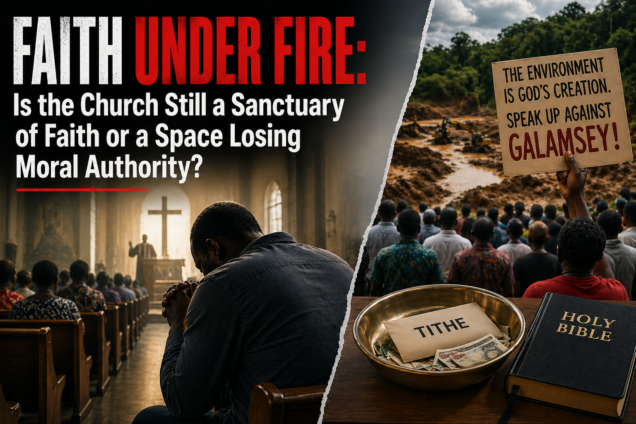
It is now being asked openly in public spaces, online platforms, and even within pews once marked by unquestioned reverence: Is the church still a sanctuary of faith, or is it gradually becoming a space losing moral authority?
Recent events in Ghana’s religious landscape have intensified this debate, not through isolated incidents alone, but through what many see as a pattern of increasing public tension between church leadership and congregants.
A viral confrontation within the Methodist Church in Ghana has become a focal point of this conversation. In the widely circulated video, a disagreement over tithing escalates after a priest reportedly describes members who do not pay tithes as “armed robbers.” The exchange has since triggered widespread reactions, with some defending doctrinal discipline and others questioning the tone and framing of financial obligations within worship spaces.
At the heart of the reaction is not only the issue of tithing itself, but the manner in which authority is exercised and received within the church. For many observers, the incident reflects a growing discomfort with what is perceived as an imbalance between spiritual guidance and institutional power.
In a parallel development, public discourse has also turned toward the Church of Pentecost and its perceived engagement with the national fight against illegal mining, known as galamsey.
The environmental consequences of galamsey are widely acknowledged—polluted rivers, degraded lands, and communities facing long-term ecological damage. In this context, religious institutions, long regarded as moral voices in society, are increasingly being evaluated on the extent and consistency of their public advocacy.
For some members of the public, the expectation is no longer limited to spiritual leadership within church walls. It now extends to visible moral engagement in national crises. The perception of silence or limited response, therefore, becomes part of a broader conversation about relevance and responsibility.
What ties these two developments together is not similarity in content, but in consequence: both have contributed to a heightened questioning of institutional credibility. The church, once largely insulated from public critique, now finds itself operating in an environment where its words, actions, and omissions are instantly amplified and debated.
This shift is not occurring in isolation. Ghana’s digital landscape has fundamentally changed how authority is perceived. Social media platforms have become spaces where religious practices are no longer internal matters, but public conversations subject to interpretation, critique, and comparison.
Yet, it would be reductive to interpret this moment solely as a crisis of faith. Religious institutions continue to play significant roles in education, healthcare delivery, community support, and moral formation across the country. Their influence remains deeply embedded in Ghana’s social fabric.
However, influence alone is no longer sufficient to shield institutions from scrutiny. The expectations of congregants are evolving. There is a growing demand for transparency in financial practices, consistency in moral advocacy, and sensitivity in communication.
The tension, therefore, is not necessarily between faith and disbelief, but between tradition and accountability—between long-established structures of authority and a generation that increasingly questions how that authority is exercised.
Whether the church is losing moral authority or simply undergoing a period of adjustment remains open to interpretation. What is clear, however, is that it is now being examined more closely than ever before.
And in that examination lies a defining question for Ghana’s religious institutions: can they preserve their role as sanctuaries of faith while adapting to a society that no longer accepts authority without explanation?
Latest Stories
-
Ghana’s Farida Iddriss elected Secretary-General of Africa Aquatics Zone II
36 seconds -
Amin Adam commissions four health facilities in Karaga
5 minutes -
Ghana’s state-owned enterprises return to profit with GH¢19.8bn gain in 2025 — SIGA
56 minutes -
Fuel prices set to rise again from Sept 1; petrol could hit GH¢16.21 – COPEC
3 hours -
REGSEC restricts Akwasidae celebrations in Denkyira amid security concerns
3 hours -
Eric Adjei distributes free fertiliser to farmers in Jaman North
3 hours -
Akufo-Addo urges NPP factions to unite behind Bawumia for 2028 victory
3 hours -
NDC mourns Western Regional Elections Director Papa Assan
3 hours -
Minerals Commission warns against fake job recruitment schemes
3 hours -
NYA CEO Osman Ayariga rallies youth against drug abuse at ‘Red Means Stop’ campaign
4 hours -
10 recruits dismissed for defying phone ban – Interior Minister
4 hours -
IEAG commends GoldBod, BoG for improving forex stability
4 hours -
Bawumia donates GH¢50,000 to St Jude Catholic Church at Weija
4 hours -
Mahama calls for faster mobilisation of AU Peace Fund resources
4 hours -
Amin Adam pays tribute to late Tolon Paramount Chief
4 hours