

Audio By Carbonatix
President John Mahama has called for a new global health order anchored on self-reliance, equity, and sovereign capacity.
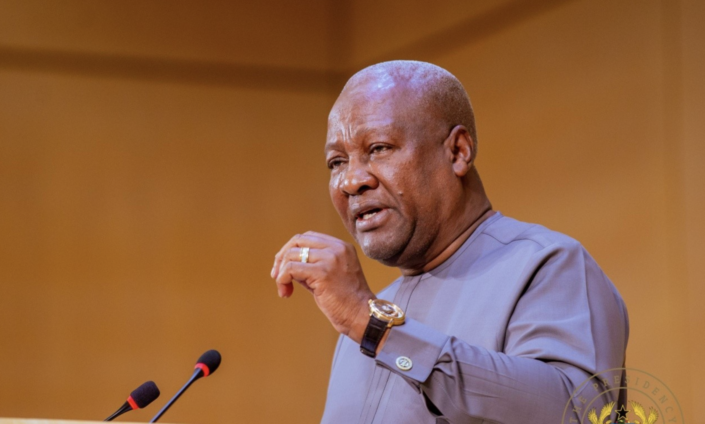
Speaking at the 79th World Health Assembly (WHA) in Geneva, Switzerland, President Mahama said they were meeting amid uncertainty.
He said shifting global geopolitics and deliberate assaults on the world’s multilateral system had created doubt about the trajectory of global health cooperation and reform.
The President said six years after the last global pandemic, COVID-19, the world health architecture was changing rapidly.
Overall, humanitarian assistance was reported to have declined by 40 per cent.
The President said some of the largest Western economies had significantly cut their overseas development assistance, adding that the World Health Organisation’s budget had been gutted by the withdrawal of United States assistance, forcing the organisation to scale down programmes and undertake steep staff retrenchments.
“In Ghana, health financing from bilateral and multilateral partners has significantly decreased since 2025. Ghana lost $78 million following the closure of USAID programmes,” the President said.
“This money went mainly into malaria programmes, maternal and child health, nutrition, HIV/AIDS programmes, including testing and delivery of antiretroviral drugs”.
President Mahama said in South Africa, the abrupt withdrawal of PEPFAR funding shuttered clinics, terminated gender-based violence programmes, and left 1.4 million people living with HIV uncertain about their treatment continuity.
“We are told that by 2030, nine million preventable deaths could occur due to these shifts”, he added.
He said it was estimated that the direct consequences of this aid suspension could push about 5.7 million Africans into poverty by the end of 2026.
He reiterated that it was this gloomy outlook for the future of global health that prompted the convening of the African Health Sovereignty Conference, famously known as the Accra Reset, in August 2025.
He said it was against this backdrop that they met at the 79th World Health Assembly.
President Mahama said these dire statistics were known, and that they were not at the Conference to lament and wring their hands over them.
“We are here, among others, to decide whether the architecture we supervise is still fit for purpose. We are here to discuss how we can continue to save lives even in the face of adversity,” he said.
“I stand before you today in the second year of my new tenure as President, mindful that the mandate given to me by my people is not merely to administer, but to transform.”
President Mahama said he came from a continent that had too often been the subject of global health policy, rather than its author.
“Today, I speak to you as one of the advocates of the Accra Reset Initiative, a movement born from the conviction that the old paradigms of dependency must give way to a new era of Health Sovereignty.”
President Mahama said with one of the more successful National Health Insurance Schemes (NHIS) in Africa, Ghana had an insurance coverage estimated at 66 per cent as of the end of 2025, leaving about 34 per cent without cover.
The President said to mop up the remaining population not covered by the NHIS, they had recently successfully begun implementing our Free Primary Health Care Programme.
President Mahama said by removing financial barriers to the most basic and essential services at the rural level and had ensured that citizens in the remotest regions of their country also enjoyed access to quality health care just as their urban counterparts.
“We are grateful that the WHO, led by Dr Tedros Ghebreyesus, was among the first to congratulate us on achieving this significant milestone,” he stated.
“We have revitalised our National Health Insurance Scheme (NHIS). By removing the cap on the health insurance fund, we have also freed up an additional GHS 3 billion, equivalent to $300 million, for healthcare investment.
“We have also streamlined NHIS operations by eliminating bottlenecks, utilising digital tools, including Al, to detect fraudulent claims, and, most importantly, prioritising prompt refunds to service providers.”
President Mahama said a health insurance scheme was as strong as the trust between the state and the hospitals that provided the care.
“We have also confronted the rising tide of non-communicable diseases by launching the Ghana Medical Trust Fund, also known as MahamaCares.”
The President said this fund was a lifeline for those suffering from NCDs—cardiovascular conditions, cancers, liver disease, and renal failures—that were previously a death sentence for the poor.
He said MahamaCares was ensuring that specialised, high-cost care was not a privilege for just a few, but a right for all.
Dr Tedros Ghebreyesus, the Director-General of the WHO, said the purpose of the meeting was not to launch a new initiative, but to bring together the many existing initiatives that have proposed reforms of the global health architecture, in part or in whole.
“That is why we have chosen as the theme for this year’s World Health Assembly, “Reshaping global health: a shared responsibility,” he said.
“And this is where the leadership of His Excellency President Mahama has been so decisive, in launching the Accra Reset last year.”
Latest Stories
-
Two lorry station masters arrested over alleged plot to kill creditor over ₵91k debt
10 minutes -
SIGA’s claim on highest audited proportion inaccurate – Bright Simons
11 minutes -
Money bouquets, spraying and dancing on cash unlawful – BoG warns
37 minutes -
Sam George pushes for nationwide 4G upgrade of rural telephony sites
37 minutes -
Local Government Ministry to support MMDAs to deliver gov’t agenda
48 minutes -
At least five killed in Sudan’s South Kordofan in attack by rebel group
59 minutes -
“Music is so stressful” – Headless YouTuber on why he won’t return
60 minutes -
Cleveland police chief proud of force but being ‘let down’ by funding
1 hour -
Black Sherif drops new 6-track EP ‘Sun Sherif’
2 hours -
GTA partners Africa’s Brain Bank for Medical City groundbreaking
2 hours -
How to check 2026 WASSCE results on mobile phone
2 hours -
President Mahama is a professional comedian – DKB
3 hours -
Final day of Joy FM Back-to-School Fair: Come shop, save and prepare for the new school year
3 hours -
GSE showed strong performance in August 2026 despite recording more stock losses
5 hours -
If CJ needs ethics law to know SOE comments were wrong, he may not be worthy of office – Arthur Kennedy
6 hours