

Audio By Carbonatix
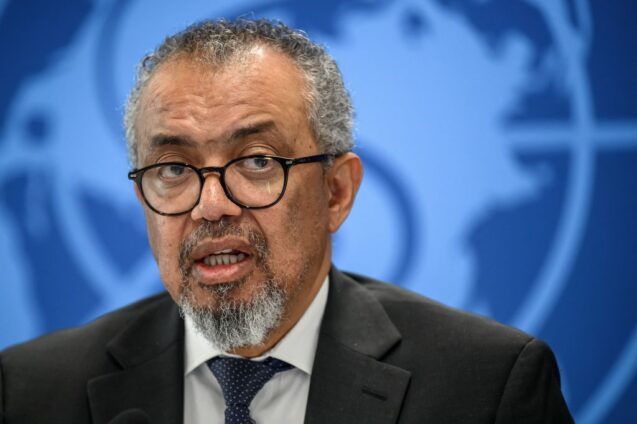
The Director-General of the World Health Organization, Tedros Adhanom Ghebreyesus, has raised alarm over the growing Ebola outbreak in the Democratic Republic of Congo and Uganda, warning that the epidemic poses a serious regional threat amid rising suspected cases and deaths.
Speaking at a media briefing on Wednesday, Dr. Tedros revealed that beyond the 51 confirmed Ebola cases in DR Congo, health authorities are also tracking nearly 600 suspected infections and 139 suspected deaths.
“We expect those numbers to keep increasing, given the amount of time the virus was circulating before the outbreak was detected,” he warned.
The WHO chief announced that he had declared the outbreak a Public Health Emergency of International Concern (PHEIC) on Sunday, citing the urgent need for international action to contain the spread of the disease.
According to him, this marks the first time a WHO Director-General has declared a PHEIC before convening an Emergency Committee under the International Health Regulations.
WHO said the outbreak is currently considered a high risk at both the national and regional levels, although the global risk remains low.
The confirmed cases in DR Congo have been recorded in the northern provinces of Ituri and North Kivu, including the cities of Bunia and Goma. Uganda has also confirmed two cases in the capital, Kampala, including one death involving individuals who travelled from DR Congo.
An American national working in DR Congo has also tested positive and has since been transferred to Germany for treatment.
Dr. Tedros outlined several factors driving concern over the outbreak, including the spread of infections in urban centres, deaths among health workers, and intensified conflict in Ituri province, which has displaced more than 100,000 people in recent months.
He warned that the situation is being made more dangerous by worsening insecurity in affected areas, stressing that, “The province of Ituri is highly insecure. Conflict has intensified since late 2025, and fighting has escalated significantly over the past two months, with over 100 000 people newly displaced.”
He further noted that the affected area is a major mining zone with significant population movement, increasing the likelihood of cross-border transmission.
The WHO Director-General also disclosed that the outbreak is caused by the Bundibugyo strain of the Ebola virus, for which there are currently no approved vaccines or treatments.
“In light of all these risks, I decided it was urgent to act immediately to prevent more deaths and mobilise an effective international response,” he said.
Dr. Tedros commended the governments of DR Congo and Uganda for their cooperation and response efforts, including Uganda’s decision to postpone the annual Martyrs’ Day celebrations, which usually attract nearly two million people.
WHO says it has already deployed emergency teams, medical supplies and funding to support response efforts, with an additional 3.4 million dollars approved from its Contingency Fund for Emergencies, bringing total emergency support to 3.9 million dollars.
Latest Stories
-
IMANI, Local Government Ministry discuss reforms on sanitation, local revenue and urban infrastructure
7 minutes -
Ghana’s international reserves drop to US$11.04 billion in August as BoG pushes for significant build-ups in coming months
7 minutes -
Four years enough for any government to deliver – IEA rejects five-year term
11 minutes -
‘The most important players are here’ – Queiroz shrugs off Ghana’s injury crisis
25 minutes -
Ayariga pledges stakeholder-led approach to Nzema, Kokomba Market redevelopment
29 minutes -
Professional collaboration is key to Ghana’s land and property development – Western Regional Minister
36 minutes -
‘When you play Ghana, it’s a derby’ – Kessié sets tone for AFCON qualifying showdown
38 minutes -
Mahama urges global institutions to invest in Africa’s cultural infrastructure
44 minutes -
Kuami Eugene joins UNICEF Ghana to promote universal birth registration
47 minutes -
Renard warns Côte d’Ivoire against complacency Ahead of Ghana clash
49 minutes -
‘Can the patient feel the difference?’ – GMTF boss challenges health leaders
50 minutes -
Office of the Registrar of Companies marks Risk Awareness Week with push for risk-smart, resilient institution
1 hour -
Full text: Mahama’s speech at high-level side event on return and restitution of cultural properties and heritage
1 hour -
ICU urges Ghanaian smock weavers to scale up production for local and export markets
1 hour -
Human remains are not collectibles, specimens – Mahama demands restitution of Africa’s heritage
1 hour