

Audio By Carbonatix
Africans continue to rely on both formal and informal justice systems to resolve legal disputes, and many question whether the courts deliver fair, affordable, and timely justice, the latest Afrobarometer Pan-Africa Profile (https://apo-opa.co/3PCQJRy) shows.
The new report, based on 50,961 interviews across 38 African countries in 2024/2025, shows that while many citizens would turn first to the police or local courts to resolve legal problems, about one-quarter prefer traditional leaders, traditional courts, or elders. Confidence in formal justice systems is not strong: Only half of Africans believe ordinary people can obtain justice through the courts. Majorities say people are frequently treated unequally under the law, and almost half think powerful individuals who break the law get off too lightly.
Financial barriers also limit access to justice: Fewer than half of citizens believe they could afford legal assistance or court costs if needed.
Key findings
• Formal and informal justice systems continue to coexist: Across 38 countries, almost half of citizens see the police (41%) or local courts (7%) as their first point of contact for resolving legal problems, but 26% would go first to traditional leaders, traditional courts, or elders (Figure 1).
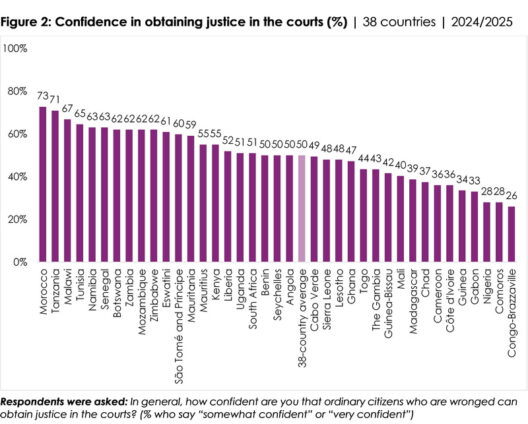
• On average, only half (50%) of Africans express confidence that ordinary citizens can obtain justice in the courts. Perceptions of fairness and timeliness in courts are similarly weak: A bare majority (51%) believe they could obtain a fair court outcome, while only 43% think cases are likely to be resolved in a reasonable time (Figure 2).
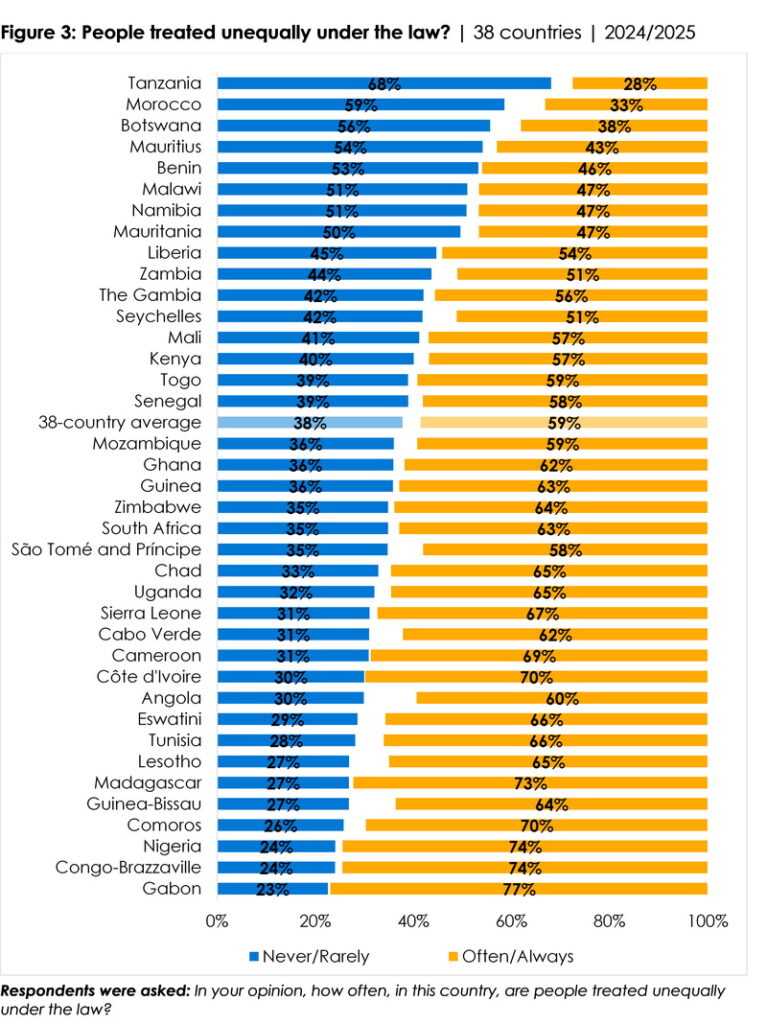
• Perceived inequality in the courts is a widespread problem: A majority (59%) of Africans believe people are “often” or “always” treated unequally under the law (Figure 3).
• Cost presents a significant barrier to using the courts to resolve problems. Only 46% think they could afford legal assistance, and just 44% believe they could afford court costs (Figure 4).
• Concerns about inequality are also widespread when it comes to the penalties imposed by courts: Almost half (48%) of respondents say the powerful get off too lightly, while only 13% say the same is true for ordinary people (Figure 5).
Afrobarometer surveys
Afrobarometer is a pan-African, nonpartisan survey research network that provides reliable data on African experiences and evaluations of democracy, governance, and quality of life. Ten survey rounds in up to 45 countries have been completed since 1999. Round 10 surveys (2024/2025) cover 38 countries.
Afrobarometer’s National Partners conduct face-to-face interviews with nationally representative samples of adults in the language of the respondent’s choice that yield country-level results with margins of error of +/-2 to +/-3 percentage points at a 95% confidence level.
Latest Stories
-
Vice President urges Methodist Church to add digital skills to women’s training programmes
2 hours -
Forestry Commission arrests 12 illegal miners in Atewa Forest
2 hours -
NPP National Treasurer aspirant involved in accident during campaign
2 hours -
Treat coastal communities as partners in sea turtle conservation – Dr Agyekumhene
2 hours -
The Chief Justice is not a Touring Minister: Baffoe-Bonnie’s SOE visits are unconstitutional officiousness
3 hours -
Enforcing environmental laws carries political cost, while offenders go unpunished – Frimpong-Boateng
3 hours -
Galamsey fight collapsed after safeguards introduced in 2018 were abandoned – Prof Frimpong-Boateng
3 hours -
Jail officials who approve projects in wetlands and forest reserves – Prof Frimpong-Boateng
3 hours -
Ghana needs $21bn to restore lands damaged by illegal mining – Frimpong-Boateng
3 hours -
Law student killed in hit-and-run on Tema Motorway; family offers GH¢50,000 bounty
3 hours -
Gas explosion near Larteh school contained after fire outbreak
3 hours -
Nigerian-British businessman dies after penis enlargement procedure in Thailand
4 hours -
CHEAP JUSTICE? – Occasional Kwatriot Kwesi Yankah writes
4 hours -
WASSCE 2026: English performance decline requires urgent action – EduWatch
4 hours -
Old Tafo MCE pledges action as residents raise alarm over faulty drainage systems
5 hours