

Audio By Carbonatix
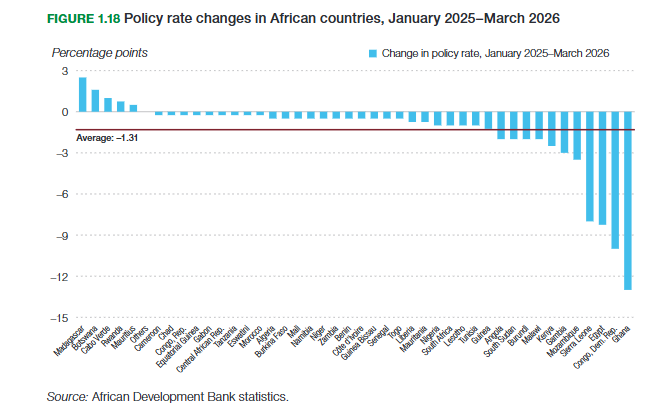
Despite a significant drop in the policy rate in the past year, Ghana is ranked 8th in Africa with the highest base lending rate, according to the African Development Bank (AfDB) 2026 African Economic Outlook.
The country’s policy rate of 14.0% is among the highest in a group of 44 countries covered by the AfDB. It is ranked jointly 8th with The Gambia.
Zimbabwe (30.00%), Nigeria (26.50%), Malawi (24.00%), Egypt (19.00%), Angola (17.00), Sierra Leone (16.75%) and Liberia (16.25%) are the first seven countries on the continent with the highest policy rates.
The Francophone countries in West Africa, which use a common currency (CFA), have the lowest policy rate in Africa.
Ghana Recorded Sharpest Drop in Policy Rate in 2025
Meanwhile, Ghana recorded the sharpest decline in the policy rate in 2025.
The Bank of Ghana cut the policy rate by 9.0% between December 2024 and December 2025. But between January 2025 and May 2026, the base lending rate in Ghana went down by 14.00%.
“Monetary policy stances in 2025 were shaped by the dynamics of inflation across the continent. The cooling off inflationary pressures provided impetus for interest rate cuts by African central banks. In 2025 alone, policy rates were cut by an average of 0.98 percentage points. Including the first quarter of 2026, the average policy rate cut amounts to 1.33 percentage points”, AfDB mentioned in the report.
“Encouraged by a rapid decline in inflation, four countries (Sierra Leone, Egypt, the Democratic Republic of Congo, and Ghana) reduced policy rates by eight percentage points or more”, it pointed out.
Cost of Borrowing Remains High
Meanwhile, the cost of borrowing in Ghana remains high despite a sharp decline in the policy rate.
Zimbabwe, Nigeria, Malawi, Egypt, Angola and Ghana recorded the highest lending rates on the African continent.
According to the May 2026 Summary of Economic and Financial Data by the Bank of Ghana, the average lending rate stood at 16.33% in April 2026.
It stood at 20.58% in January 2026, but fell to 19.17% in February 2026 and subsequently to 17.74% in March 2026.
Similarly, the Ghana Reference Rate has also fallen sharply to 10.06% in April 2026, from 15.68% in January 2026.
Between January 2025 and May 2026, Ghana's Monetary Policy Rate (MPR) was adjusted by the Bank of Ghana from an initial high of 28.0% in early 2025 down to 14.0% by May 2026, reflecting steady disinflation and improving macroeconomic stability.
However, in May 2026, the Bank of Ghana kept the policy rate at 14.0%.
It cited risks in the outlook to inflation and growth.
The Monetary Policy Committee alluded that it will continue to monitor incoming data, in particular relating to potential spillover of the geopolitical tensions to the domestic economy and take appropriate policy actions when necessary.
The Committee also decided to amend the dynamic Cash Reserve Ratio to a uniform ratio of 20 percent, maintained in the domestic currency, effective June 4, 2026
Latest Stories
-
Africa not seeking Western cash in reparations campaign – Ablakwa
12 minutes -
Production decline, reserve depletion threaten Ghana’s upstream sector – Jinapor
16 minutes -
Surveyors caution against treating compensation disputes as professional misconduct
19 minutes -
Mahama calls for AU dialogue on migration after South Africa xenophobic tensions
24 minutes -
I haven’t experienced any envy in the gospel music industry — Ohemaa Mercy
2 hours -
Prayer does not solve everything — Ohemaa Mercy
2 hours -
New PURC office symbolises stronger consumer protection – Dr Jinapor
3 hours -
Rev. Wengam re-elected Assemblies of God, Ghana General Superintendent
3 hours -
Less than 20km of clearing left to connect Accra-Kumasi Expressway to Kumasi – Agbodza
3 hours -
US judge strikes down policy suspending immigrant visa processing for 75 nations
3 hours -
MCEs collecting fees from galamseyers are facilitating illegality – Ken Ashigbey
3 hours -
Developer LMI Holdings commits to completing first 700 Saglemi housing units
3 hours -
Africa’s next chapter will be built by institution-builders, not idea-havers
3 hours -
Wenchi Traditional Council suspends Twafohene indefinitely
4 hours -
Kpassa-Merimeri road undergoes filling and levelling works to improve accessibility
4 hours