

Audio By Carbonatix
The National Democratic Congress (NDC) and the J.J. Rawlings Foundation have used a lecture marking the 79th birthday of former President Jerry John Rawlings to challenge party members and public officials to uphold the principles of probity, accountability and social justice that defined his political career.
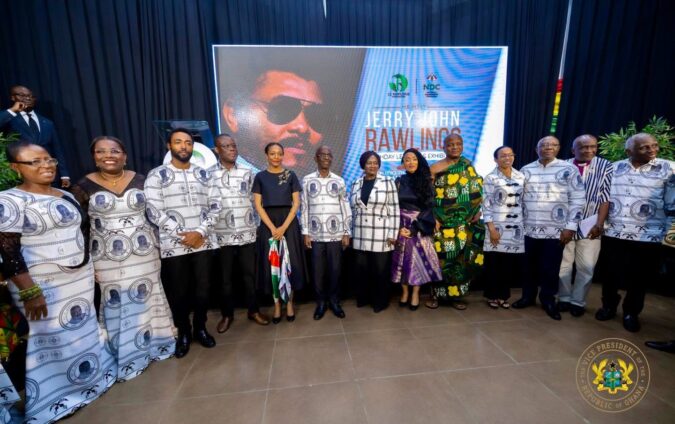
The event, held at the Ghana Academy of Arts and Sciences in Accra on Monday, June 22, under the theme “From Revolution to Fourth Republic: The Rawlings Legacy", brought together leading figures of the NDC, academics, former government officials and supporters to reflect on the impact of the late former President on Ghana's democratic and political development.
The programme came just hours after the unveiling of a bust of Rawlings and the naming of part of the NDC headquarters in his honour.
Former Local Government Minister and current Board Chairman of the Ghana Investment Promotion Centre, Dr Akwasi Opong-Fosu, said the gesture was more than a symbolic act.
"A few hours ago, we made history. We carved the name Jerry John Rawlings onto the NDC headquarters building with his bust. We did not name a building; we signed a covenant," he told the gathering.
Speaking on the topic "Probity Has an Address: What the Rawlings House Demands from Us", Dr Opong-Fosu described Rawlings as a leader who resonated with ordinary Ghanaians.
"To the ordinary worker, market woman, farmer, student and the man in the street, he was charismatic because he made them feel seen," he said.
"To the poor, weak and vulnerable, he was empathetic, tender-hearted and compassionate because he understood their struggles."
He said Rawlings remained a powerful and sometimes intimidating figure whose presence commanded attention both at home and abroad.
Reflecting on the June 4, 1979 uprising, Dr Opong-Fosu said that Ghana had failed to fully confront the conditions that led to the revolution.
"Forty-six years on, the revolution is asking a serious question: did we eradicate impunity or did impunity just change clothes?" he asked.
According to him, public discussion of June 4 had often focused on its excesses while ignoring the social and economic frustrations that fuelled the uprising.
"We condemned the methods of the revolution, but we were never willing to address what created it in our national conversations," he said.
Dr Opong-Fosu further said that Rawlings and the June 4 uprising were inseparable.
"Rawlings caused the uprising by speaking. June 4 caused Rawlings to answer. The real cause behind both was Ghana's pain at the time," he stated.
He said the naming of the party headquarters after Rawlings should serve as a reminder that the issues of inequality, impunity and neglect of ordinary citizens still required attention.
"If June 4 was Ghana's pain demanding an answer, then naming the headquarters after Rawlings is not nostalgia. It is a covenant," he said.
Dr Opong-Fosu described Rawlings' decision to return Ghana to constitutional rule as the defining achievement of his political career.
"In 1992, Rawlings did what most revolutionaries fear. He ditched the gun for the constitution," he said.
"This is Rawlings' crowning achievement. The hallmark of his legacy. He moved us from revolution to republic, from rule by decrees to rule of law, from PNDC to Parliament."
He also cited remarks made by former Presidents John Agyekum Kufuor, Nana Addo Dankwa Akufo-Addo and John Dramani Mahama as evidence of the broad recognition of Rawlings' role in Ghana's democratic development.
"When your political rival, your successor and your protégé all say the same things about you, that is profound," he noted.
Former Information and National Security Minister Kofi Totobi Quakye also paid tribute to Rawlings, recalling the close relationship they shared over nearly two decades.
"For almost 19 years I sat at the feet of Flight Lieutenant Rawlings," he said.
"I was among the many student leaders of that time. Many of them were never heard of again, but Jerry John Rawlings picked me. He saw something in me and brought me close to him."
Mr Totobi Quakye said Rawlings' legacy should not be reduced to political slogans or ceremonial tributes.
"The life of Jerry Rawlings cannot be reduced to a few remarks. The revolution he came to embody cannot be reduced to nostalgia, and the legacy he left behind cannot be measured merely through praise singing," he said.
"It must be examined, it must be protected and, above all, it must be lived."
He warned the NDC against abandoning the values on which the party was founded and urged members to remain committed to public service.
"The NDC was not founded as a vehicle for personal aggrandisement. It was not founded for opportunists, political mercenaries, contractors of convenience, or persons whose only ideology is personal profit," he said.
Mr Totobi Quakye expressed concern that some Ghanaians continued to question whether the NDC still represented a distinct standard of governance.
"How can it still be a question whether the party of Rawlings stands for probity and accountability? How can it still be a question whether we came to serve or merely take our turn?" he asked.
He cautioned that public confidence in democracy could be weakened if citizens came to believe that Ghana's two major political parties offered little difference in values or governance.
"The deeper danger is that we may help convince the Ghanaian people that the two dominant parties are in the end the same," he said.
Delivering the keynote address, lawyer and academic Tsatsu Tsikata said the event was not intended to glorify Rawlings but to reflect on the lessons of his leadership.
"We do not gather out of nostalgia about the past or to idolise an individual. He himself would not have tolerated such approaches to this event," he said.
"Our commemoration is because the Rawlings legacy is important for the nation, especially to the youth."
Mr Tsikata urged the NDC to use the occasion to reflect on its future direction and the values it wished to present to the country.
"There is a danger that we lower the bar of what the nation expects of us in the NDC and that we aim to be just a little better than the previous government," he warned.
"That would be both an affront to the people of Ghana and an affront to the illustrious traditions of the NDC."
He described accountability and the fight against corruption as central principles that remained relevant today.
"Accountability matters. Standing resolutely against corruption matters," he stressed.
Mr Tsikata also highlighted what he described as Rawlings' contribution to economic reform, decentralisation, national development and democratic governance.
He pointed to policies aimed at empowering farmers, expanding rural development, attracting investment, improving education, extending electricity nationwide and liberalising the telecommunications and broadcasting sectors.
According to him, Rawlings' greatest achievement was his ability to inspire talented Ghanaians to dedicate themselves to national service.
"Perhaps the most important achievement which consolidates his legacy is that he drew into the service of the nation the dedication and commitment of some of the most talented and patriotic Ghanaians of his generation," he said.
Mr Tsikata further urged the NDC to preserve the values associated with Rawlings while recognising that the legacy belonged to the nation as a whole.
"We must project it. Indeed, as a party, we must own it. But we must recognise that it is owned by the nation and not just by us," he said.
Latest Stories
-
NSMQ 2026: Holy Child School storms back from two-year NSMQ absence to book One-Eighth ticket
1 hour -
GNFS dismisses reports of unpaid 2025 rent allowance
2 hours -
Gordon Asare-Bediako steps down from NPP Communications Director race, backs Dennis Aboagye
2 hours -
GES dismisses requirement for newly promoted teachers to submit documents for salary adjustments
3 hours -
Meko Bono 2026: Vice President pledges agricultural revival as Atebubu hosts grand homecoming
4 hours -
Russian skydiver Sergey Boytcov sets world record with 11,551-metre stratosphere jump
4 hours -
Ablakwa-led committee submits five reports to Mahama ahead of 2027 AU chairmanship
4 hours -
Africa not seeking Western cash in reparations campaign – Ablakwa
4 hours -
Production decline, reserve depletion threaten Ghana’s upstream sector – Jinapor
4 hours -
Surveyors caution against treating compensation disputes as professional misconduct
4 hours -
Mahama calls for AU dialogue on migration after South Africa xenophobic tensions
4 hours -
I haven’t experienced any envy in the gospel music industry — Ohemaa Mercy
6 hours -
Prayer does not solve everything — Ohemaa Mercy
6 hours -
New PURC office symbolises stronger consumer protection – Dr Jinapor
6 hours -
Rev. Wengam re-elected Assemblies of God, Ghana General Superintendent
6 hours