


Audio By Carbonatix
Hundreds of schools have planned for at least partial closures, and multiple train operators, including the UK's largest, have warned people not to travel unless necessary as temperatures climb.
The top temperature recorded on Tuesday was 34.6 °C in Wisley, Surrey. Northern Ireland and Scotland saw their hottest days of the year, with temperatures reaching 28.1 °C and 29 °C respectively, while Wales hit a high of 32.2 °C.
The heatwave is expected to intensify, with temperatures forecast to reach around 37-38 °C in southern England on Wednesday.
A red extreme heat warning has been issued across parts of England and Wales from Wednesday morning to Thursday evening, meaning there is a danger to life.
A rare red extreme heat warning is still expected from 09:00 BST on Wednesday to 21:00 Thursday, meaning there will be an exceptional spell of hot and humid weather in parts of south and central England and south Wales, according to the Met Office.
In southern England, a maximum of 39 °C on Wednesday is not out of the question.
High humidity levels will make conditions even more uncomfortable - while the air temperature might be 35 °C, for example, it may feel more like it's 41 °C.
The forecaster warns of a risk of serious illness or danger to life in the affected areas. Loss of power and other essential services, such as water, are also likely due to a greater risk of failure of heat-sensitive systems and equipment.
Significantly more people are likely to visit coastal areas, lakes and rivers, leading to an increased risk of water safety incidents, it says.
The record for the UK's highest June temperature - 35.6 °C in 1976 - is likely to be shattered, but maximum temperatures will fall short of the all-time high of 40.3 °C set in 2022.
The UK was forecast to experience its hottest June day on Tuesday, but temperatures were around 2-3 °C lower than predicted in south-east England after intense rainfall and flash flooding in some locations overnight.
Overnight temperatures will also remain high this week, and some locations will not get cooler than 20 °C, becoming what is known as a tropical night.
A red heat health alert has also been issued by the UK Health Security Agency (UKHSA), from 01:00 on Wednesday until 23:00 on Thursday.
Prof Robin May, chief scientific officer at the UKHSA, said this was only the second time they had issued the red heat health warning - the last time in July 2022.
Speaking on BBC Radio 4's Today programme, he said the warning "signals a very widespread threat" from the heat, including threats "to people who generally think of themselves as not being particularly threatened by heat".
"Often we are warning about the vulnerable, the elderly, the young, but in this case we're also warning otherwise healthy people in their prime of life to take very cautious steps, because this heat is going to be quite intense and can have very serious life threatening effects even in people who are completely fit," he said.
Matthew Hopkins of the acute and ambulance network for the NHS alliance told the Today programme that he expected demand on emergency services to increase over the next few days during the extremely hot weather.

More than 300 schools across England and Wales are planning to be partially or fully closed on Tuesday and later this week due to the weather.
Others are also closing early on Wednesday and Thursday to protect children from the heat, with some pupils told they can wear a PE kit instead of a full school uniform on those days.
The Department for Education does not itself "normally advise schools to close"; instead, it issues guidance on how best to manage high temperatures.
There will also be travel disruption for those travelling by car, rail and air, the Met Office warned.
On the National Rail network, passengers have been urged to avoid non-essential travel and to ensure they carry water.
GTR - the UK's largest train operator - said it will suspend the Gatwick Express from early afternoon on Wednesday and Thursday. The airport will still have services via Thameslink and Southern trains.
The operator will also implement safety speed restrictions across the next two days, with fewer trains on Thameslink, Great Northern and Southern lines.
GTR passengers can get refunds for tickets they have bought for Tuesday and the next couple of days if they will no longer be travelling.
Avanti West Coast also said it would run fewer train services between Tuesday and Thursday, while Chiltern Railways has reduced its services by more than half over those three days.
National Rail explained that heat can cause a number of issues, including overhead lines expanding and rails buckling.
The RAC said it is anticipating breakdown assistance will "increase significantly as temperatures peak", adding that it was already dealing with 10% more breakdowns than usual for this time of year.
Meanwhile, ceremonial guard changes in London and Windsor have been cancelled on Tuesday, Wednesday and Thursday in a bid to reduce risks for the military personnel, horses and the public.
Less severe amber weather warnings are in place until Friday for parts of south and central England and parts of Wales.
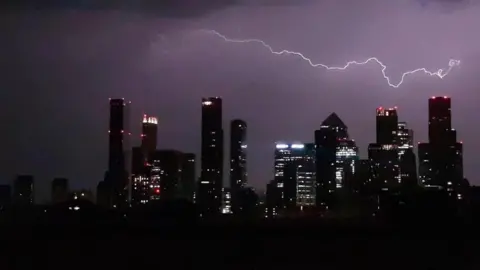
Tuesday's hot and humid weather was prefaced by thunderstorms in the early hours, with some 29,000 lightning strikes recorded in the south, the Met Office said.
The storms caused flash flooding and travel disruption across parts of England, with the London Fire Brigade reporting that it responded to 400 calls overnight.
Emergency services said two house fires in London and one in Bristol were believed to have been caused by lightning strikes.
There were also power outages in south-west England, with hundreds of homes briefly without electricity on Monday evening, according to the National Grid.
The immediate cause of the heatwave is a "heat dome" - an area of high pressure that becomes "stuck", trapping warm air underneath it.
While it is difficult to link individual extreme weather events to climate change, scientists say climate change makes heatwaves more frequent and more intense.
Over the last 30 years, Europe has been warming by 0.56 °C per decade, according to the Copernicus climate service - enough to make heat extremes significantly more severe.
The UN warned on Thursday that global average temperatures were likely to continue at or near record levels this year and for the next four years.
Latest Stories
-
BSIFF 2026 official selection brings films from 11 countries to Kumasi
4 minutes -
Minerals Commission inaugurates GH¢28m multipurpose sports complex in Kenyasi
14 minutes -
OSP has made corruption too costly to engage in lightly – Kissi Agyebeng
25 minutes -
U.S. FDA approves landmark pancreatic cancer drug that’s shown to improve survival
28 minutes -
NSA extends August 28 deadline for National Service applicants with biodata mismatches
31 minutes -
Ghanaian woman dies in China after collapsing at airport on journey to pursue Master’s Degree
37 minutes -
NSMQ 2026: Osei Tutu SHS hold off Ahantaman Girls, Presby SHTS to reach quarterfinals
52 minutes -
We worked with the FBI on Asante Berko case – OSP rejects claims it lacks competence
57 minutes -
Keep political actors out of police affairs to tackle electoral violence — Asah-Asante
59 minutes -
Africa cannot fund energy needs with public budgets alone – Ato Forson
1 hour -
NSMQ 2026: Keta SHTS secures quarterfinals spot after beating Anum Presby, Kadjebi Asato
1 hour -
OSP has saved Ghana over 20 times the resources invested in it – Kissi Agyebeng
1 hour -
Kwabena Donkor, four others named as persons of interest in Asante Berko case – OSP
1 hour -
Police interdict officer over alleged demolition at Accra Race Course
1 hour -
Performance of OSP shouldn’t be measured by political applause – Kissi Agyebeng
1 hour