


Audio By Carbonatix
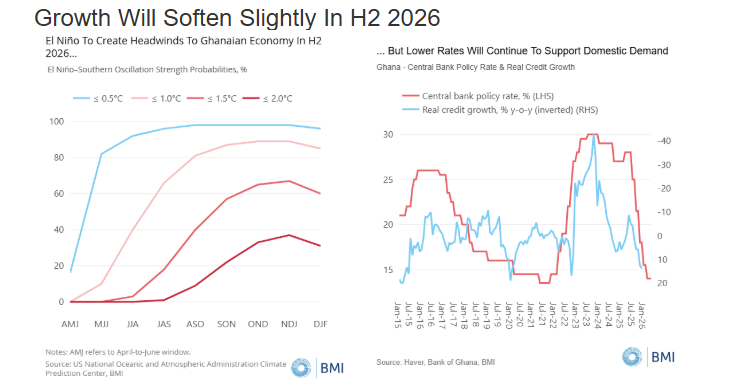
Ghana’s economic growth will moderate to 4.7% in 2027 from 5.7% in 2026, UK-based Fitch Solutions has disclosed.
This is as a result of less favourable base effects and weaker agricultural output.
According to Fitch Solutions, stagnant oil and cocoa production will constrain export growth.
“Fiscal pressures will also intensify as principal repayments under the Domestic Debt Exchange Programme, launched in December 2022, begin to fall due, while Eurobond debt-service obligations also increase. As a result, a larger share of government resources will be directed towards debt servicing at the expense of government consumption”, it pointed out.
It added that risks to its 2026-2027 growth outlook for Ghana are mixed but tilted to the downside.
“A tighter-than-expected monetary policy stance by the US Federal Reserve in response to elevated inflation would weigh on global gold prices and, by extension, Ghana’s export earnings. This would put pressure on the cedi, resulting in higher inflation than we currently forecast and a corresponding drag on household consumption and broader economic activity in H2 2026 and 2027”.
On the upside, the UK-based firm said domestic demand could prove more resilient than its anticipate. “Should consumer and business sentiment remain strong – despite rising inflation and geopolitical uncertainty – household spending and private investment would likely outperform our expectations. In this scenario, economic growth would exceed our current forecasts”.
Economic Activity to Remain Robust in Quarter 2
Meanwhile, the UK-based firm expects economic activity to remain robust in the second quarter of 2026 despite disruptions in global energy markets stemming from the US-Iran conflict.
“As we have argued previously, Ghana’s macroeconomic fundamentals are relatively insulated from the current energy shock, supported by its broadly balanced oil trade position and elevated gold prices, which provide a key external anchor. While domestic fuel prices have increased by 8.8% since the start of the US–Iran conflict and diesel prices are up 19.7% (in USD terms), price increases remain below market levels as the government has absorbed part of the cost”.
“As such, inflationary pressures have remained contained: headline inflation rose only modestly from 3.2% y-o-y in February to 3.7% in May, remaining well below the 2010-2025 average of 15.7%. This suggests that household purchasing power remains intact, supporting private consumption growth”, it added.
Ghana’s economy expanded by a robust 6.4% year-on-year in quarter one 2026, accelerating from 5.8% in quarter 4 2025.
.
Latest Stories
-
Let’s wait and see – Agalga refuses to take sides on extortion allegation as OSP probe begins
3 seconds -
FDA intensifies drive to ensure iodised salt reaches consumers
5 minutes -
HTU partners Praise Export to boost student training, employability
10 minutes -
Samuel Abu Jinapor proposes independent body to fight galamsey
16 minutes -
Government moves to review Minerals and Mining Act to strengthen regulation
22 minutes -
Investors channel most funds into 364-day government securities
27 minutes -
Ghana is much safer this year than even 2025 – Interior Minister
33 minutes -
These allegations carry a lot of weight – Agalga concedes extortion claims are serious
34 minutes -
Opoku-Agyemang lauds peaceful co-existence, unity of Bono people
37 minutes -
$1.7bn gold loss is not a ‘cost of doing business’ – PAGA
37 minutes -
Gov’t, media must sustain partnership to safeguard Ghana’s democratic gains – Shamima
45 minutes -
Mahama congratulates newly elected Executive Presbytery of Assemblies of God, Ghana
50 minutes -
Work begins to reclaim Lafa basin to curb flooding in Mallam, Weija
56 minutes -
Mahama opens 28th AMCOA Conference
1 hour -
Let there be a ceasefire – Agalga urges calm as extortion allegations rock Parliament
1 hour