

Audio By Carbonatix
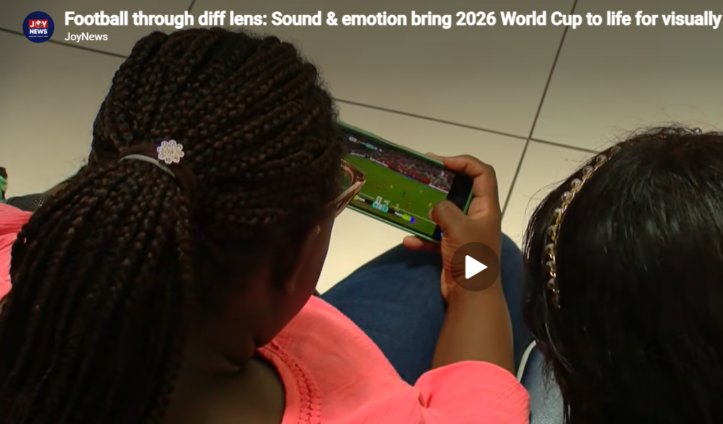
As the FIFA World Cup captivates millions of viewers around the globe, many Ghanaians living with visual impairment are finding their own ways to stay connected to the action.
They may not see the goals, tackles or celebrations, but they still experience the tension, excitement and heartbreak that make football the world's most beloved sport.
For Dr Obeng Asamoah, Director of the Ghana Blind Union, football has remained an important part of his life despite losing his sight at the age of 18.
Like many football enthusiasts, he follows matches closely, relying on commentary and his understanding of the game to create a mental picture of the action on the pitch.
"I've always loved football. When I could see, I used to play the game myself. Now that I can't see, I rely on commentary. From the commentator's voice, I can tell which team is dominating play and which players are seeing more of the ball. The excitement in the commentator's voice helps me follow the action," Dr Obeng Asamoah said.
For him, losing his sight did not mean losing his passion for football.
Forty-six-year-old Abdul Razak Yusif shares a similar experience. A social worker and father of two, Razak's love for football began long before he lost his sight.
He played football as a young boy and grew up supporting the Black Stars. Although he lost his vision at the age of 17, his passion for the sport has never faded.
Today, he follows matches through radio commentary, crowd reactions and years of football knowledge that help him interpret what is happening on the field.
"I rely on commentators who can describe the game well. Sometimes, the way they describe a situation can make you feel tense, relieved or excited. It's almost like you are right there watching the match," he said.
However, not every visually impaired football fan relies solely on commentary.
For Wilhemina, an LLB student and entrepreneur, family support plays a significant role in helping her enjoy the game.
Whenever a match is on, a relative often sits with her and explains the action as it unfolds. The reactions in the room, the excitement in people's voices and the atmosphere around her all help shape her understanding of the game.
"I rely on what the commentators say and mostly on my friends and relatives. When the national anthem is played before a match, it gives me a calm feeling and lets me know that something important is about to begin.
"Sometimes, I even forget that I'm blind because of the reactions around me. I can tell what is happening in the game from the tone of my relatives' voices and how they react during key moments," she said.
For Dr Obeng, Razak and Wilhemina, not being able to see the game has not diminished their love for football.
They may experience the World Cup differently, but they still celebrate the goals, feel the tension and share in the joy and disappointment that come with supporting a team.
Their stories serve as a reminder that football's greatest power lies not only in what is seen on the pitch, but also in the emotions and sense of belonging it inspires in people everywhere.
Latest Stories
-
OSP has saved Ghana over 20 times the resources invested in it – Kissi Agyebeng
1 minute -
Kwabena Donkor, four others named as persons of interest in Asante Berko case – OSP
2 minutes -
Police interdict officer over alleged demolition at Accra Race Course
5 minutes -
Performance of OSP shouldn’t be measured by political applause – Kissi Agyebeng
6 minutes -
April 15 ruling brought OSP prosecutions to standstill – Kissi Agyebeng
16 minutes -
The continuity of the self
16 minutes -
Claims OSP has achieved nothing are testable – Kissi Agyebeng
18 minutes -
First National Bank redefines gifting with launch of Investment Gift Cards
21 minutes -
Supreme Court has settled OSP’s prosecutorial mandate – Kissi Agyebeng
21 minutes -
OSP recovered GH¢8.5m, $2m and saved state over GH¢100m through payroll cleanup – Kissi Agyebeng
27 minutes -
World Bank says 56.4% of Ghanaians remain in poverty despite economic growth
30 minutes -
The Inconvenient Truth: The Boardroom is where tomorrow is quietly written or quietly erased
31 minutes -
Personal dislike for OSP leadership behind calls to abolish office – Kissi Agyebeng
31 minutes -
AMA arrests 6 drivers, mates for allegedly charging unapproved fares in Accra CBD
36 minutes -
Attacks on OSP linked to discomfort over its investigative powers – Kissi Agyebeng
36 minutes