

Audio By Carbonatix
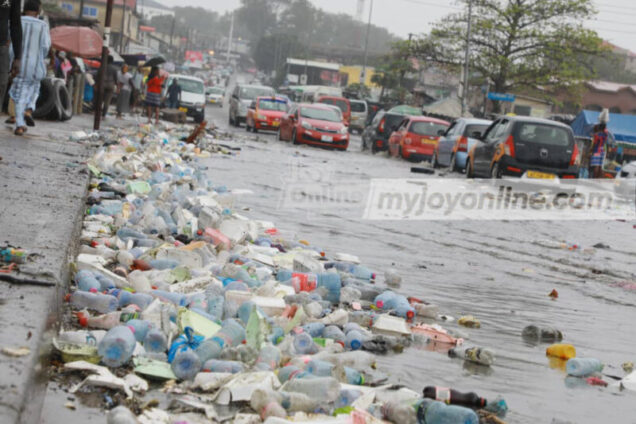
About $1 billion in international financing has flowed into Ghana's flood control, sanitation, and urban water infrastructure over the past two decades, yet the country, particularly Accra, continues to suffer devastating floods that claim lives and destroy property almost every rainy season.
A JoyNews Research review of official records from the World Bank, African Development Bank (AfDB), and African Water Facility shows Ghana has secured approximately $990 million in major multilateral financing between 2000 and 2024 for flood resilience, sanitation, and water infrastructure. Of that amount, about $723 million was specifically targeted at Greater Accra and the Greater Accra Metropolitan Area (GAMA).
The two-decade total: $990 million across 11 major projects
JoyNews Research traced the financing back to 2000, identifying 11 major World Bank and African Development Bank-backed projects spanning water access, sanitation and flood resilience. Together, they total approximately $990 million in Board-approved financing.
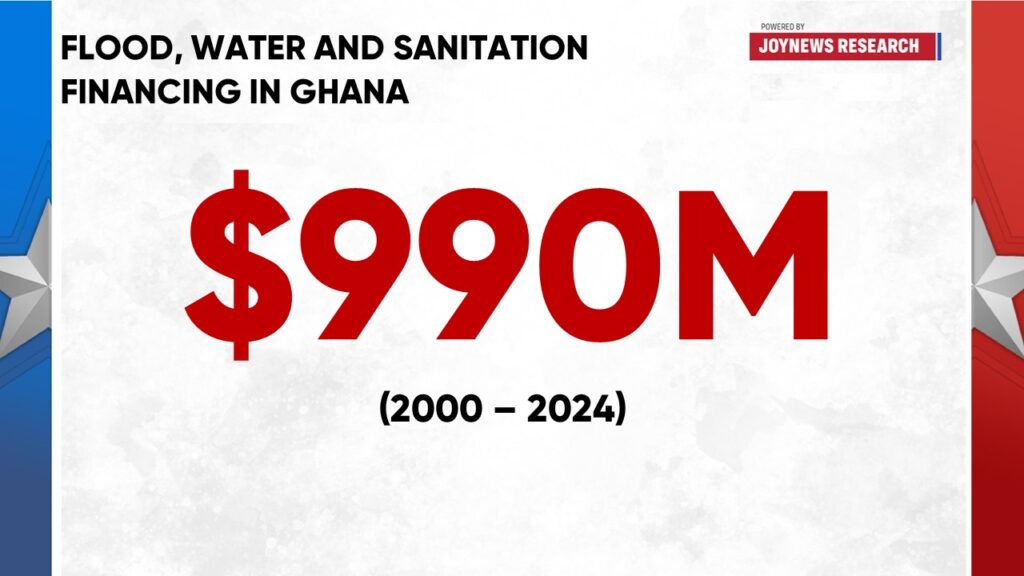
Not all of this money was Accra-specific. Some of it funded national rural and urban water programmes that touched the capital as one beneficiary among many. Stripping the analysis down to projects targeted specifically at Greater Accra or the GAMA brings the figure to approximately $723 million—still a substantial sum, channelled through four major financing packages plus one small project-preparation grant.
The earliest identified financing dates to 2000, when the World Bank approved a $21.9 million credit for the second phase of the Community Water and Sanitation Program, a rural and small-town initiative that eventually reached nearly 800,000 people nationwide. In 2004, the Bank approved a $120 million Urban Water Project—$103 million from the Bank itself, $5 million from the Nordic Development Fund and $12 million from the Government of Ghana—aimed at expanding piped water access and shoring up the finances of Ghana Water Company Limited. A further $50 million was added to that project in 2012. In 2010, a separate $75 million World Bank credit supported the Sustainable Rural Water and Sanitation Project across six regions.
The African Development Bank entered the picture in 2006, when its concessional lending arm, the African Development Fund, signed a $68 million loan for the Accra Sewerage Improvement Project—intended to lift sanitation access in urban and peri-urban Accra from 40 per cent to 65 per cent and benefit around 1.5 million people. Two decades on, much of Accra's sewerage network remains incomplete. In 2024, the African Water Facility, a project preparation fund hosted by the AfDB, approved a modest grant of €225,000 simply to update feasibility studies and engineering designs for a long-stalled follow-up project in Accra East—work that was originally designed back in 2005 but never built for lack of funding.
At the centre of this two-decade picture sits a more recent and more concentrated body of financing that JoyNews Research independently verified line by line against official World Bank press releases and project documentation: five World Bank-backed projects since 2013, totalling exactly $655 million.
The first is the Greater Accra Metropolitan Area (GAMA) Sanitation and Water Project, approved on 6 June 2013 for $150 million. It was designed to expand access to sanitation and water in low-income parts of Accra, and a decade later, the results were measurable: household toilet access in Greater Accra rose from 21 per cent in 2014 to 51.7 per cent in 2021, according to Ghana's Population and Housing Census.
The second, and arguably the most consequential, is the Greater Accra Resilient and Integrated Development (GARID) Project. Approved on 29 May 2019 for $200 million, GARID was conceived specifically to tackle flooding in the Odaw River Basin—the catchment that includes some of Accra's most flood-prone and densely populated communities, among them Old Fadama, Nima and Agbogbloshie. Its scope includes drainage upgrades, dredging of the Odaw channel, flood retention infrastructure, and solid waste management to stop drains clogging in the first place.
The GAMA project received two further injections of World Bank financing: $125 million in September 2020 to extend the programme into the Greater Kumasi Metropolitan Area and respond to COVID-19 hygiene needs, and a further $30 million in August 2024 to cover cost overruns driven by inflation and complete the rehabilitation of the Asafo Sewerage Network.
GARID, meanwhile, received a $150 million top-up in May 2023, taking its total financing envelope to $350 million and explicitly citing the devastating flood of 3 June 2015—which affected 53,000 people and caused an estimated $105 million in reconstruction costs—as the rationale for scaling up.
Money committed is not money spent
Here lies the uncomfortable part of the story. Board approval of a loan or credit is not the same as the money being spent on the ground, and the gap between the two is where much of the public frustration is rooted.
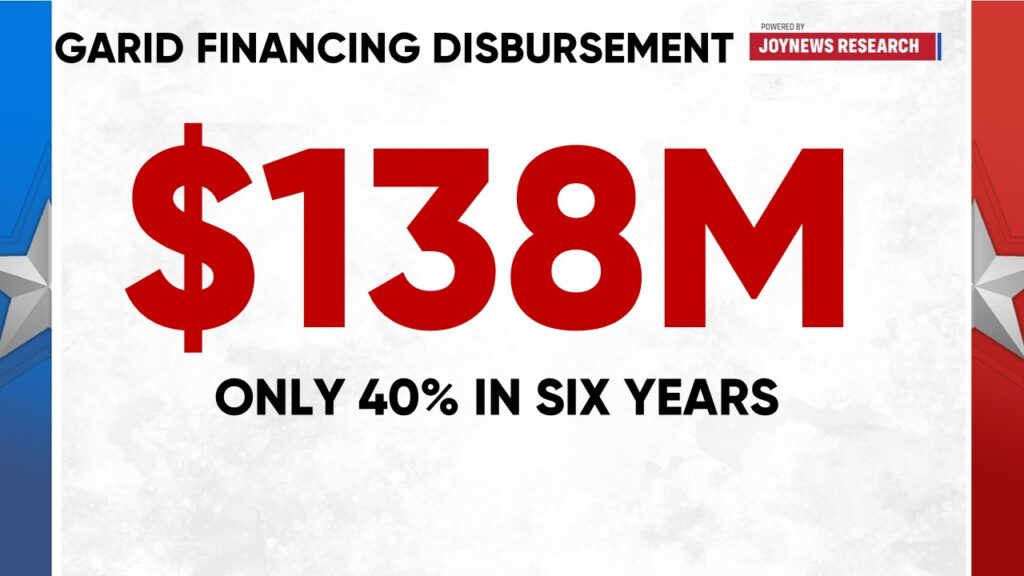
According to the World Bank's own implementation reports, cumulative disbursement under the combined $350 million GARID financing stood at only about $138 million as of the most recent reporting period, roughly 40 per cent of the total credit. And the reasons for the delay include the following: Government capping of project funding: GH¢13.8m removed from project account and later replaced; contractors not paid on time, no disbursements for 16 months; work slowed or abandoned at some sites; delays increased project costs, compensation payments were delayed, and permit and safety compliance issues, among others.
Some of that early disbursement, it should be noted, was not spent on flood works at all. A portion of GARID funding was redirected in 2020 to Ghana's COVID-19 emergency response—a reallocation that has previously drawn criticism from opposition lawmakers in Parliament, who in 2024 demanded a full account of how the GARID money had been used after visiting project sites and reportedly finding minimal preliminary work completed.
There has been visible progress more recently. Nine major civil works contracts under GARID are now active, including performance-based dredging of the Odaw Channel—described as the first project of its kind in Africa—which began in early 2024. Work is underway in communities including Nima, Akweteyman, Alogboshie, and Achimota. But critical sections of the planned drainage and flood mitigation works remain unfinished, even as the rains keep coming.
A governance problem as much as a funding one
Development professionals who track Accra's flooding crisis increasingly argue that the missing piece is not more money, but better enforcement of the rules that already exist.
That assessment is hard to dismiss when set against recent events. After the June 2026 floods, President John Mahama questioned how some of the buildings now earmarked for demolition had obtained planning permits to be built in waterways in the first place. "But some of the houses have building permits. How did they get them? So we have to do some soul-searching," he said, directing state agencies to prepare a comprehensive assessment of flood-prone areas across the capital.
Eleven years on from the 3 June 2015 disaster that killed more than 150 people near Kwame Nkrumah Circle, the single deadliest flood event that originally justified GARID's design,n Accra remains caught in what one analyst has called a cycle of "disaster, outrage, and promises of reform."
A newer tool: insurance instead of infrastructure
Separately from capital construction projects, Ghana has, in the past two years, begun experimenting with a different kind of financial protection: parametric, trigger-based disaster insurance that pays out automatically once predefined conditions—rainfall levels, drought severity—are met, without the lengthy claims process of conventional insurance.
In 2024, Ghana purchased its first sovereign drought insurance policy through the African Risk Capacity, with premium support from Germany's development bank KfW. It has already paid out roughly $960,000 in February 2025 and $1.93 million in April 2025 to fund emergency food and seed distribution in drought-hit northern regions. A parallel flood-specific insurance product for Greater Accra was in the procurement stage as of September 2025, developed with the Ministry of Finance and international partners.
These instruments do not build a single drain or dredge a single channel. What they offer instead is speed: rapid liquidity in the immediate aftermath of a disaster, before slower-moving infrastructure financing or government budget processes can respond. Whether they will meaningfully complement—or merely sit alongside—the hundreds of millions already committed to Accra's drains and sewers remains to be seen.
The case for an independent evaluation
Given the scale of the money involved, the documented gap between what has been approved and what has actually been spent, and the human cost of flooding that continues year after year, the argument for a rigorous, independent impact evaluation of these projects is difficult to ignore.
Some of the evidence base for such an evaluation already exists. The original 2013 GAMA Sanitation and Water Project closed in December 2020 and has a published Implementation Completion and Results Report, alongside an independently verifiable improvement in toilet access captured by the national census. GARID and its additional financing, by contrast, remain substantially under-disbursed and mid-implementation, meaning any evaluation of that project would need to assess implementation progress and bottlenecks rather than completed outcomes.
What both halves of the picture share is a simple, public-interest question that has not yet been definitively answered: of the nearly $1 billion in international financing channelled toward fixing Ghana's water, sanitation and flooding problems over the past two decades, how much has translated into fewer flooded homes, fewer lost lives, and a more resilient capital and how much remains tied up in disbursement delays, displaced funds, and unfinished works?
Until that question is answered with hard evidence rather than competing political claims, Accra's residents are likely to keep watching the rains with the same anxious uncertainty they have lived with for a generation.
Latest Stories
-
Ablakwa urges African leaders to adopt new leadership paradigm to create opportunities for youth
2 minutes -
Photos: Mahama holds talks with Serbian President in Belgrade
12 minutes -
Local gold refining good for economy but costs must be controlled – Economist
12 minutes -
Keir Starmer announces he is standing down as MP
13 minutes -
One still missing after Grand Canyon floods kill two and prompts rescue efforts
14 minutes -
Mahama Ayariga calls for major overhaul of Ghana’s waste management system
17 minutes -
GoldBod programme contributed just 1.3% to reserves increase – Amin Adam
18 minutes -
Drive to Inspire–Africa equips UESD students with skills for future careers
20 minutes -
Diana Hamilton reveals she experiences stage fright before performances
24 minutes -
Number of ATMs declined by 0.5% to 2,272 in 2024 – BoG
24 minutes -
Look beyond government securities, GVCA tells pension funds
25 minutes -
COCOBOD settles GH¢2.3bn DDEP obligations for 2026
27 minutes -
Police arrest 6 for allegedly killing tricycle rider over failure to make sales
31 minutes -
Mahama unveils ‘Accra Reset’ blueprint for fairer global economic order
34 minutes -
Mahama calls for stronger climate finance, renewable energy investment for developing nations
35 minutes