

Audio By Carbonatix
Introduction
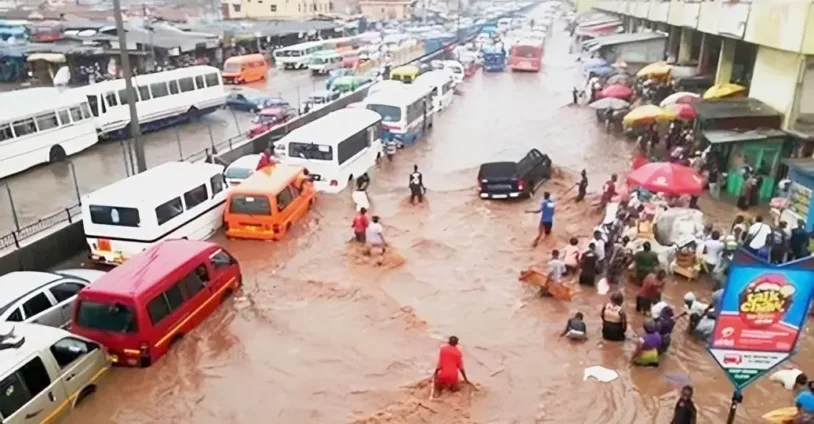
On the 3rd of June 2026, Accra, the capital city of Ghana, was saddled once again with incidents of flooding, building collapse and fire outbreaks. This date marked exactly 11 years since the 3rd June, 2015 disaster, when more than 150 people lost their lives due to flooding and fire.
Reasonable expectations were that measures would have been put in place to ensure that Accra does not go through such an experience again. However, the situation has worsened. The population of Accra has increased. More buildings have been constructed in waterways and flood-prone areas. Structurally deficient buildings are scattered all over the city, and vegetative depletion continues unabated. The capital city is under enormous stress, and media discussions have centered around the effectiveness of Accra as a capital city. Some key questions have been: Is Accra too susceptible to natural and manmade disasters? Is Accra equipped to service its growing population? Can Accra alter its current growth dynamic? Can a new capital city relieve Accra of the development pressure amidst climate change?
The Greater Accra Region covers an area of 3,245 km2, representing 1.4% of the total land area of Ghana. It is the smallest region out of the sixteen regions of Ghana with a population of approximately 5.46 million. The second smallest region is the Ahafo Region, which covers an area of 5,193 km2 with an estimated population of 565,000. Population explosion has resulted in the developmental pressure on the Greater Accra Region becoming unbearable. On the eve of independence in 1957, the population of Accra was 190,000. The World Population Review estimates the current population of Accra to be approximately 2.95 million.
In 1877, a few years after the British had assumed political control of Ghana, they moved Ghana’s capital from Cape Coast to Accra. Accra was preferred because of its climatic conditions and the conduciveness of the population to taxation. Climatic conditions were essential because of the drier climate in Accra compared to Cape Coast. Accra became the economic centre of Ghana after the completion of railway lines to the mining and agricultural areas located in the interior of Ghana.
In 1944, the first physical plan of Accra was prepared by Maxwell Fry to ensure the provision of sanitation, lighting, water, a market, a slaughterhouse, and streets. In 1958, another plan was drafted with the full elements of a master plan by Alan Ford and B. D. W. Treavallion, but very little was done in respect of its implementation. The notable activity undertaken was the Ring Road Industrial Area. Subsequent physical plans have suffered the same fate.
Ills of Accra
The manifestation of poor urban planning is evident in almost all communities in Accra. The only exception is the semblance of order in communities like Airport Residential, Cantonments, North Labone and Airport West. Even so, rapid transformation of these communities by real estate developers is reversing their positive qualities. Some of the ills affecting Accra are;
Seismic Zones and Flooding: The Greater Accra Metropolitan Area (GAMA) is situated in an active seismic zone. This automatically means that buildings are susceptible to earthquakes. Accra experienced earthquakes in 1862 and 1939, and there have been numerous earth tremors. Apart from the seismic concerns associated with Accra, heavy rainfall patterns have become a dreaded yearly occurrence that affects many inhabitants. Each year’s deluge leads to a significant loss of property and lives. The periodic flooding of Accra is largely a result of the city’s inability to accommodate intensive stormwater runoff due to an ineffective and insufficient storm drainage network. The ability of soils in urban Accra to absorb rainwater has been greatly reduced as a result of impermeable paved parking lots, asphalted roads and the extensive coverage of land parcels by buildings. These impermeable surfaces have increased the intensity of rainwater run-off and the quantity of pollutants received by urban water bodies such as rivers and streams. Rainwater is unable to be discharged fast enough, hence increasing the likelihood of flooding whenever it rains.
Rural Urban Migration and Population Growth: An illusion of economic opportunities has lured many people from all over Ghana to Accra. This movement has led to a high population increase coupled with a scramble for the limited and inadequate services available. Over the years, the sprawling of the city has hindered the provision of essential services (water, solid waste disposal, refuse collection, good drainage and electricity). Provision of essential services to sprawling areas has become costly and difficult. The existing facilities are also deteriorating due to lack of maintenance, and the needed injection of investment to overhaul these systems is not forthcoming.
Urban Mobility: The increase in automobile use has made the vehicular traffic situation in Accra unbearable. The dominance of low-capacity vehicles and the high travel time make the traffic an unpleasant experience daily. Air pollution is almost twice the regional average in Africa despite a relatively low motorisation rate. This can be attributed to the high average age of vehicles in Ghana (14.2 years). Mass transit, non-motorised transport and railways have not been effective. Pedestrians and cyclists are not adequately catered for in all communities in the city. Most roads in the city are not in the best of condition as a result of the poor maintenance culture and substandard construction by some contractors.
Ineffective Planning and Law Enforcement: Ineffective planning schemes as a result of staffing deficiency of the MMDAs in the Greater Accra Region, and political interference in the enforcement of laws, have resulted in disorderly development within Accra and unplanned settlements on the urban periphery. There is a lack of funding and technical capacity for the MMDAs to implement enacted policies. Planning lags behind urban growth. Boundary disputes and tension among some MMDAs also halt development or perpetuate infractions by developers. Some developers do not adhere to building codes,s and as such, ch the use of unqualified artisans to develop high-rise buildings is on the rise. Some developers build without title to land and planning permits. The 2025 World Bank Report (A Sustainable Cities Strategy for Ghana) estimates that 90% of housing in Urban Ghana is built without local authority control. There is low participation of citizens in urban planning. Citizens are unaware of Spatial Planning Frameworks, Structure Plans and Local Plans. With financial inducement, developers are able to get away with many planning infractions.
The tax base of these MMDAs is also affected as a result of poor planning. Over and above that, development is often halted in viable areas due to litigation. Poor record-keeping and documentation make land purchases a high-risk venture, and with the absence of documentary proof, litigation is a common occurrence. There is a high rate of fraudulent land transactions with multiple sales and contested ownership. Litigation is a major reason why people with the required resources often shy away from investing in infrastructure development. The result has been a capital city lacking civic centres, urban parks and recreational areas, with a constant thirst for the destruction of urban vegetation and greenery.
Proliferation of Informal Settlements: Housing is also another problem that has affected the city. Middle- and lower-income earners find it increasingly difficult to find houses to buy or rent since houses on the market come at exorbitant prices and mostly target the wealthy. This has resulted in an increase in substandard housing and congestion in many parts of Accra. The urgent need for affordable housing has also led to many structurally unsound houses being occupied by desperate tenants in the city. Landlords have often used that as an excuse to fill the market with death traps. No matter how poorly constructed a building is, people are willing to take the risk of occupying the said buildings. The collapse of buildings is now a regular occurrence. Accra has become a capital where density standards, use standards,s and dimensional standards mean very little.
Future of Accra
Undoing the layers of urban ills in Accra requires bold political decisions and a huge financial commitment. In order to halt the decay of Accra, it is necessary to introduce appropriate, effective and functional checks and controls – while development plans and strategies for the injection of rational order are finalised. Demolishing buildings on a large-scale is likely to invite voter apathy and, as such,h must be done with intensive stakeholder engagement and bipartisan support.
Land litigation and land ownership issues remain a barrier to the development of Accra. Thus, increasing the percentage of state land is a necessary measure. The state must invest heavily in acquiring land in Accra to aid preparation for the needed infrastructure investment by the private sector. The MMDAs in the Greater Accra Metropolitan Area (GAMA) need to attract the best professionals (architects, lawyers, planners, environmentalists, accountants and ecologists) by offering competitive salaries and other benefits. The necessary legal and regulatory changes to support the tooling of staff must be established. MMDAs must ensure new designs have architectural elements suitable to Accra’s local climate, topography and history. This will result in the establishment of character and distinction in GA.MA.
That being said, in solving the flooding menace, the first step is a restructuring of the siting, layout and arrangement of roads and buildings for all new developments in a way that ensures stormwater is managed at the neighbourhood level. Further to this step, law enforcement must be viewed
as a very critical part of the long-term sustainable solution to this perennial problem. The government must ensure that the percentage of land occupied by structures meets the requirements of the National Building Regulations, 2022 LI 2465. Land features of natural drainage should be preserved, and development should be restricted in these natural drainage areas. These natural drainage areas could then be repurposed into mini-urban parks and recreational areas.
Building a new capital city
Despite the long processes involved in designing and building capital cities, if there is sound justification, then a national dialogue should be undertaken to allay the fears of citizens that it will become an avenue for financial malfeasance. In the past, existing cities were made capital cities due to some natural advantages over other cities. These included a city being a great port, a city where the intersection of continental highways occurred, a city rich in mineral deposits, a city with a rich historical past or a city in proximity to a river or arable land. The contemporary criteria for selecting a new capital city include access to water, a central location, land availability, defence considerations and resources in the surrounding regions. Many modern capital cities are located near the centre of the country, so that they are more accessible to its population and have better protection from possible invasion.
Different nations approach the capital city selection based on what works best for unity and economic development. Some countries have multiple capital cities. South Africa has Pretoria, Cape Town and Bloemfontein; Eswatini has Mbabane and Lobamba; Yemen has Sana and Aden; Sri Lanka has Sri Jayawardenepura Kotte and Colombo; Bolivia has Sucre and La Paz; and the Netherlands has The Hague and Amsterdam. Some countries have also changed their capital cities but have not built new ones. Examples are Bolama to Bissau in Guinea-Bissau, Massawa to Asmara in Eritrea, Zinder to Niamey in Niger, and Saint Louis to Dakar in Senegal. In Morocco, Rabat is the present capital,l but Fez, Meknes, Marrakesh, and other towns were capital cities in the past.
In Africa, the countries with capital cities which were purposefully built are Nigeria (Abuja), Ivory Coast (Yamoussoukro), Malawi (Lilongwe), Tanzania (Dodoma), Botswana (Gaborone), Mauritania (Nouakchott) and Zambia (Lusaka). In the last decade,e three African countries have been
developing new capital cities. Cuidad de la Paz is to replace Malabo in Equatorial Guinea. Ramciel is to replace Juba in South Sudan, and a new capital for Egypt is under construction. Outside of Africa, other countries have also built capital cities. Myanmar (Naypyidaw), Indonesia (Nusantara), Malaysia (Putrajaya), Kazakhstan (Astana), Belize (Belmopan), Turkey (Ankara), Pakistan (Islamabad), Canada (Ottawa), India (New Delhi), Brazil, (Brasilia), Australia (Canberra), USA ( Washington D. C.), Malta (Valletta) and Peru (Lima) There are also countries which operate without formal capitals like Switzerland and Nauru. Overall, there are numerous advantages associated with having multiple vibrant cities in a country in addition to the capital city rather than having all major commercial activities concentrated in the capital city.
Regarding Ghana, a new capital city will pave the way for local professionals, especially those in the built environment such as engineers, architects, city planners and landscape architects,s to build a capital city where buildings are designed in context, with neighbourhoods that rely less on automobiles for mobility. Reducing auto dependence will contribute to having cleaner air, less energy consumption and fewer greenhouse gas emissions, thus helping to address climate change. This will ensure that the needs of cyclists and pedestrians are realised and that public transport is given the necessary attention, with Bus Rapid Transit (BRT) being implemented without any inhibitions. Urban parks and recreational areas can be incorporated into designs while mixed-use and mixed-income housing units are built to meet the needs of “persons with disabilities” and the urban poor.
City planning and design professionals, in consultation with traditional leaders, the government, and all other stakeholders, can deliberate on the site selection criteria. A committee should then be set up to ensure the best site is selected, and afterwards,s through a design competition, structure and local plans will be developed. The implementation of the capital city plans and design falls within the ambit of a lot more professionals and institutions. They include mortgage institutions, real estate developers, legal practitioners, chiefs, landscape architects, environmentalists, engineers, urban designers, property managers, civic society groups, community-based organisations, and, most importantly, the ruling government. Each of these stakeholders has a unique contribution to make to a city's success.
Conclusion
Whether one favours a city to grow organically or prefers it to be conceived and built comes with its pros and cons. It is worth noting that critics of a new capital city of Ghana are optimistic that Accra will purge itself of all its ills with time. It is undeniable that the situation in Accra is bound to get worse if no conscious effort is made to undo the mistakes of the past.
Ghana has a youthful population, nd so it has to be factored into any major decision-making of the government concerning city development. Education and skills development of the youth are imperative. With the necessary skills and higher-wage occupations, the youth can prepare for residential and mixed-use projects in the early stages of their career. This may help them in using the right professionals to carry out these developments and help minimise the spatial chaos in cities. Retirement migration and second home development also need consideration in dealing with the congestion issues in the urban centres. There are many single-family detached residential facilities which are occupied by single retired individuals, which can be converted to rental units with the necessary permits from the MMDAs. Such measures can help raise revenue to help with their health and upkeep.
Finally, built environment professionals must be able to take initiatives that will impact city development without the involvement of the central government. Architects, urban planners, surveyors and engineers can pool resources together and also solicit funds from private organisations to undertake planning and urban design interventions in cities. Built environment professionals mustn't leave the critical aspects of the development of cities to the central government alone. Private participation is greatly required if citizens can make any meaningful impact in Ghana’s quest to build resilient cities.
Latest Stories
-
Taxi rank executives arrested over alleged attempted murder
38 minutes -
Galamsey operator who posed as pastor to defile student jailed 15 years
49 minutes -
Court sentences pub owner, shop attendant for selling expired food, sanitary offences
58 minutes -
Mac Allister ‘sad’ at no Liverpool contract offer
1 hour -
Ghana pays $3.5m to University of Memphis over scholarship debt
1 hour -
Fidelity Bank champions value chain approach to unlock Ghana’s agricultural potential
1 hour -
People don’t remember style of play – GFA Comms Director defends Quieroz appointment
2 hours -
Finance Ministry needs ‘refresher course’ in own records over GES recruitment – Adutwum’s spokesperson
2 hours -
Techiman 24-hour market project on course as Regional Minister inspects work, hails construction quality
2 hours -
Bono East Regional Fire Command engages master artisans in fire safety drive
2 hours -
Hitz FM’s Mr Haglah earns 2026 Ghana Entertainment Awards USA nomination
2 hours -
Accra Turf Club to hit the streets over Race Course demolition
3 hours -
Ashanti GJA launches 2025 regional media awards to celebrate excellence in journalism
3 hours -
From doubt to delight: Prang mother who thought GH¢1m win was a scam now celebrates
3 hours -
Energy Ministry says proposed private sector participation in ECG is not privatisation
3 hours