

Audio By Carbonatix
The Ghana Institution of Engineering (GhIE) has called for sweeping reforms to address Ghana's recurring flood disasters, urging the government to move beyond emergency responses and implement long-term engineering, planning and environmental measures to protect lives and property.
In a position statement released on June 30 in the aftermath of the devastating floods that recently swept through Accra and other parts of the country, the institution said Ghana possessed sufficient technical knowledge to solve the problem, stressing that the real challenge was the failure to implement well-established solutions.
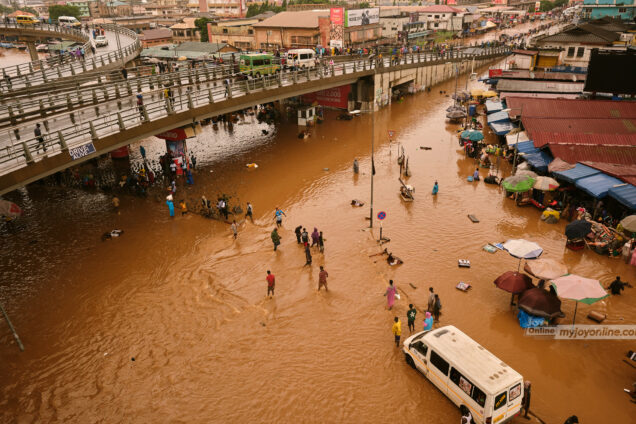
The statement comes after torrential rains triggered widespread flooding across the capital, leaving at least 12 people dead, thousands displaced and extensive damage to homes, businesses and public infrastructure.
The engineers proposed a comprehensive package of interventions spanning immediate, medium and long-term actions aimed at improving flood resilience, urban planning, drainage infrastructure and environmental management.
National priority
Among the key recommendations is a call for government to treat the rehabilitation of the Odaw River and Korle Lagoon drainage system as a national priority.
The institution urged authorities to commission an independent review of the Korle Lagoon restoration works and the Odaw outfall to identify engineering bottlenecks contributing to flooding, even during relatively dry periods, before undertaking urgent repairs.
The engineers also recommended restoring dependable waste collection services across communities and enforcing sanitation by-laws to prevent indiscriminate dumping of refuse into drains and waterways.
"Get established collection back on a dependable schedule in every community, so that households are not forced to choose between costly informal collectors and the nearest gutter," the statement said.
It added that authorities should combine improved waste collection with strict enforcement against illegal dumping and structures obstructing drainage channels.
"This is a problem we can actually solve, but only if we treat collection as an essential service and enforcement as a standing duty, not a seasonal campaign," it emphasised.
Roads and drainage
GhIE further called for the formal integration of the Department of Urban Roads and the Ghana Highway Authority into the country's flood response strategy.
It urged the government to audit, rehabilitate and routinely maintain roadside drains and culverts in flood-prone areas while ensuring that every new road project incorporates functional drainage infrastructure backed by dedicated maintenance budgets.
"A road built without a working drain is just a future flood channel," the statement warned.
Development controls
The institution proposed the adoption of a National Post-Development Runoff Control Policy to ensure that new developments do not increase stormwater runoff beyond natural levels.
It also advocated strict enforcement of planning regulations, including halting construction on waterways and wetlands, removing illegal structures obstructing major drains, protecting buffer zones and prohibiting full-plot paving.
"Stop building in the wrong places, and mean it," the engineers urged.
"This is the hardest step, because it touches powerful interests and uncomfortable permits. It is also the one that matters most, because no amount of engineering can save a city that keeps building over its own rivers."
Nature-based solutions
The statement also promoted nature-based approaches to flood management, recommending the creation of detention and retention ponds to temporarily store stormwater during heavy rainfall before releasing it gradually.
It further proposed pilot projects incorporating rain gardens, bioswales, soak-aways and retrofitted drainage systems in rapidly urbanising areas such as Ga East, Adenta, Kasoa, Weija and Spintex.
According to the institution, these projects would demonstrate practical and cost-effective approaches to reducing urban flooding.
To improve institutional coordination, GhIE recommended establishing catchment-based planning units with the authority to coordinate the numerous agencies responsible for stormwater management.
"You cannot defend a city neighbourhood by neighbourhood when the water doesn't respect any of those boundaries," the statement noted.
Long-term reforms
Looking beyond immediate interventions, the institution called for the adoption of a National Rainwater Harvesting Policy requiring new buildings to incorporate rainwater harvesting systems while encouraging owners of existing buildings to retrofit their properties.
It also advocated integrating flood resilience into all planning approvals so that every building permit and road project considers its impact on stormwater management.
In addition, GhIE urged a shift in drainage philosophy from rapidly channelling stormwater away to capturing, slowing, storing and absorbing rainfall close to where it falls.
The institution further stressed the need to cultivate a maintenance culture by empowering communities to keep drains clear, supporting local businesses involved in drainage maintenance and ensuring sustained funding for drain and waste management.
Action, not reports
Concluding its statement, the engineering body said Ghana's recurring flood disasters were not caused solely by heavy rainfall but by failures in planning, enforcement, waste management, drainage design and urban development.
"Ghana does not have a knowledge problem. We have an action problem," the statement declared.
"Today’s flood was not caused by rain alone. It was caused by how we plan, how we enforce our own laws, how we collect our waste, how we build and drain our roads, and how we move water through our city. Every one of those is within our power to change. We are simply choosing, year after year, not to."
Reflecting on previous flood disasters, including the June 3, 2015 tragedy and subsequent flooding episodes, the institution said engineers had consistently provided practical recommendations but implementation had remained weak.
"We have stood here before, after June 3, 2015, after 2020, after the floods of earlier this June. Each time we mourn, we promise, and we move on until the next rain."
"The engineers have written the reports. We know exactly why the city floods and exactly what to do about it."
It reaffirmed GhIE's readiness to collaborate with the Ministry of Works, Housing and Water Resources, the Greater Accra Regional Coordinating Council, Metropolitan, Municipal and District Assemblies and other relevant agencies to translate engineering proposals into practical solutions.
"The plans are written. The warnings have been given. What we need now is the will to act, before the next rain falls."
Latest Stories
-
Barcelona close to deal for Arsenal’s Jesus
2 hours -
Three-week international break a concern – Mourinho
2 hours -
Bellingham scores as Mourinho’s Real win again
2 hours -
Tech trouble leaves Chelsea game ref without comms
2 hours -
Wife of man who died after turbulence sues airline
2 hours -
Russia says it helped to repel Niger attempted coup
2 hours -
Michail Antonio helps young Ghanaians chase Premier League dreams
4 hours -
Zambian opposition leader charged with treason
4 hours -
Iceland votes against restarting EU membership talks
4 hours -
WhatsApp chat used to launder cash for crime and extremism
4 hours -
US judge blocks Pentagon’s Anthropic blacklisting
5 hours -
Tinubu files case in US court to block release of alleged drug trafficking record – Lawyer
5 hours -
‘Powder Guy’ denies $32,000 visa fraud charges
5 hours -
Two suspects arrested over lynching at Daboya
5 hours -
Mobile phones contributing to Christians’ spiritual decline – Bishop Patu
5 hours