

Audio By Carbonatix
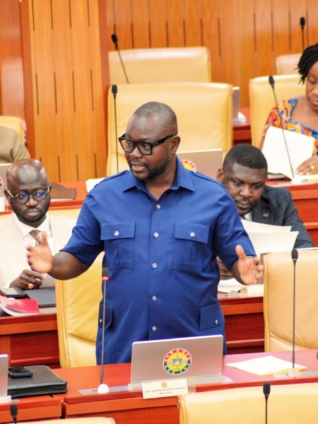
The Ranking Member on Parliament’s Select Committee on Local Government and Decentralisation, Francis Asenso-Boakye, has called on government to immediately declare a National Flood Emergency Preparedness Exercise in response to the recent devastating floods across the country.
Making a statement on the floor of Parliament on Tuesday, June 30, Mr Asenso-Boakye described the flooding incidents as a national emergency that requires urgent, coordinated, and proactive intervention to prevent further loss of lives and destruction of property.
The Bantama MP expressed deep sorrow over the tragic consequences of the recent heavy rains, extending his sympathies to families who lost loved ones as well as individuals whose homes, businesses, and livelihoods were severely affected.
The former Works and Housing Minister said he was deeply disturbed by videos circulating on social media showing helpless citizens being swept away by floodwaters, with others trapped in collapsing structures as bystanders watched in despair.
According to him, such heartbreaking scenes serve as a painful reminder that Ghana’s flood crisis can no longer be treated as a seasonal inconvenience.
“Flooding has become one of Ghana’s most persistent national challenges. This is not the time for political point-scoring. Floodwaters do not discriminate; they affect all Ghanaians alike,” he stated.
Mr Asenso-Boakye therefore urged government to institute a one-week National Flood Emergency Preparedness Exercise involving all key state institutions, including the Metropolitan, Municipal and District Assemblies (MMDAs), NADMO, the Hydrological Services Authority, and the security agencies.
He explained that the exercise should focus on desilting drains, clearing blocked waterways, removing obstructions from water channels, pre-positioning emergency response teams, and intensifying public education on flood preparedness and safety.
He noted that Ghana’s recurring flooding problem is driven by several longstanding factors, including inadequate drainage infrastructure, weak enforcement of planning regulations, poor sanitation, rapid urbanisation, and the growing effects of climate change.
The Ranking Member further stressed that flooding should never become an accepted feature of Ghana’s rainy season, insisting that the country already understands both the causes and solutions to the problem.
“What remains is the political will to sustain investment, enforce our planning laws, strengthen sanitation management and promote responsible citizenship,” he emphasized.
He concluded by calling for collective action from government, local authorities, communities, and citizens to reduce the devastating human and economic cost of floods and build safer, more resilient communities nationwide.
Latest Stories
-
Barcelona close to deal for Arsenal’s Jesus
1 hour -
Three-week international break a concern – Mourinho
1 hour -
Bellingham scores as Mourinho’s Real win again
2 hours -
Tech trouble leaves Chelsea game ref without comms
2 hours -
Wife of man who died after turbulence sues airline
2 hours -
Russia says it helped to repel Niger attempted coup
2 hours -
Michail Antonio helps young Ghanaians chase Premier League dreams
4 hours -
Zambian opposition leader charged with treason
4 hours -
Iceland votes against restarting EU membership talks
4 hours -
WhatsApp chat used to launder cash for crime and extremism
4 hours -
US judge blocks Pentagon’s Anthropic blacklisting
4 hours -
Tinubu files case in US court to block release of alleged drug trafficking record – Lawyer
4 hours -
‘Powder Guy’ denies $32,000 visa fraud charges
5 hours -
Two suspects arrested over lynching at Daboya
5 hours -
Mobile phones contributing to Christians’ spiritual decline – Bishop Patu
5 hours