


Audio By Carbonatix
Why Ghana needs a new architecture — GOGPO, EwRP and BSNC — to convert procurement from the nation's largest source of leakage into its largest lever for growth
Public procurement is the single largest channel of government expenditure in Ghana, absorbing an estimated 70 per cent of national annual budgets across Ministries, Metropolitan and Municipal Assemblies, Departments and Agencies (MMDDAs). It is also, on the evidence of successive Auditor-General reports, the channel most persistently exposed to irregularity, inefficiency and outright value leakage. In 2024 alone, the Auditor-General uncovered GH¢18.42 billion in public-sector financial irregularities — a 109 per cent jump on the prior year — of which GH¢2.8 billion was attributed to procurement and administrative infractions, with a further GH¢871.8 million lost specifically to contract-management breaches (Ghana Audit Service, 2025).
This article builds on two works by Dr. Kankson Kpentey, Head of Procurement at GCB Bank PLC and Executive Director of South-Western Pacific International Limited: a January 2023 media engagement with Joy Business calling for the wholesale reconstruction of Ghana's public procurement architecture, and a subsequent, more detailed November 2023 policy paper, “Reorchestration vs. Reconfiguration of Public Sector Procurement,” which sets out the full institutional design. Sequencing and elaborating on both, the article presents a technical blueprint: a new Government of Ghana Procurement Organisation (GOGPO), reporting to Parliament rather than the Finance Ministry, alongside a reconstituted, independent Public Procurement Authority; a complete governance organogram and category management tree; an Enhanced Public Procurement Act; a No-Budget-No-Procurement-No-PO-No-Payment Source-to-Pay control regime enforced through an Enterprise-wide Resource Planning (EwRP) platform; and a Breaches, Sanctions and Non-Compliance (BSNC) league table with a live, PowerBI-driven performance dashboard.
The article situates these recommendations against global, continental and regional benchmarks — the World Bank's estimate that public procurement equals 12–20 per cent of global GDP, the OECD's finding that 8–25 per cent of procured value is lost to mismanagement or corruption, and the African Union's Agenda 2063 and AfCFTA integration agenda — and against Ghana's own legal architecture under the Public Procurement Act, 2003 (Act 663) as amended by Act 914 (2016), and the Public Financial Management Act, 2016 (Act 921). It closes with a business-process-reengineering roadmap and an illustrative five-year GDP simulation showing the scale of the growth dividend available if procurement leakage is converted into productive public investment.
1. Introduction: Two Works, Sequenced
Speaking to Joy Business in a media engagement that forms the empirical and rhetorical spine of this article, Dr. Kankson Kpentey argued that Ghana's development and growth aspirations are being quietly eroded by an architecture of public procurement that was never designed for the scale of public spend it now carries. “There is the need for us as a people and government to reconstruct the architecture of procurement in the public sector space for optimal and consistent benefit realisation,” he told Joy Business, calling specifically for a legislated successor to the erstwhile Ghana National Procurement Agency (GNPA) concept — a Ghana Government Procurement Organisation (GOGPO) reporting to Parliament as appointing and reporting authority, rather than to the Finance Ministry, an executive arm of government.
Ten months later, in a more detailed policy paper titled “Reorchestration vs. Reconfiguration of Public Sector Procurement” (Kpentey, 2023, November 1), Dr. Kpentey extended that initial call into an implementable institutional design — a full governance organogram, a category management tree, a funding model, and a set of enforceable process controls. This article sequences both works: the January 2023 media engagement supplies the founding diagnosis and rationale, while the November 2023 policy paper supplies the structural detail — the organogram, the category tree, the Source-to-Pay control regime and the performance-reporting architecture — that renders the reconstruction implementable rather than aspirational.
This is not a marginal administrative preference. Because procurable expenditure constitutes roughly 70 per cent of national annual budgets, the way it is organised, governed and executed is, in effect, the way the state itself is organised, governed and executed. Every leakage point in the procurement value chain is a leakage point in the nation's capacity to build roads, equip hospitals, pay contractors on time and create jobs. The remainder of this article develops that thesis in seven moves: first, the audit evidence for the scale of the problem; second, the global economics of procurement leakage; third, continental and regional best-practice benchmarks; fourth, Ghana's current legal and institutional architecture; fifth, the technical reconstruction blueprint drawn from both works, including the full GOGPO organogram and category tree; sixth, a process-reengineering roadmap; and finally, an illustrative GDP simulation.
2. The Auditor-General's Evidence: A Widening, Not Narrowing, Gap
Dr. Kpentey's original media engagement drew on the 2021 and 2020 Auditor-General reports. “The sum of the irregularities and the financial attributions assigned in the 2021 Audit Report … was a circa GH¢17.5 billion, out of this Procurement, Stores and Contracts constituted a circa GH¢591 million, representing 3.4 per cent of the total irregularities reported,” he noted, adding that the comparable 2020 figures were GH¢12.9 billion in total irregularities, of which procurement, stores and contracts contributed GH¢947 million, or 7.4 per cent — improvement, on his reading, of roughly 118 per cent year-on-year in the procurement share.
Extending that same trend line to the most recent data materially changes the picture. Total irregularities fell to GH¢15.1 billion in 2022 and GH¢8.8 billion in 2023 — the low point of the five-year series and, at the time, a plausible signal that reforms were taking hold (Public Services Commission, 2024). That optimism did not survive 2024. The Auditor-General's report on the public accounts for the year ended 31 December 2024 recorded total irregularities of GH¢18,415,673,589 — a 109 per cent increase on 2023 — of which GH¢15.57 billion was classified as recoverable and GH¢2.84 billion as administrative infractions comprising procurement irregularities, delayed contract payments and undocumented stores (Ghana Audit Service, 2025; MyJoyOnline, 2025a).
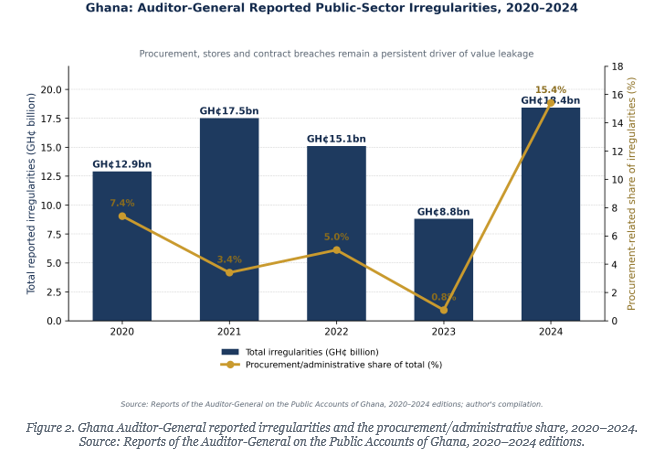
Three features of the 2024 report are especially instructive for the procurement-reconstruction argument. First, the energy sector — principally the Electricity Company of Ghana (ECG) — accounted for approximately 86 per cent of the year's total irregularities, including under-declared revenue of GH¢2.95 billion, an additional GH¢251 million paid to intermediaries instead of direct manufacturer procurement, and a GH¢75 million digital-collections contract executed without a signed agreement (BusinessDay Ghana, 2025; MyJoyOnline, 2025b). Second, contract-management irregularities alone — largely unpaid Interim Payment Certificates and unenforced contract clauses — reached GH¢871.8 million, the highest figure in the preceding six years (MyJoyOnline, 2025c). Third, and most tellingly for the institutional-design argument advanced below, the Auditor-General attributed the recurrence of these breaches not to gaps in the law but to poor internal controls, weak audit-committee oversight and “flagrant disregard” for existing statutes — the Public Procurement Act, the Public Financial Management Act and the Audit Service Act among them (MyJoyOnline, 2025a). That diagnosis is corroborated independently. IMANI Africa's third Fiscal Recklessness Index isolated GH¢4.9 billion in discrepancies among MDAs between 2021 and 2023, equal to roughly 2.36 per cent of GDP in 2023 alone, and found the Ministry of Finance itself — the body currently vested with procurement oversight under the Public Financial Management Act — carrying the highest recklessness score among all institutions assessed (Imani Africa, 2025). The coincidence of that finding with Dr. Kpentey's structural recommendation — that procurement oversight should shift from the Finance Ministry to a Parliament-facing GOGPO — is difficult to treat as accidental.
3. The Global View: Procurement Infractions as a Development-Finance Problem
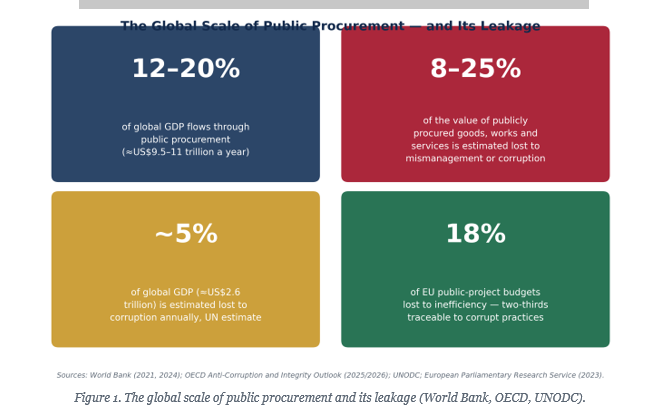
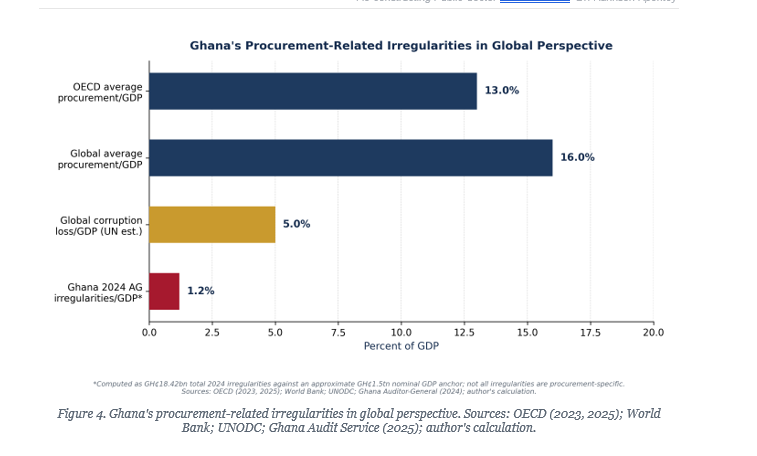
Ghana's experience is a national instance of a well-documented global pattern. Public procurement is, by some distance, the largest interface between the public purse and the private market: the World Bank estimates that it accounts for 12–20 per cent of global GDP, equivalent to roughly US$9.5–11 trillion a year, while the OECD puts the average procurement share of GDP among its member states at approximately 13 per cent (World Bank, 2020, 2024; OECD, 2023). That scale is precisely what makes procurement the sector of choice for corruption and mismanagement: the OECD's Anti-Corruption and Integrity Outlook estimates that 8–25 per cent of global public investment may be lost to mismanagement or corruption, while a European Parliamentary Research Service study cited in the same Outlook put the cumulative cost of corruption risk in EU procurement between 2016 and 2021 at approximately €29.6 billion (OECD, 2026).
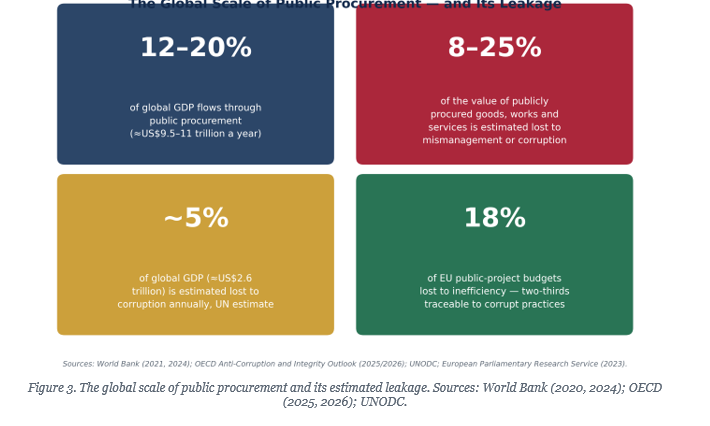
Independent estimates converge on a similar order of magnitude for corruption more broadly. The United Nations Office on Drugs and Crime and related analyses put annual bribery flows at approximately US$1 trillion and total corruption losses at roughly US$2.6 trillion, or about 5 per cent of global GDP (World Bank, 2024). The IMF's own bribery-specific estimate is more conservative, at approximately 2 per cent of global GDP, but its broader finding is arguably more relevant to the Ghanaian case: countries perceived as less corrupt collect, on average, 4 per cent of GDP more in tax revenue than equally developed peers with high corruption, and a coordinated global reduction in corruption could recover on the order of US$1 trillion — 1.25 per cent of global GDP — in lost tax revenue (Mauro, 2019).
Two implications follow directly for the Ghanaian debate. First, procurement leakage is not principally a governance-ethics problem to be solved through exhortation; it is a public-finance and growth problem that responds to institutional redesign, digitisation and enforcement — the IMF specifically credits electronic procurement systems in Chile and Korea with materially curtailing corruption (Mauro, 2019). Second, the fiscal upside of closing the gap is large enough to matter at the macroeconomic level, which is the premise underlying the five-year GDP simulation presented in Section 9 of this article.
3.1 Anti-Corruption Architecture as Growth Infrastructure
The consistent theme across the World Bank, OECD and IMF literature is that corruption and procurement mismanagement act as a tax on investment and a brake on growth: they deter capital formation, exacerbate inequality, raise the effective cost of public services and erode institutional trust (Baker Tilly, 2026; OECD, 2020). Infrastructure projects are disproportionately exposed because their scale, uniqueness and long delivery horizons make cost inflation and bribery harder to detect — a pattern that maps closely onto Ghana's own experience, where energy-sector and large-infrastructure contracts account for the overwhelming share of recent Auditor-General findings. The policy corollary, echoed by the OECD's integrity guidance, is that procurement reform should be treated as growth infrastructure in its own right, not merely as a compliance exercise bolted onto existing budget processes.
4. Continental and Regional Benchmarks: Where Ghana Sits
At the continental level, the African Union's Agenda 2063 — the fifty-year development blueprint adopted by African Heads of State — explicitly identifies harmonised, transparent and efficient public procurement as an enabler of the industrialisation and infrastructure connectivity goals that sit at the heart of the agenda (African Union, n.d.). The African Continental Free Trade Area (AfCFTA), operational since 2021 and headquartered in Accra, adds a further layer of urgency: as intra-African trade in goods, services and government contracts deepens, the competitiveness of a member state's public procurement system — its transparency, its digitisation, its dispute-resolution credibility — becomes a determinant of whether that state's firms can compete for regional public contracts at all (Africa Center for Strategic Studies, 2026).
Sector-specific research on green public procurement across four African economies — South Africa, Zambia, Kenya and Ghana — found Ghana still at the pilot stage of institutionalising sustainability criteria in public buying, trailing South Africa and Zambia's more advanced regulatory mandates and Kenya's sectoral integration in infrastructure and energy procurement (Panya & Ochiri, 2025). The consistent continental diagnosis — weak enforcement mechanisms, limited supplier capacity, thin monitoring systems and low professional awareness — mirrors, almost point for point, the domestic diagnosis in Section 2 above, reinforcing the case that Ghana's procurement challenge is not sui generis but a locally acute instance of a continental pattern that regional harmonisation efforts are only beginning to address.
4.1 Global Legal and Normative Reference Points
Ghana's own procurement statute sits within a recognisable global family of reform. The UNCITRAL Model Law on Public Procurement — the United Nations' template instrument, revised in 2011 and used as a drafting reference by dozens of jurisdictions — and the OECD Recommendation on Public Procurement both converge on the same design principles that Dr. Kpentey's recommendations independently echo: consolidated institutional accountability, transparency and competition in tendering, life-cycle value-for-money assessment rather than lowest-price-only evaluation, and mandatory use of electronic procurement platforms to create an auditable digital trail. Multilateral development banks — the World Bank and the African Development Bank among them — apply harmonised procurement frameworks to the projects they finance in Ghana that already impose many of these disciplines on a project-by-project basis; the GOGPO proposal, in effect, asks Ghana to generalise those disciplines across the whole of domestically financed procurement rather than confining them to donor-funded projects.
4.2 Where Ghana Sits on the Benchmark
Set against these benchmarks, and against Ghana's own approximate GH¢1.5 trillion nominal GDP anchor for 2026, the 2024 Auditor-General irregularities figure of GH¢18.42 billion equates to roughly 1.2 per cent of GDP — smaller in relative terms than the global 5 per cent corruption-loss estimate, but concentrated overwhelmingly in a small number of state-owned enterprises and large contracts, which is precisely the profile the global literature identifies as most responsive to institutional and digital reform.
5. Ghana's Current Legal and Institutional Architecture
Ghana's procurement governance has progressed through three recognisable eras, a trajectory Dr. Kpentey traced directly in his media engagement: from an era in which public procurement was “not effectively coordinated and regulated,” through the establishment of a Public Procurement Board, to the elevation of that Board into a full Public Procurement Authority (PPA) under the Public Procurement Act, 2003 (Act 663), subsequently strengthened by the Public Procurement (Amendment) Act, 2016 (Act 914). “We can also confidently state that the control environment has improved to some extent,” he observed, “despite isolated reported infractions and irregularities with some financial attributions to same” — a qualified endorsement that the audit evidence in Section 2 substantially confirms, and substantially complicates.
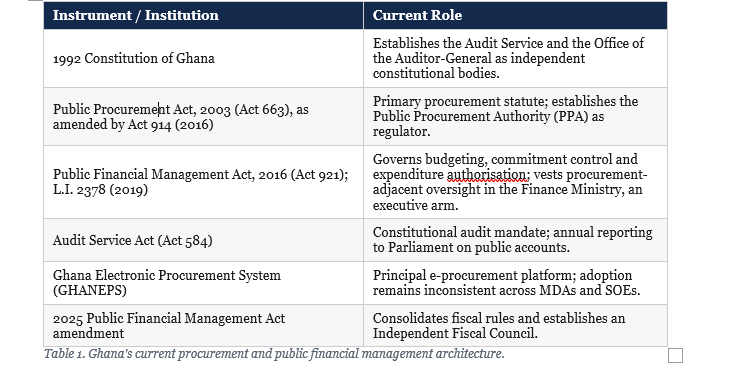
That statutory framework sits alongside the Public Financial Management Act, 2016 (Act 921) and its implementing Public Financial Management Regulations, 2019 (L.I. 2378), which together govern budgeting, commitment control and expenditure authorisation across MMDDAs, and the Audit Service Act, 1993 / 2000 (Act 584), which establishes the Auditor-General's constitutional mandate to audit and report annually to Parliament on the public accounts. The Ghana Electronic Procurement System (GHANEPS) represents the state's principal digitisation vehicle to date, intended to route public procurement through an auditable online platform; yet the 2024 Auditor-General report repeatedly cites entities — including the National Lottery Authority, the Ghana Library Authority and the Bulk Oil Storage and Transportation Company — for failing to route procurement through GHANEPS at all (MyJoyOnline, 2025b; Ghana Audit Service, 2025).
5.1 A Framework Under Repair, Not Yet Reconstructed
Policy movement continues. A 2025 amendment to the Public Financial Management Act consolidated and repealed the earlier Fiscal Responsibility Act, embedding fiscal rules and creating an Independent Fiscal Council within a single statute, and IMANI Africa's parallel policy work has pressed for automated data links between the Ghana Revenue Authority, state utilities and commercial banks, alongside mandatory integration of high-value contracts into the Ghana Integrated Financial Management Information System (GIFMIS) (Imani Africa, 2025). These are welcome, incremental repairs. What they are not, on the evidence Dr. Kpentey advances and this article develops, is a reconstruction of the underlying institutional architecture — the question of who owns end-to-end execution authority for procurement, to whom that authority reports, and what enforceable consequence attaches to non-compliance.
6. Diagnosis: Why Public and Private Sector Procurement Diverge
Asked by Joy Business what accounts for the persistent performance gap between public and private sector procurement, Dr. Kpentey was candid about the limits of available data: “there is not available particular data to effect such substantiation, but one may infer based on experiences given from practitioners' perspectives across the sectors.” His inference, framed around six comparative key result areas — strategy, regulation and standards, compliance frameworks, operating model, spend complexity, and size — is nonetheless a useful diagnostic lens, and one this article adopts.
“Public Sector Procurement (PuSP) has a highly decentralised operating model and is governed by a parliamentary act, whereas matured Private Sector Procurement (PrSP) operating frameworks in terms of policy and governance standards are more agile and centrally aligned … PrSP Operating Policies and Governance Regimes are generally localised and dynamic, employing technology platforms to deliver high operational performance and continuous improvement across the Procurement value chain.” — Dr. Kankson Kpentey, Joy Business media engagement
The practical consequence of this divergence is that private-sector procurement functions typically concentrate execution authority, spend visibility and technology investment in a single accountable structure, even within decentralised multinational or matrix organisations, whereas Ghana's public procurement remains fragmented across dozens of MMDDAs with uneven capacity, uneven digitisation and uneven enforcement of the same statute. That fragmentation is precisely what the GOGPO model set out in Section 7 is designed to correct — not by centralising political control over what is bought, but by centralising execution capability, category expertise and technology investment while leaving budget ownership and planning with the MMDDAs themselves.
7. The Reconstruction Blueprint
The technical core of this article rests on four interlocking recommendations, first advanced in Dr. Kpentey's January 2023 media engagement and subsequently developed into a full institutional design in his November 2023 policy paper, “Reorchestration vs. Reconfiguration of Public Sector Procurement”: a re-legislated institutional home for procurement execution (GOGPO), alongside a reconstituted, independent procurement regulator; a control regime that makes unbudgeted spending structurally impossible; a technology platform that operationalises that control; and a transparency-and-accountability mechanism that makes non-compliance visible and costly. Each is developed below, with the organogram and category management tree reproduced in refined form as Figures 5 and 7.
7.1 The Current Operating Model and Why It Fails
The November 2023 policy paper is more explicit than the earlier media engagement about the mechanics of the current model's failure. Public sector procurement today is decentralised to the level of individual MMDAs, each operating its own procurement department under the umbrella of the Public Procurement Act, 2003 (Act 663) as amended by Act 914 (2016), with the regulatory authority reporting into the Finance Ministry under the construct of the Public Financial Management Act (Act 921). Dr. Kpentey's diagnosis of why this fails is blunt: a “defective and deficient execution mandate, lacking central authority, autonomy, control and performance accountability regarding the effective and efficient conduct of procurement across MMDAs,” with “undue political interference significantly accounting for this.”
Two further mechanisms compound the institutional gap. First, the current construct “lacks self-empowering capability that engender[s] conducting procurement strategically, in a professional fashion and in line with best practices” — in other words, forty-odd fragmented MMDA procurement units cannot individually build the category expertise, market intelligence or negotiating scale that a consolidated function could. Second, and more troublingly, the paper identifies a governance pathology of “employer–employee abuse of power vs. fiduciary obligation vs. undue political influences in the conduct of procurement delivery, significantly resulting in the reported annual inefficiencies, spend leakages and budget overruns” — a description that aligns precisely with the Auditor-General's own attribution of the 2024 spike in irregularities to poor internal controls and “flagrant disregard” for existing statutes (Section 2 above). The reconstruction blueprint that follows is designed to address both mechanisms simultaneously: centralising execution capability while removing the political-interference channel through Parliamentary, rather than executive-ministry, oversight.
7.2 A Government of Ghana Procurement Organisation (GOGPO) and a Reconstituted PPA
“An enhanced reconfiguration of the erstwhile Ghana National Procurement Agency (GNPA) framework is required, wherefore a new legislation be instituted, establishing a Ghana Government Procurement Organisation (GOGPO) with responsibility to the Parliament of Ghana … rather than the Finance Ministry, which is an executive arm of government, as subtly prescribed in the Public Financial Management Act (Act 921).” — Dr. Kankson Kpentey, Joy Business media engagement, January 2023
The November 2023 policy paper refines this into a two-body model. First, a second amendment of the Public Procurement Act would reconstitute the existing Public Procurement Authority as an independent ‘New PPA’, reporting to Parliament rather than the Finance Ministry, but subject to parliamentary checks and balances — retaining its regulatory and standard-setting role. Second, and separately, execution of public sector procurement would be centralised into a new “Enlarged Entity”, the Government of Ghana Procurement Organisation (GOGPO), which would also report to Parliament rather than the Finance Ministry, deepening and centralising authority over procurable spend and sourcing pipelines, control and performance accountability. The New PPA and GOGPO are therefore deliberately distinct: one regulates, one executes, and both are answerable to the legislature rather than to a single executive ministry that is itself a major procuring entity.
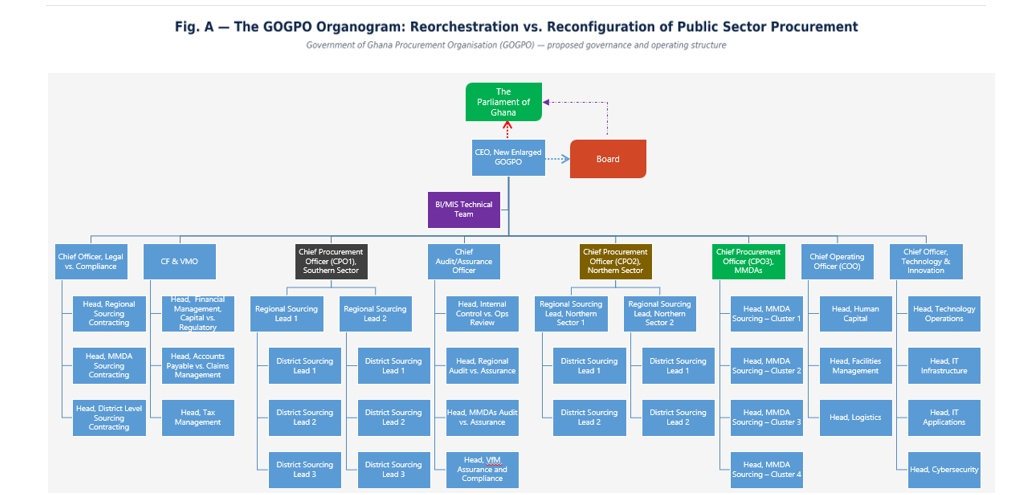
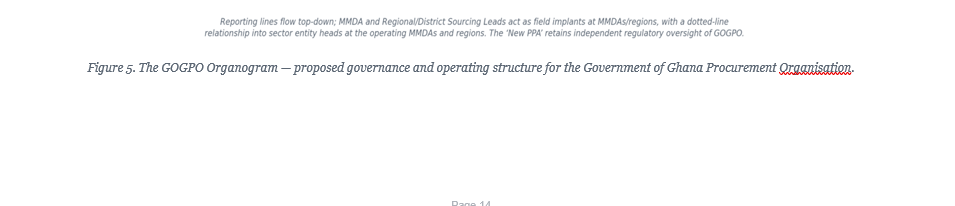
GOGPO's governance is structured around a Board and a Chief Executive Officer, with Directors of Procurement organised by sourcing category and by sector or MMDA grouping, each with sector-specific sourcing leads operating under a category management regime. A dedicated Directorate for Regional Sourcing extends this structure to Regional and District Procurement Leads, who act as implants embedded at the respective MMDAs and regions — reporting formally into the MMDA and Regional Directors of Sourcing at GOGPO head office, while maintaining a dotted-line relationship with the sector entity heads at the operating MMDAs and regions they serve. The full structure is set out in Figure 5.
Critically, and as Dr. Kpentey was careful to specify in both the media engagement and the policy paper, this is not a recommendation to centralise budgeting: MMDAs retain the obligation to plan and budget for their own annual procurable requirements, both Capex and Opex, and then transition those plans to GOGPO to execute procurement and strategic sourcing from start to finish. Demand planning remains a MMDA responsibility; execution, sourcing strategy and category expertise are consolidated centrally.
Funding and staffing model
The policy paper is specific about how the ‘Enlarged GOGPO’ would be capitalised and staffed. GOGPO would receive initial paid-up capital and, for at least the first five years, annual operating budgetary funding from the Government of Ghana via a dedicated budgetary allocation. Thereafter, GOGPO would transition to running its own balance sheet, generating income through a sustainably structured Master Services Framework with an embedded services-fee regime — for example, time-and-materials, retainership or fixed-fee-per-transaction arrangements — charged to MMDAs for the provision and conduct of procurement services. All GOGPO employees, whether existing staff transferred from current procurement units, migrated personnel, or new hires, would draw their salaries, benefits and emoluments from GOGPO itself, reinforcing the single-employer accountability line the current fragmented model lacks.
7.3 The GOGPO Organogram
Figure 5 reproduces, in refined form, the proposed GOGPO organogram: Parliament as appointing and reporting authority; a Board and Chief Executive Officer supported by a BI/MIS technical team; and eight executive pillars — Legal & Compliance, Finance & Vendor Management, two geographic Chief Procurement Officers for the Southern and Northern sectors, Audit/Assurance, a Chief Procurement Officer for MMDA clusters, Operations, and Technology & Innovation — each cascading into functional heads and, for the geographic CPOs, Regional and District Sourcing Leads. The ‘New PPA’ sits alongside Parliament as an independent regulator exercising checks and balances over GOGPO, rather than forming part of its management chain.
7.4 No-Budget-No-Procurement-No-PO-No-Payment: The Source-to-Pay Control Regime
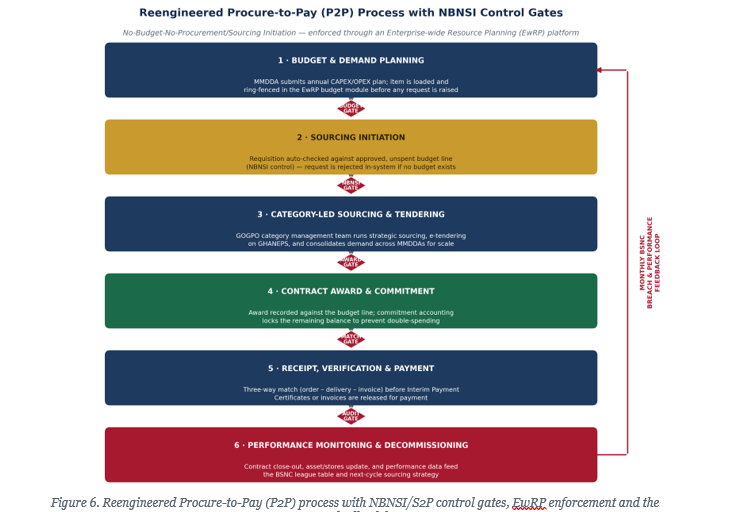
The second pillar is a control regime, not merely a policy statement. The original media engagement called this a No-Budget-No-Procurement/Sourcing Initiation (NBNSI) regime; the November 2023 policy paper tightens it into a four-stage rule: “A NO BUDGET vs. NO PROCUREMENT vs. NO PO vs. NO PAYMENT Regime shall be instituted as a critical protocol for sourcing initiation.” Every sourcing initiation must trace its source to the system-uploaded annual plan and budget, matched against a unique budget-item code tied to the MMDA's unique spend ID — meaning a procurement requisition cannot be raised, a purchase order cannot be issued, and an invoice cannot be paid, unless each prior gate has cleared against an approved, unspent budget line inside the platform. This single control, rigorously enforced across what the policy paper terms the Source-to-Pay (S2P) cycle, would have pre-empted a meaningful share of the specific 2024 Auditor-General findings — including procurements executed outside approval thresholds and goods and services procured without any budget authorisation trail (Ghana Audit Service, 2025).
The policy paper adds two governance refinements that materially strengthen the original NBNSI proposal. First, Annual Procurement Plans (APPs) must be submitted, reviewed and approved entirely on the system — “no manual transmission of APPs from MMDAs shall apply” — closing the paper-based workaround that currently allows unplanned spending to enter the system informally. Second, exceptions to competitive tendering are subjected to an additional legislative check: justification for Single or Selective Tendering requires review and approval by a proposed Parliamentary Select Committee on National Procurement (PSCoNP), which then makes a recommendation to the New PPA; the New PPA itself would have no mandate to approve Selective, Single or Sole Sourcing without prior PSCoNP approval, and such sourcing could only be initiated by an MMDA through GOGPO once that governance process concludes. Emergency Procurement follows a parallel, faster track — a Prior or Advance Event Note to the PSCoNP alongside execution, followed by a Post-Event Note for ratification — with both notes filed on the same digital platform, ensuring even urgent, uncompetitive procurement leaves a complete, auditable governance trail rather than an informal one.
7.5 The Enterprise-wide Resource Planning (EwRP) Platform
EwRP is the technological substrate that makes the Source-to-Pay control regime, category management and BSNC reporting operationally real rather than aspirational. The policy paper is explicit that this need not mean building an entirely new system: “an enhanced ERP System whether or not GIFMIS vs. GHANEP, had to be repurposed and deployed to effectively manage procurement across the Procure-to-Pay (P2P) cycle” — that is, GOGPO's technology strategy should enhance and integrate Ghana's existing GIFMIS and GHANEPS platforms rather than duplicate them. On that repurposed platform, MMDAs would use a dedicated annual planning and budgeting utility to capture their annual procurement plans and budgets (APB); the Finance Ministry would extract that MMDA-level data directly from the system to compile the final national budget; the approved national budget, with its detailed breakdown structure and unique codes, would be uploaded back onto the platform grouped per MMDA and region; and cash cover together with Finance Ministry clearance for all Capex spend would be initiated, reviewed, approved and released through the same system before any procurement process could commence.
End to end, the platform would standardise tender issuance through predetermined standard templates, capture bid and proposal submissions and evaluation results with recommendations routed for system-based review and approval, and record contract award and regret notifications to unsuccessful vendors — with supplier selection and sourcing-method justification likewise submitted through the system for the New PPA to review and approve as formal Service Requests. A built-in escalation matrix would enforce service-delivery turnaround times, and procurement and sourcing leads at every MMDA would work from a system-generated task pane reflecting exactly what falls within their category mandate.
7.6 Category Management: The Category Tree
Operationally, GOGPO would organise around category management and strategic sourcing disciplines — grouping similar spend under dedicated category teams with market expertise, consolidated demand data and negotiating leverage. “Leveraging category management and effective strategic sourcing regimes … will enable procurable budgets vs. spend visibility, reduce variety, and consolidate volumes to capitalise on scale to create and deliver sustainable value, while fostering competition, transparency, accountability and economy,” Dr. Kpentey noted in the original media engagement. The November 2023 policy paper operationalises this into a full two-level category tree: nine top-level (L1) categories — spanning IT; Civil Works and Construction; Power, Electricals and Engineering; Services and Consultancy; Logistics, Travel and Protocols; General Office Appliances and Equipment; Real Estate and Facility Management; Office Furniture, Fixtures and Fittings; and Physical Security and Surveillance — each broken into specific L2 sourcing sub-categories, reproduced in refined form in Figure 7. As the paper notes, the tree is illustrative rather than exhaustive: GOGPO would review, align and adapt it to each MMDA's specific operating needs, and the GOGPO organogram in Figure 5 is explicitly designed to mirror this category structure through its sector-based Chief Procurement Officer roles.
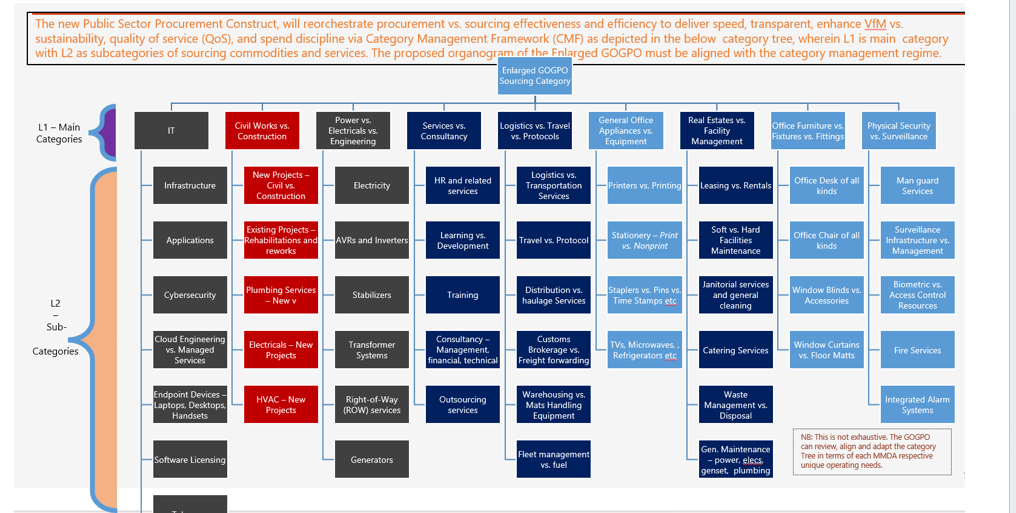

7.7 Breaches, Sanctions and Non-Compliance (BSNC): Key Result Areas and the Live Dashboard
The fourth pillar closes the loop between control and consequence. “Under this recommended construct, a Breaches and Noncompliance Reporting and League Table/Dashboard must be an obligatory monthly performance reporting structure and a KPI for the new organisation and all MMDDAs,” Dr. Kpentey specified in the media engagement. The November 2023 policy paper converts this into a defined quarterly reporting obligation across eight Key Result Areas: compliance and assurance; sanctions and recoveries; a breaches-versus-remediation league report; budget performance against savings; cost efficiency and value-for-money initiatives implemented; sustainability; contracting and contract management; and customer experience, tracked via a Net Promoter Score (NPS) scorecard — alongside further KPIs to be determined over time.
Beyond the quarterly report, the paper calls for a Live Procurement Conduct Dashboard covering all in-flight capital and operating procurement projects, published using PowerBI visualisation capability and fed directly from the ERP system (whether GIFMIS- or GHANEPS-based). This would give real-time, continuous visibility — not merely an annual, retrospective one — to spend-controlling officers, project owners, procurement beneficiaries and the general public alike. Combined with an enforceable sanctions regime for confirmed breaches, this is designed to shift procurement governance from an annual audit-and-explain cycle to a continuous compliance-and-correct cycle, converting the Auditor-General's yearly finding into a standing, publicly visible management discipline.
8. Business Process Reengineering Framework and Implementation Roadmap
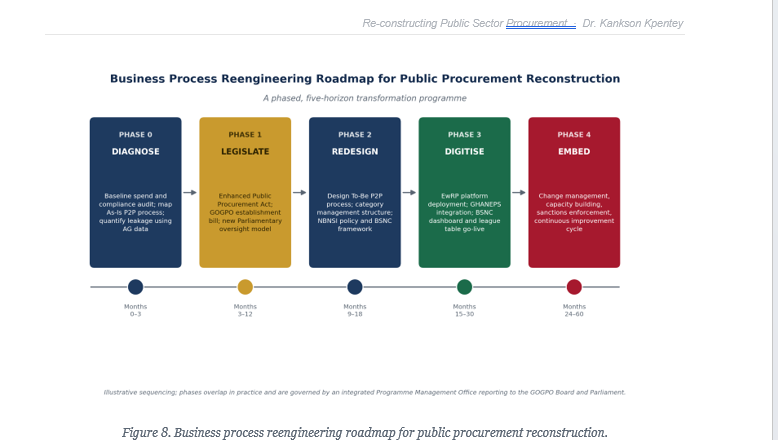
Legislating GOGPO into existence is a necessary but insufficient condition for success. Every comparable public-sector transformation — in Ghana and elsewhere — has foundered as often on sequencing and change management as on the underlying policy design. The roadmap below sets out a five-phase business process reengineering (BPR) programme, moving from diagnosis through legislation, process redesign, digitisation and institutional embedding, with phases deliberately overlapping rather than strictly sequential.
8.1 Phase Detail
- Diagnose (Months 0–3): Commission a baseline spend and compliance audit across MMDDAs; map the As-Is Procure-to-Pay process end-to-end; quantify current leakage using Auditor-General data as the empirical baseline against which future BSNC performance will be measured.
- Legislate (Months 3–12): Draft and pass the Enhanced Public Procurement Act and the GOGPO establishment bill; define the Parliamentary appointment, reporting and removal procedures for the GOGPO Board and Chief Executive; amend the Public Financial Management Act to remove the residual procurement-execution role of the Finance Ministry.
- Redesign (Months 9–18): Design the To-Be P2P process with embedded NBNSI control gates (illustrated in Figure 6); stand up category management structures and recruit category leads; finalise BSNC sanctions schedules and league-table methodology in consultation with the Public Procurement Authority and the Audit Service.
- Digitise (Months 15–30): Procure and deploy the EwRP platform; integrate it with GHANEPS and GIFMIS rather than duplicating them; pilot the NBNSI budget-gate control in two or three large-spend MMDDAs before national roll-out; launch the BSNC dashboard in parallel.
- Embed (Months 24–60): Run sustained change-management and capacity-building programmes for procurement officers across MMDDAs; enforce the sanctions regime against confirmed breaches without exception; institutionalise a continuous-improvement cycle in which BSNC data feeds back into category strategy and sourcing decisions.
Governance of the programme itself matters as much as its content. A dedicated Programme Management Office, reporting jointly to the GOGPO Board (once established) and, in the interim, to a Parliamentary oversight committee, should hold end-to-end accountability for sequencing, budget and risk — mirroring the same principle of consolidated, accountable execution authority that underlies the GOGPO model itself.
9. Economic Simulation: GDP, Growth and Development Impact, 2026–2031
Ghana's macroeconomic position provides a credible anchor for a forward-looking simulation. The 2026 Budget projects nominal GDP of approximately GH¢1.5 trillion with real growth of 4.9 per cent, following real GDP expansion of 5.8 per cent in 2024 and roughly 6 per cent in 2025, and an IMF-consistent medium-term growth path converging toward the economy's estimated potential rate of about 5 per cent per annum as macroeconomic stability is consolidated (EY, 2025; World Bank, 2026; IMF, 2025). Ghana's nominal GDP in US-dollar terms reached an estimated US$118.3 billion in 2026, making it the continent's eighth-largest economy (Citinewsroom, 2026).
Against that baseline, the simulation below models two illustrative scenarios rather than a formal econometric forecast. The Baseline path simply extends the government's own stated growth trajectory with no additional procurement dividend. The GOGPO Reform scenario assumes that a portion of the GH¢ billions in annual procurement-related irregularities and leakage identified by the Auditor-General — of the order of 1.0–1.5 per cent of GDP on the 2024 evidence — is progressively recovered and productively reinvested as GOGPO, EwRP and BSNC mature, lifting real growth by an additional 0.2 percentage points in the first full year of implementation, rising in phased steps to approximately 1.0 percentage point by year five as institutional capability and category-management maturity compound.
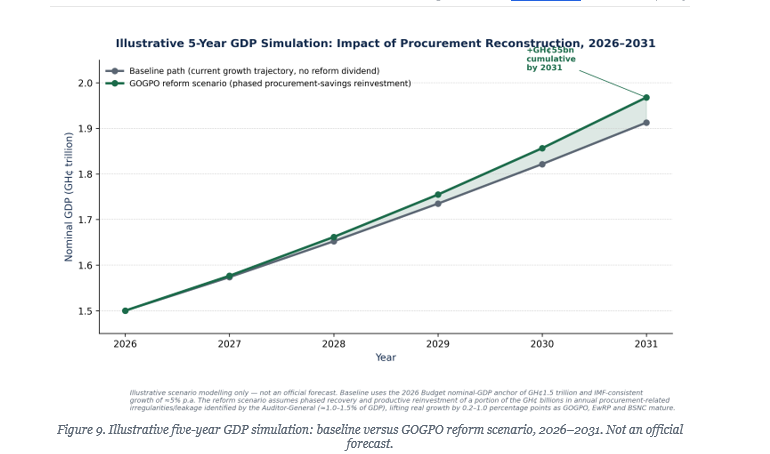
forecast.
On these illustrative assumptions, the reform scenario would generate a cumulative nominal GDP dividend of approximately GH¢55 billion by 2031 relative to the baseline path — fiscal space equivalent, on 2024 audit evidence, to roughly three years of total procurement-related irregularities being converted into productive investment rather than value leakage. The mechanism through which this dividend would materialise is precisely the one the OECD and IMF literature identifies as most effective globally: consolidated execution authority, mandatory electronic procurement, and enforceable consequence for non-compliance (Mauro, 2019; OECD, 2026).
9.1 Methodological Caveats
- This is a scenario illustration, not a general-equilibrium forecast; it does not model exchange-rate, inflation, fiscal-financing or sectoral feedback effects in detail.
- The reform dividend is modelled as an additive growth-rate effect phased in over five years to reflect realistic institutional build-out time, consistent with the implementation roadmap in Section 8.
- Actual outcomes will depend on the pace of legislative passage, EwRP procurement and deployment timelines, and — critically — the consistency of sanctions enforcement under the BSNC regime, which the Auditor-General's own reports repeatedly identify as the weakest link in Ghana's current control environment.
- The simulation should be read as an order-of-magnitude illustration of why procurement reconstruction is a growth-policy question, not solely a public-financial-management or anti-corruption question.
10. Risk and Governance Safeguards
No institutional redesign of this scale is risk-free, and a credible article should say so plainly. Four risks deserve explicit safeguarding in the enabling legislation.
- Concentration risk: consolidating execution authority in a single body raises the stakes of any single point of failure or capture. The Parliamentary reporting line, combined with mandatory publication of the BSNC league table and continued independent Auditor-General oversight, is designed as a countervailing check — but the enabling Act should also entrench fixed-term, for-cause-only removal provisions for the GOGPO Board to insulate it from short-term political interference in either direction.
- Transition risk: any large public institution reform carries execution risk during the changeover period. The phased roadmap in Section 8 is deliberately sequenced to pilot NBNSI and EwRP in a small number of MMDDAs before national roll-out, precisely to surface and correct implementation problems at manageable scale.
- Capacity risk: category management and strategic sourcing are specialist disciplines in short domestic supply. A dedicated capacity-building and professional-certification track, potentially delivered in partnership with tertiary and professional-training institutions, should run in parallel with Phase 2 and Phase 3 of the roadmap.
- Data and cyber-security risk: an EwRP platform consolidating government-wide spend data is a high-value target. Its design must meet, at minimum, the data-protection and cyber-security standards Ghana already applies to GIFMIS and GHANEPS, with independent security audits built into the digitisation phase.
11. Conclusion: From Annual Audit Finding to Continuous National Advantage
Ghana does not lack procurement law; it lacks a procurement architecture matched to the scale, complexity and consequence of the spending that law is meant to govern. The Auditor-General's reports — read across 2020 to 2024 — tell a consistent story of a control environment that improves in some years and deteriorates sharply in others, precisely because the underlying institutional design has not changed even as the scale of public spend and the sophistication of the risks it carries have grown. “Both public and private sector organisations must take steps to reconfigure how they operate in terms of procurement conduct, and regard procurement as a strategic role within the construct of the entire enterprise operating model,” Dr. Kpentey urged in closing his media engagement — language this article has sought to translate from strategic principle into implementable institutional design.
The way forward, as Dr. Kpentey framed it, runs through the country's ongoing constitutional review process as an opportunity to reconstruct the architecture of public procurement by new legislation; the acceleration of an EwRP technology platform to execute that legislation in practice; the operationalisation of the BSNC framework with quarterly public reporting and remediation; and an accompanying procurement performance management and benefit-realisation regime. Taken together, these measures are designed to do more than reduce next year's Auditor-General finding — they are designed to convert Ghana's largest channel of public expenditure from its most persistent source of leakage into a deliberate, continuously managed lever for enhanced value for money, accelerated national development and inclusive economic growth.
Latest Stories
-
Tinubu files case in US court to block release of alleged drug trafficking record – Lawyer
2 hours -
‘Powder Guy’ denies $32,000 visa fraud charges
2 hours -
Two suspects arrested over lynching at Daboya
2 hours -
Mobile phones contributing to Christians’ spiritual decline – Bishop Patu
2 hours -
Government to develop 150-acre air cargo hub at Tamale Airport – Goosie Tanoh
2 hours -
Stronger GRA digital systems needed at ports – IEAG
3 hours -
24-Hour Economy Secretariat brokers $270m poultry project to cut chicken imports
3 hours -
Ghana attaches particular importance to sustainable African-owned financing of peace – Mahama
3 hours -
Ho to establish first public college of education – MCE announces
3 hours -
“We are one house – let’s settle this at home” – Atomaase Royal family calls for unity, rallies behind Twafohene
3 hours -
Job advertisements increase 45 per cent year-on-year in June – BoG
3 hours -
The Missing Middle and the Overlooked Small: Why Ghana Must Serve Both the ‘S’ and ‘M’ in MSME’s
3 hours -
African Union Extraordinary Summit: Ghana welcomes Luanda Action Plan
3 hours -
Mahama returns from Angola after AU extraordinary summit
4 hours -
Ghana qualifies for quarterfinals of Africa Volleyball Nations Cup after beating Zambia
4 hours