

Audio By Carbonatix
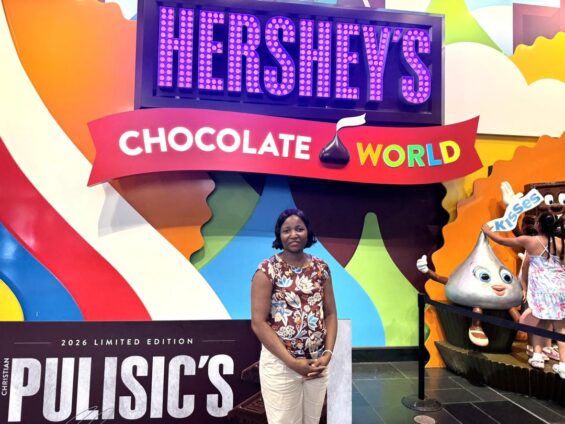
A recent visit to Hershey, the chocolate town in Pennsylvania, United States, popularly branded as “The Sweetest Place on Earth,” left me reflecting deeply.
The story of Hershey begins thousands of miles away in the cocoa farms of Ghana and Côte d’Ivoire, which together produce most of the world’s cocoa. Yet while the beans are grown in West Africa, much of the value they generate is created elsewhere.
For more than a century, Hershey has grown into one of the world’s most iconic chocolate companies. Today, much of the cocoa that fuels its success comes from Ghana and Côte d’Ivoire, a powerful reminder that although the beans originate in Africa, much of the wealth they create is realized elsewhere.
As a development practitioner working at the intersection of partnerships, communications, and resource mobilization, I have spent time in remote cocoa growing communities in Ghana, where I have seen firsthand the hard work of farmers who produce one of the world’s most sought-after commodity, yet receive only a small fraction of its economic value.
Hershey is not just a chocolate company. It is an ecosystem built around manufacturing, tourism, entertainment, and globally recognized brands. This transformation was driven by the vision of Milton Hershey, who saw chocolate not merely as a product, but as a catalyst for economic opportunity and social impact. Today, attractions such as Hersheypark, which spans 121 acres, reflect how this vision has evolved into a thriving destination.
His legacy extends beyond business through the Milton Hershey School, which provides education, housing, healthcare, and other essential services to more than 2,000 children from lower income families each year at no cost.
In 2025, the Hershey Company generated nearly US$12 billion in sales, while the broaderHershey ecosystem, including amusement park experiences, hotels, restaurants, museums, botanical gardens, a zoo, theatre, and live entertainment venues, supports a much larger local economy built around cocoa.
This raises a fundamental question: why are cocoa producing countries still capturing so little value?
The solution is simple: export more value. By scaling up processing into chocolate, cocoa butter, cosmetics, and other high value products, African countries can capture more of the cocoa economy. Beyond this, cocoa can power broader ecosystems, from tourism and culinary experiences to innovation and entrepreneurship, creating jobs far beyond farming.
Hershey shows that prosperity comes not from resources alone, but from transforming them into industries, brands, and experiences. For Africa, this requires investment in infrastructure, manufacturing, and skills, along with policies that support local industry. It also presents a clear opportunity for private investors. With the right partnerships and long-term vision, Africa’s cocoa sector can deliver both strong returns and meaningful development impact.
Ghana and Côte d’Ivoire have supplied the world with premium cocoa for generations. The next chapter must be about producing premium chocolate, building global brands, and expanding local industries.
The attraction of Hershey, its amusement, entertainment, jobs, wealth, tourism, and education, would not exist without adding value to cocoa grown by smallholder farmers, largely in Ghana and Côte d’Ivoire. That is the lesson.
The future of cocoa should not only be grown in Africa. It should increasingly be made in Africa to power sustainable development.
And perhaps one day, visitors will travel not only to Hershey to experience the world of chocolate, but to Africa as well, where the story truly begins.
The Writer is a Partnerships and Communications Specialist for Africa at UNDP
Latest Stories
-
National Chief Imam remains Ghana’s strongest symbol of interfaith harmony – Mahama Ayariga
2 minutes -
Nhyiaesohene pledges support to ECG to curb encroachment
3 minutes -
Somanya residents demand asphalt overlay to protect road investment
10 minutes -
Kumawu MP leads stakeholders meeting on human rights, child labour
14 minutes -
Breakfast: To skip or not to skip? An evidence-based perspective on weight management and overall health
32 minutes -
Breast Cancer survivor Miriam Ablah Anani breaks silence on infertility stigma, abandonment and cancer battle
1 hour -
Enough of the Insults: Mahama, Bawumia must help reset Ghana’s political discourse
2 hours -
Mission schools have the right to remain 100% Christian – Christian Apologetic Alliance
4 hours -
UG reopens portal for applicants to review entries after WASSCE results
5 hours -
Ampem Darkoa Ladies miss out on CAF Champions League qualification after penalty shootout loss
6 hours -
Herbal Medicine: Less than 15% practitioners registered
9 hours -
Road inspections not a witch-hunt against contractors — Agbodza
9 hours -
HTU clinic upgraded to primary hospital after HeFRA inspection
9 hours -
“When I am gone, just like Kwame Nkrumah people will appreciate me” – Kurt Okraku
10 hours -
“I love people who are not only critical but constructive” – Kurt Okraku
10 hours