

Audio By Carbonatix
Ghana must look beyond the narrative of violent extremism in the Sahel as merely a spillover threat and confront the deeper political, economic and social vulnerabilities that could create openings for instability, security consultant Prof. Kwesi Aning has warned.
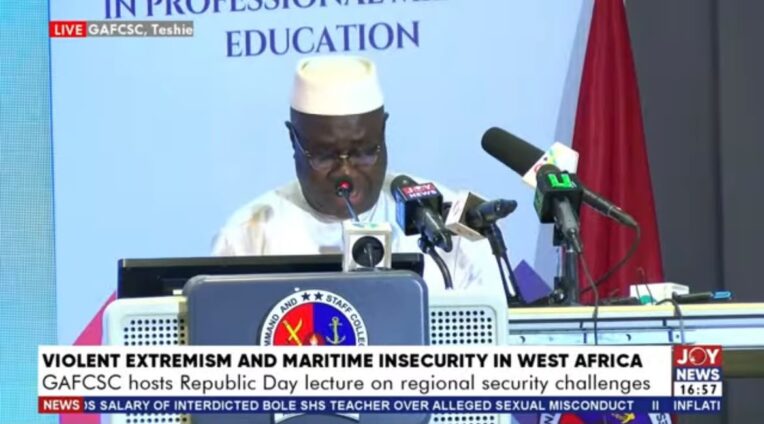
Delivering a lecture at the 50th Anniversary Republic Day Lecture at the Ghana Armed Forces Command and Staff College in Teshie, Prof. Aning said the expansion of violence from the Sahel into coastal West Africa must be understood within the wider context of domestic grievances, weak governance structures and external influences.
He argued that while violent extremism in the Sahel is increasingly moving towards coastal states, Ghana’s response must not only focus on border security but also address factors that extremist groups exploit, including youth unemployment, illicit financial flows and local grievances.
“The Sahel has now become an existential stress test for the whole of the region,” he said, stressing that the geography of insecurity is expanding beyond traditional conflict zones.
Prof. Aning cautioned against assuming that Ghana’s northern borders are the only vulnerability, warning that security threats could also emerge from internal conditions that create opportunities for criminal and extremist networks.
He pointed to possible physical security threats along the Burkina Faso border, economic threats through illicit gold mining, cattle trade and organised crime, as well as humanitarian pressures from displacement and food insecurity.
On the recent killing of Ghanaian tomato traders in Burkina Faso, he questioned how the traders were able to travel hundreds of kilometres into an area affected by insecurity without adequate intelligence or security coordination.
“They managed to cross the border, travelled almost 500 kilometres into enemy territory and did their business. What did they negotiate with? How did they negotiate safe passage? What intelligence did they take from Ghana out there?” he questioned.
Prof. Aning also warned that Ghana could face long-term risks of domestic radicalisation if northern marginalisation and opportunities for criminal activity in other parts of the country are not addressed.
He said the growing instability in the Sahel has implications for trade, regional integration and security cooperation, particularly as countries in the region experience changing alliances and weakening traditional security frameworks.
According to him, Ghana has an opportunity to play a stronger leadership role in reshaping regional security cooperation, especially as West Africa searches for new approaches to counter terrorism and transnational crime.
“Expanding violence from the Sahel is no longer just a Sahel problem. The geography of risk is expanding,” Prof. Aning stressed.
The lecture was held on the theme: “From the Sahel to the Gulf: Violent Extremism and Maritime Insecurity in West Africa: Implications for Ghana and Regional Security.”
Latest Stories
-
Ghana’s cashew industry faces processing gap as Côte d’Ivoire moves to capture more value
7 minutes -
“Our greatest wealth is not in our soil but our people” — Upper West Minister
12 minutes -
Luex Healthcare launches children’s health education book series with Luey the Lion
25 minutes -
NAGRAT urges gov’t to communicate early if September deadline cannot be met
56 minutes -
We trust government to meet September deadline on teachers’ promotions – NAGRAT
1 hour -
“We dare not fail” – Gov’t promises to honour teachers’ promotion pay deal
1 hour -
The GH¢19.8 billion mirage: Inside Ghana’s state enterprise turnaround
1 hour -
Luv FM High School Debate: KNUST SHS and Osei Adutwum SHS set up thrilling final after dramatic semi-finals
1 hour -
KNUST AI Coordinator urges structured adoption of AI in teacher education
2 hours -
Nepal rescuers blast hillside in search of hydropower workers as families wait anxiously
2 hours -
Teachers who pass promotional exam to get January 2026 start date after gov’t resolves promotion dispute – Dr Apaak assures
2 hours -
NSMQ 2026: St. John’s School rally from slow start to book semi-final spot
2 hours -
Promotion pay row: Gov’t gives teachers September 2026 to complete salary adjustments
2 hours -
Financial irregularities plummet by 62.9% as state tightens fiscal controls
2 hours -
DVLA to expand mobile services to underserved communities in Ghana’s Eastern Corridor of the Northern Region
3 hours