

Audio By Carbonatix
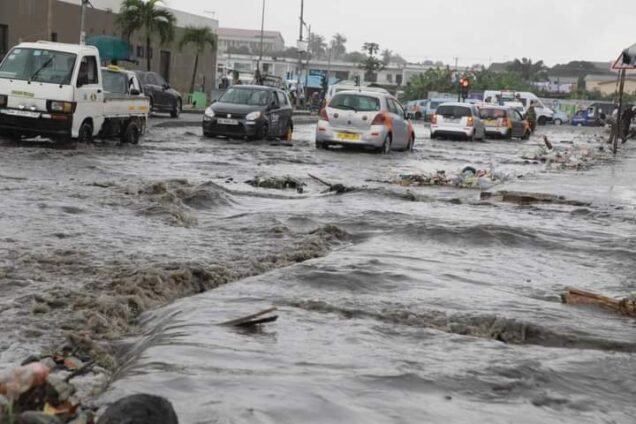
The Chairman of the Civil Technical Division of the Ghana Institution of Engineering (GHIE), Ing. Michael Obeng Konadu, has called for a major rethink of Ghana’s approach to flood control, urging authorities to return to the natural systems that once helped manage rainfall and runoff.
Speaking on Joy FM’s Super Morning Show on the recurring flooding problem, Ing. Konadu said the country’s natural environment originally had features that allowed it to absorb and slow down rainwater, reducing the risk of floods.
However, he said years of unplanned development, paving, and construction on water-holding areas have stripped nature of that role.
“Well, at the time, the natural environment had certain characteristics, which enabled nature to take care of some of the problems. We’ve taken away nature’s ability to help us in that regard,” he said.
He explained that areas that were naturally meant to hold water for a period have been built over, while surfaces that once allowed rainwater to soak into the ground have been replaced.
“The way we built, we filled areas which were supposed to hold water for some time. We’ve actually used surfaces that initially allowed infiltration into the soil. So, the original natural way of dealing with precipitation has been altered,” he said.
According to him, the result is that rainwater is now pushed quickly into drainage channels that are too small to cope.
“And now, everything is being forced into the small drainage system, and it can’t handle it. It can’t cope well. So, today, that’s a problem we’re faced with,” he added.
Ing. Konadu said Ghana must stop treating flood control simply as an effort to move water away as quickly as possible.
Instead, he said, the country should identify how water naturally flows across each catchment and preserve or restore spaces where it can be detained, slowed and absorbed.
“So what we’re saying now, let us try and go back to the original way nature did these things,” he said.
He explained that this would mean identifying natural drainage paths, preserving areas where water can be held temporarily, and introducing what he described as nature-based methods to manage stormwater.
“We identify areas where water can be held for some time. We identify the natural drainage paths and, as much as possible, clear them, and then we introduce measures we call nature-based methods,” he said.
He said these methods use infrastructure and vegetation to mimic natural processes and slow the movement of water through the system.
“There are some technologies which mimic nature in the way we encourage water to flow, and we use vegetation and a few other things to slow the water down so that it takes its time and flows through,” he explained.
Ing. Konadu said one of the main causes of flooding is not always the amount of rain that falls, but the speed at which water is pushed downstream.
“The reason it floods, really, is that the water that is being moved is being moved so fast that everything just rushes downstream and then goes to pond there and creates problems,” he said.
He said if authorities are able to hold water for some time and reduce the speed at which it moves, the pressure on drainage systems would ease significantly.
“So if we could find ways of holding the water a bit, slowing down the movement through the system, then the issues will be downplayed a bit, and then the water moves into the drainage system without disrupting the surrounding environment,” he said.
He pointed to wetlands and natural retention areas as part of the solution, saying such spaces must be protected rather than destroyed by development.
When asked what could be done in the short to medium term, Ing. Konadu said the immediate priority should be to identify locations where existing developments are blocking the flow of water and clear those obstructions.
“Well, immediately, we try to, more or less, save the situation where people are, and we really believe that our respondents should help,” he said.
He said attention should focus first on the major flood points where water is being prevented from reaching its final outlet.
“There are certain places where, obviously, current developments are impeding the water from getting into the final deposition. We should be able to identify those places and then clear them. Some of those things are caused by certain structures. Others are blocked. We should work on that,” he said.
According to him, tackling those major choke points should be the first emergency step, while longer-term measures are put in place to stop the flooding from recurring.
Ing. Konadu also called for a more coordinated approach to drainage planning, especially in relation to roads, culverts, and roadside drains.
He said roads are often built by different agencies without proper reference to the wider stormwater system, leaving drainage infrastructure disconnected and ineffective.
“The thing about flooding is that they are catchment-scale kind of issues,” he said.
“So, if you have a road in an individual MMDA that is built in a certain way, without reference to the overall catchment stormwater planning, it doesn’t work well.”
He said several state institutions are carrying out drainage-related works at different levels without enough coordination, and said that one authority should oversee drainage planning across the full catchment.
“We have a number of different agencies, all doing different things at their own scale. So, what we are trying to get done is get an overall agency to oversee everything in regard to this,” he said.
Ing. Konadu referred to the Hydrological Services Authority, saying it was established with this kind of role in mind, but may not yet have enough authority to bring all the relevant institutions together under one plan.
He said the way forward is for one body to carry out catchment-scale mapping and drainage planning, with other agencies feeding into a single system.
“We must have an authority that will do the catchment-scale mapping and drainage planning, and then the other agencies would all feed into it so that we have a network system, not isolated drains here and there,” he said.
Latest Stories
-
Sherif Ghali steps down as CEO of Ghana Chamber of Young Entrepreneurs after 10 years
7 minutes -
Signals Bureau case: ‘I had about 60 questions’ – Atta Akyea welcomes extra cross-examination day
8 minutes -
Africa’s colonial ecological debt could exceed hundreds of trillions of dollars – Report
26 minutes -
Ibrahim Sulemana joins Sassuolo on loan from Atalanta
30 minutes -
Former UK Prime Minister Keir Starmer to stand down as MP to focus on world affairs
36 minutes -
Built to Last, Left to Rot: Ghana’s maintenance crisis
42 minutes -
Number of debit cards issued by banks decreased by 11.8% to 5.7m in 2025
1 hour -
Total mobile money transaction values grew by 50.8% to GH¢4.54trn in 2025
1 hour -
Private aggregators, not state, will bear local refining costs – GoldBod
1 hour -
Ablakwa urges African leaders to adopt new leadership paradigm to create opportunities for youth
1 hour -
Photos: Mahama holds talks with Serbian President in Belgrade
1 hour -
Local gold refining good for economy but costs must be controlled – Economist
1 hour -
Keir Starmer announces he is standing down as MP
1 hour -
One still missing after Grand Canyon floods kill two and prompts rescue efforts
1 hour -
Mahama Ayariga calls for major overhaul of Ghana’s waste management system
1 hour