

Audio By Carbonatix
Mr Speaker, I am indeed happy that Ghana has taken important early steps to position itself in the emerging global carbon credit market. Through the Ghana Carbon Market Office, hosted by the Environmental Protection Authority, the country has a national institutional arrangement to support (i) Article 6 of the Paris Agreement, (ii) voluntary carbon market activities, (iii) mitigation activity development, (iv) authorisation, monitoring, reporting, and verification of carbon projects, (v) registry operations and corresponding adjustments. This is a significant national opportunity.
The benefits of a properly managed carbon market are not lost on us, and we have already begun recording dozens of mitigation activities across the energy, agriculture, forestry, and transportation sectors. This demonstrates that Ghana is not starting from zero. The foundations exist.
The carbon credit market must not be treated merely as a trading platform for emissions reductions. It must be treated as a national development instrument. Ghana’s approach must be guided by one central principle: To deliver real national value. Real emissions reductions, Real community benefits and Real private-sector investment.
The first direction government must take is to strengthen policy clarity and regulatory certainty. All stakeholders and participants need to know the rules. The framework already exists with the Carbon Market Office and Ghana Carbon Registry. The next step is to make the rules simpler, faster, and more predictable. Approval processes must be transparent, timelines must be clear, fees must be reasonable, and the distinction between Article 6 transactions, voluntary carbon market projects, and non-authorised domestic carbon activities must be clearly communicated.
Second, government must protect Ghana’s national interest in every carbon transaction. Carbon credits are not ordinary commodities. They are linked to Ghana’s Nationally Determined Contributions (NDCs), international reporting obligations, community assets, land rights, biodiversity, and future development space. Government must therefore ensure that authorisation of internationally transferred mitigation outcomes does not weaken
Ghana’s ability to meet its own climate commitments. We must not sell cheap today what we may need tomorrow to meet our own NDC targets.
Ghana must also insist on high-integrity carbon credits. The global carbon market has suffered credibility challenges because of weak projects, inflated claims, double counting, poor community consultation and questionable additionality. Ghana must not become a destination for low-quality carbon projects. Every project must demonstrate environmental integrity and transparent benefit-sharing. This reinforces the government's commitment to putting communities at the centre. Many carbon projects depend on land, forests, farms and community practices. These are not abstract assets but rather attributes of communities, farmers, households, traditional authorities, and private actors. Carbon projects should therefore proceed with proper stakeholder engagement, free and informed local participation, clear grievance mechanisms, and fair benefit-sharing.
Ghana must build a strong domestic project pipeline. The government should now deliberately prioritise high-impact sectors, be it in renewable energy, methane reduction, landfill gas management, regenerative agriculture, forest restoration, mangrove protection, climate-smart irrigation, public transport, industrial energy efficiency and water purification. These sectors can reduce emissions while solving everyday development problems. Our carbon financing should therefore be aligned with Ghana’s jobs agenda, food security agenda, energy transition agenda and local economic development strategy.
Mr Speaker, government must build national capacity. Carbon market development requires specialised skills, including project design, carbon accounting, MRV, legal contracting, Article 6 authorisation, registry management, financial structuring and community benefit-sharing among other key roles. Ghana should not rely excessively on foreign consultants. The country must train Ghanaian experts, universities, private firms, district assemblies, NGOs and financial institutions to participate meaningfully in the market. A national carbon finance academy, linked to the Carbon Market Office at the EPA, universities and the private sector, should be institutionalised.
Furthermore, we must strengthen the Ghana Carbon Registry. It must accurately and timeously track mitigation activities, issuances, transfers, cancellations, retirements, authorisations and corresponding adjustments. The registry should be digital, transparent, secure, regularly updated, and linked to Ghana’s national greenhouse gas inventory and NDC accounting system.
Government must also improve coordination among the various key sectors involved in the carbon market. The current governance architecture involving the Ministry of Environment, the EPA, the Carbon Market Office, the Inter-Ministerial Committee, the Carbon Market
Committee and the Technical Advisory Committee is important. These institutions must be properly resourced and politically supported to carry out their objectives in a coordinated manner. Carbon market decisions should not sit in files for months.
Mr Speaker, Ghana must use carbon markets to attract investment. The country should welcome credible investors who bring technology, finance and long-term partnerships while carefully avoiding projects without sustainable financing, capacity, or implementation plans. In all this, Ghana must show leadership in Africa. With the right reforms, Ghana can become a trusted regional hub for credible carbon assets. We already have a framework with a number of bilateral cooperation arrangements, and a growing project pipeline.
Though the carbon credit market offers Ghana an opportunity, it also carries risk. If poorly managed, it can create confusion, speculation, unfair contracts, and loss of national value. If properly governed, it can position Ghana as a leader in Africa’s green transition. Our national position should therefore be clear. That Ghana is open for carbon market investment; but only on terms that protect environmental integrity, national interest, community rights, and long-term development.
I thank you for the opportunity, Mr Speaker.
*******
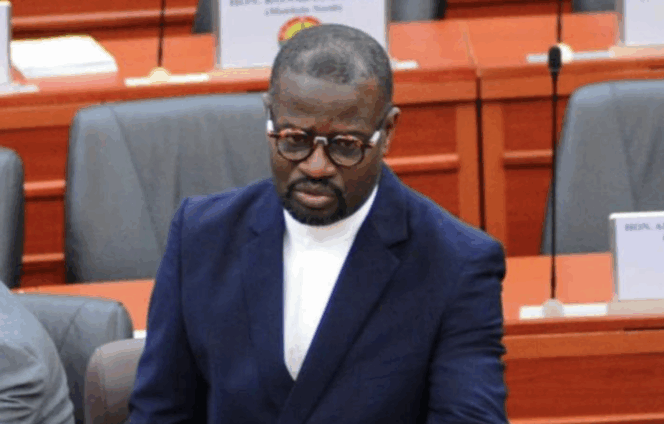
This statement was delivered by the Minority Chief Whip and Nsawam-Adoagyiri MP, Frank Annoh-Dompreh on July, 2, 2026
Latest Stories
-
African health manufacturers meet in Addis Ababa for AHMTEC 2026, focus shifts from building capacity to commercial scale
3 minutes -
Court delays can amount to denial of justice – Mahama
10 minutes -
NPP approves proxy voting for October 3 national officers elections
20 minutes -
Yemen’s Houthis reportedly seize strategic Red Sea port of Mokha
22 minutes -
Horse racing community hits Accra streets, petitions Presidency over demolished Racecourse
23 minutes -
Two arrested over alleged plot to kill Susu collector at Botwe in Accra
27 minutes -
Jirapa MP provides SHS prospectus items to 1,196 fresh graduates
32 minutes -
Ghana signs offshore deals with Eni, Vitol to revive oil exploration
32 minutes -
Two feared dead, several injured after trailer crashes into vehicles at Krofrom
37 minutes -
Where did we lose it? The falling standards of our airwaves and silence of regulators
38 minutes -
I remain fully committed to judicial independence – Mahama
41 minutes -
NDC opens nominations for 2026 constituency executive elections on September 15
42 minutes -
GROW2 project exceeds targets for women farmers in Northern Ghana
57 minutes -
Twenty-five dead after fire on cargo ship in eastern China
59 minutes -
The Battle For The Soul of the Ghanaian BAR: Is it a freedom of association or regulatory anarchy?
1 hour