

Audio By Carbonatix
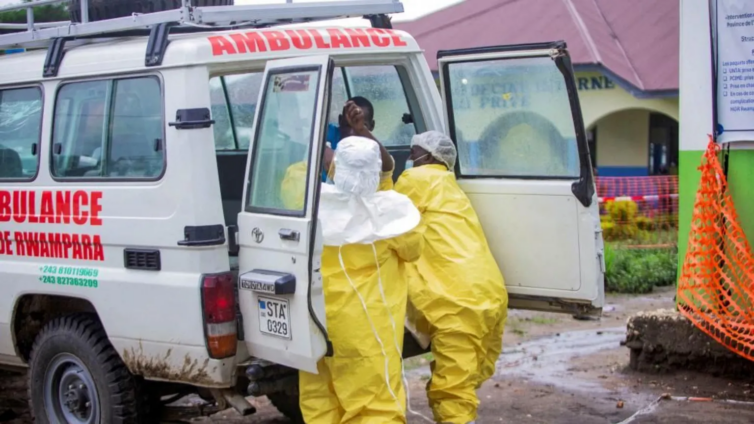
A trial of potential treatments for the strain of virus behind the current deadly Ebola outbreak in the Democratic Republic of Congo (DRC) has begun, the World Health Organisation (WHO) has announced.
The first patient has been enrolled in the DRC, WHO chief Tedros Adhanom Ghebreyesus said on Thursday.
More than 1,400 cases and 438 deaths have been confirmed in the DRC alone, according to the WHO.
There are currently no approved vaccines or treatments for the Bundibugyo virus strain of the disease, which is highly infectious.
The current trial is sponsored by the WHO, and is being co-ordinated by scientists at the Institut National de Recherche Biomédicale in DRC, the Institute of Tropical Medicine in Belgium, and the University of Oxford in the UK.
Speaking to reporters from the WHO headquarters in Geneva on Thursday, Tedros said: "The clinical trial of two therapeutics began, with the enrolment of the first patient.
"Even without approved therapeutics, people are recovering from this disease, but of course, we could save many more lives with safe and effective therapeutics in our toolkit," the WHO head said.
The current outbreak of Ebola in the DRC and Uganda began in May, and has been declared a public health emergency by the WHO.
According to WHO data, there have been 1,406 confirmed cases in DRC, with 301 suspected cases and 438 deaths, as of 30 June.
There have also been 20 confirmed cases in Uganda, leading to two deaths, and one confirmed case in France, as of 1 July.
The disease is caused by a virus that attacks the body's immune systems and organs.
It typically infects animals, such as fruit bats, but outbreaks among humans can sometimes start when people handle infected animals.
People usually become contagious only after developing symptoms, and it takes 2 to 21 days for symptoms to appear.
They come on suddenly and start like the flu or malaria with fever, headache and tiredness.
Vaccines must be developed for each Ebola species, of which there are six, but only three are known to cause outbreaks.
Latest Stories
-
LGA commends State-Owned Enterprises for recording strong 2025 performance
3 minutes -
The million-dollar problem sitting offshore: Why Ghana’s cement makers are adding GH¢12 to every bag
8 minutes -
Ghana Water serves about 18.5 million people nationwide – MD
14 minutes -
Daily Insight for CEOs: Closing the gap between strategy and execution
30 minutes -
Mahama’s Feed the Industries policy to rejuvenate industry, drive real-sector growth and 24-hour economy
31 minutes -
Ghana Water MD admits ‘smart’ meters installed since 2017 still not fully activated
40 minutes -
Bongofari, others salute Ebo Taylor at tribute concert
41 minutes -
Africa Food Systems Forum: John Dumelo urges Ghanaian youth to embrace agriculture
41 minutes -
Africa World Airlines resumes Accra – Abidjan direct flights
43 minutes -
Ageing GWCL pipelines dating back to 1960s driving water losses – MD laments
44 minutes -
Africa Food Systems Forum: Dumelo calls for borderless Africa to boost agricultural trade
47 minutes -
First National Bank’s Investment Gift Cards out now to give Ghanaians a new way to gift a brighter future
50 minutes -
Is Free SHS really free? What new research found
52 minutes -
13 dead, 5 critically injured in fatal accident on Sege-Tema highway
53 minutes -
Ghana Water loses nearly half of daily supply to theft and leakages – Adam Mutawakilu
1 hour