

Audio By Carbonatix
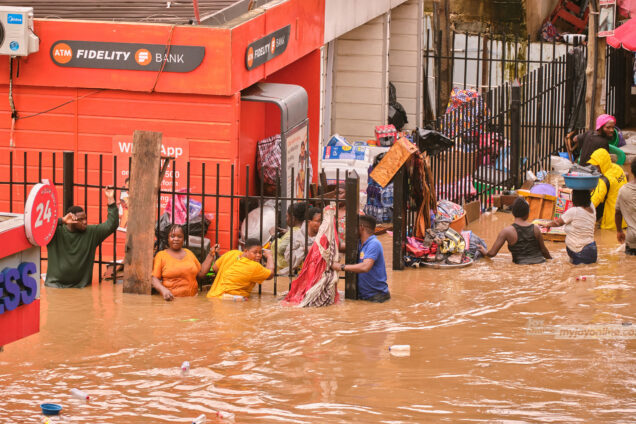
When the rain starts in Accra, the panic sets in.
Residents scroll through news and social media feeds, trying to find out which part of the city has flooded, which streets to avoid and whether their neighbourhood has been spared.
The most popular question remains: Why does Accra flood so easily?
We have been told often, too many times, that it is so because our drains are too small, too shallow or even too clogged.
What if the story is wrong? What if the real trigger of our floods is not the size of the drains or even the garbage choking the drains?
The irony is, year after year, we widen and deepen drains, build more drains and yet, the more we try, the faster and more violently the city seems to drown in its stormwater. Our most trusted solution may be making the problem worse.
As a country, we have been so focused on the drains that overflow so much that we never take a step back to look at the surfaces that send water to the drains.
For more than three decades, Accra has been paving over the very ground that protects us.
Natural soils, wetlands and open spaces that absorbed rainfall have been replaced with concrete and tiled compounds, asphalt roads and rooftops that stretch from wall to wall.
With this way of development, the city has lost its ability to absorb water and is repelling it.
When rain falls on exposed natural soil, most of it infiltrates.
When it falls on concrete, it becomes instant runoff.
In hydrology, this effect is called effective imperviousness, describing the percentage of hard surfaces that drain directly into gutters and channels.
With nearly every compound paved or tiled, and most roof gutters sending water straight to the drains, the effective imperviousness of Accra is extremely high.
For every 50 square metres of impervious surface, a typical 150mm rainfall over an hour or two, the paved compound sheds approximately 10,000 litres of water into the drains within minutes.
Rainwater hits these surfaces and enters the drainage network at a fast pace and all at once, as opposed to infiltrating the ground slowly.
This results in flash flooding.
When this occurs, it is not because the drains are overwhelmed with the amount of rain falling; they are overwhelmed because too much water reaches them too quickly.
A one-hour storm becomes a torrent because hundreds of thousands of hard, impervious surfaces shed water at the same time into the drains.
Hydrological studies show that the smallest increase in impervious areas can double or triple the peak flow of stormwater.
This is a reality in Accra, with almost all compounds made impervious and nearly all connected to its drains.
The urban form of Accra makes the problem worse as the city is densely built with low porosity neighbourhoods, tightly packed buildings, narrow roads and open ground is relatively scarce.
Environments like these trap and redirect runoff, causing water to pool in places that have no natural escape.
Floodplains that once absorbed and slowed stormwater have also been built over, reducing buffers that protect the city.
Climate change may have changed rain patterns and intensity, but it is not responsible for Accra’s floods.
Accra is flooding because the city has changed.
Compounds that once absorbed rainfall have been sealed under concrete and tiles from boundary wall to boundary wall.
Driveways are paved smoothly, and rooftop downspouts empty onto these hard surfaces or directly into drains.
This leaves stormwater with only one path, off the surface and into the drains.
In places like Adabraka, Osu and Weija, storm water races across surfaces which are sealed and in low-lying lands like Spintex and Santor, where flood plains have been built into estates, the storm water is shed outward and downhill.
Narrowing
The Odaw Basin is also narrowing due to encroachment and hardscaping, making the buffer a tunnel.
The entire city has been engineered to flash flood as soon as the first drop of rain hits the concrete, long before it reaches a drain.
Accra does not require bigger drains; it needs to slow the stormwater hitting its drains at the source.
As the city keeps sealing the ground and piping rain directly into the drains, the city is continually designing its floods.
Bigger drains only relocate violent stormwater downstream.
The only sustainable path to end this cycle is to disconnect stormwater from drains and reduce impervious surfaces.
We must change how water meets the ground to keep Accra dry.
This can be achieved by decoupling the stormwater systems and the drains.
Currently, stormwater drains directly and quickly into the gutters and creates an instant surge that the drains cannot handle.
Direct downspout to drain piping must cease, and roof water must be directed onto soil or landscaped basins where it can infiltrate slowly and replenish groundwater.
We must also install infiltration strips, bioswales and vegetated strips to absorb and filter runoff before it hits the drains.
Rain gardens, detention tanks and permeable surfaces can be installed to slow stormwater and prevent ordinary rainfall from turning into a flood.
Once stormwater systems have been decoupled from the drains, we must reduce the amount of impermeable surfaces across the city, as they also increase runoff severity and cause the drains to be overwhelmed.
We must start depaving unnecessarily paved over areas, considering that a little concrete adds little value but huge hydrological stress.
Residential plots in the city must be required to maintain permeable ground cover as opposed to the current wall-to-wall tiling or concrete happening at the moment.
Developers must incorporate permeable pavements, green courtyards, roofs and open soil zones into their sites to increase infiltration.
We can also protect the remaining buffer areas from further construction.
Reducing impervious surfaces in Accra will lower runoff volumes since rainwater will have other paths other than the streets and drains. Accra’s floods can be a thing of the past.
Clear
The science is clear, and the solutions are within our very own hands.
Parliament must take the lead by updating our building codes from 2018.
A new code requiring developers and private homeowners to ensure that new developments have infiltration features, limit the hardscaping, especially on residential plots and manage stormwater on site before it is released to the public drains.
The revision of existing codes must prohibit reckless sealing of soil and paving residential compounds from boundary wall to boundary wall, especially in rapidly growing neighbourhoods such as East Legon Hills, Adjiringanor, to name a few.
Requiring developers to incorporate a lot more permeable surfaces, retention systems and natural drainage and educating homeowners about how their choice to pave their compounds entirely is not a harmless choice but a costly one to the city is key.
These measures, however, will be irrelevant without consistent enforcement.
The government can lead by example, by investing in depaving public spaces and government developments that have been unnecessarily hardscaped, restoring green corridors and building bioswales, retention basins, green roofs and rain gardens, choosing permeable paving in its new developments to allow rainwater to infiltrate more and run less.
In conclusion, to reduce flooding, Accra must fix the mechanism that contributes to the floods in the city and not the symptoms.
It must break the direct connection between its paved surfaces and drains, require all buildings and compounds to infiltrate most of their runoff, reduce the city’s effective impervious area and slow stormwater at its source.
A flood-free Accra is not fated; it is a choice and one we must collectively make.
The writer is a MEM Candidate, Yale University.
Latest Stories
-
Flight recorders recovered from ‘devastating’ Amazon cargo plane crash
13 minutes -
AI cancer cures slowed by chip shortage, says UK’s biggest tech boss
22 minutes -
Grindr to pay £26m to settle claims it allegedly shared users’ HIV status
32 minutes -
China to pump $54bn into state banks and insurers to boost economy
41 minutes -
Legal Green Association to hold maiden law students’ conference
41 minutes -
Dolly Parton’s sister pleads for end to ‘AI garbage’ posts after singer’s death
51 minutes -
Minority calls for itemised bill on GH¢49.7 million South Africa evacuation expenditure
55 minutes -
Australians will be able to switch off social media algorithms under planned legislation
60 minutes -
WAEC admits more study needed into fluctuating core subject performance
1 hour -
Jordan Ayew close to EFL Championship move as Sheffield Utd talks intensify
1 hour -
WAEC questions why core-subject failure keeps shifting from one subject to another
1 hour -
Herbert Mensah joins African Collaborations Group advisory board
1 hour -
WAEC demands further study into persistent English Language failures
2 hours -
Rybakina sweeps past Osaka to close in on number one ranking
2 hours -
Zheng wins set from 5-0 down again to stun Swiatek
2 hours