


Audio By Carbonatix
Economist and Professor of Finance at the University of Ghana Business School, Godfred Bokpin, says Ghana’s transition to a cash-lite economy could help reduce the cost of replacing physical currency.
He says as more people use digital payments, less cash will be handled daily, reducing pressure on banknotes and helping prolong the life of the country’s currency.
Prof. Bokpin said digital payments offer benefits beyond convenience. He said heavy reliance on cash places a burden on the central bank because physical notes wear out with frequent handling.
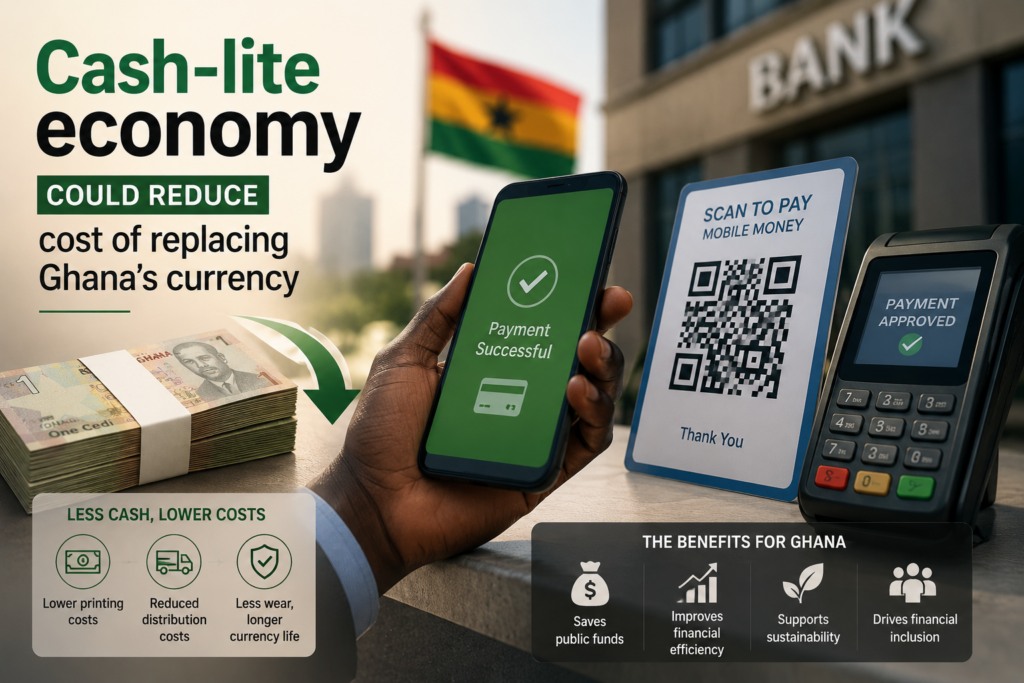
“The understanding is that, once there is increased uptake, transaction costs will come down and volume will also increase. It helps in terms of inclusion as well. It also helps the central bank when it comes to the cost of replacing physical currency. As people handle less cash and switch more to digital payments, it helps prolong the longevity of the currency. In terms of the benefits, the convenience, the increased output and the welfare benefit are quite huge,” he explained.

Prof. Bokpin was speaking in a yet-to-be-aired documentary, “The Trust Crisis,” ahead of the maiden Digital Economy Forum under the theme, “The Trust Crisis: Why Fraud Is Holding Back Ghana’s Digital Economy.”
The thought-leadership platform, an initiative of Hubtel, will air on JoyNews and Joy FM on Wednesday, July 22, 2026, at 8 p.m.
The forum will bring together regulators, banks, fintech companies, telecommunications firms, security agencies and consumers to examine whether Ghana’s regulatory system is keepng pace with the growth of digital finance.

Currency management is one of the hidden costs of a cash-heavy economy. Banknotes must be printed, transported, stored, secured, sorted and replaced when they become worn out or damaged.
A shift towards digital payments can reduce how often physical notes move from hand to hand, especially in retail transactions, transport, market trading and informal-sector payments.
Ghana’s payment system has already recorded strong growth in digital transactions.
The Bank of Ghana’s 2024 Payment Systems Oversight Report shows that payment service providers processed about 8.1 billion transactions valued at approximately GH¢3 trillion in 2024. The report said the growth reflected increased adoption of digital payments and stronger oversight of payment service providers.
Prof. Bokpin said the shift is part of a wider global trend that Ghana cannot ignore. He said the digital economy is expected to grow faster than the traditional economy, making investment in payment infrastructure necessary.

“That is where the world is heading, and we do not have an option. Economies are increasingly being digitised, especially in the area of payments, and a lot of investment has also been made in infrastructure to enable digital payments. The digital economy, based on digital apps and technologies, is expected to grow faster than the traditional economy. Every projection is heading in that direction,” he said.
But the economist warned that the benefits of a cash-lite economy depend on public confidence in digital financial services.
He said fraud could push some consumers and traders back to cash, undermining the gains from digitisation. He further said this could reverse progress because users who fear fraud are more likely to prefer cash-based transactions.
“We know that in Ghana, because of fraud associated with MoMo here and there, there are communities and traders who do not want to accept MoMo payment. It is simply because they do not have confidence in the system. One direct effect is unwillingness to participate. What that means is that they will prefer to do more cash-based transactions,” he further said.
The Bank of Ghana’s 2024 fraud report shows that banks, specialised deposit-taking institutions and payment service providers recorded 16,733 fraud cases in 2024. The report described fraud in banks, SDIs and payment service providers as attempted or successful fraudulent activities recorded between January and December 2024.
For Prof. Bokpin, the answer is not to slow digitisation, but to manage the risks better. He said digital payments remain important for financial inclusion, lower transaction costs and wider economic participation.

“For a country like Ghana, with a huge informal sector and a huge unbanked population, these avenues allow the economy to rope in the unbanked. Digital payments, digital apps and fintech open up the market and rope in all these people. If there is greater uptake, transaction costs will also come down. Once the volume comes through, the average cost will come down, and the benefit can be passed on to consumers overall,” the economist added.
Prof. Bokpin said Ghana must therefore protect trust in digital payments if it wants to reduce dependence on physical cash. The challenge, he said, is to build a digital financial system that is convenient, inclusive and safe enough for consumers and businesses to keep using.
He believes a cash-lite economy can reduce the burden of currency replacement and support broader economic inclusion, but only if fraud does not push users back to cash.
Latest Stories
-
I haven’t experienced any envy in the gospel music industry — Ohemaa Mercy
21 minutes -
Prayer does not solve everything — Ohemaa Mercy
32 minutes -
New PURC office symbolises stronger consumer protection – Dr Jinapor
1 hour -
Rev. Wengam re-elected Assemblies of God, Ghana General Superintendent
1 hour -
Less than 20km of clearing left to connect Accra-Kumasi Expressway to Kumasi – Agbodza
1 hour -
US judge strikes down policy suspending immigrant visa processing for 75 nations
1 hour -
MCEs collecting fees from galamseyers are facilitating illegality – Ken Ashigbey
2 hours -
Developer LMI Holdings commits to completing first 700 Saglemi housing units
2 hours -
Africa’s next chapter will be built by institution-builders, not idea-havers
2 hours -
Wenchi Traditional Council suspends Twafohene indefinitely
2 hours -
Kpassa-Merimeri road undergoes filling and levelling works to improve accessibility
2 hours -
9 Blue Water Guards arrested over alleged bribery, impersonation
3 hours -
Wildlife guard shot dead during Kakum patrol
3 hours -
‘I reject them without qualification’ — Afenyo-Markin hits back over Sammy Gyamfi’s claims
4 hours -
GoldBod must appear before a parliamentary inquiry to answer for gold-trade losses — Appiagyei
4 hours