

Audio By Carbonatix
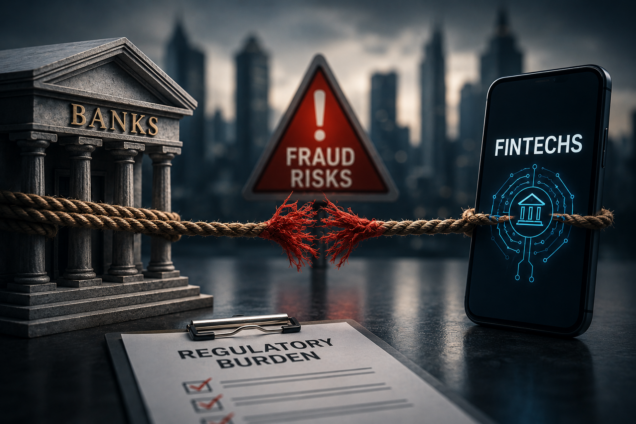
Banks and fintech companies are raising competing concerns over regulation in Ghana's digital financial sector, with each side suggesting the other operates under a lighter supervisory regime.
But the Head of Fintech and Innovation at the Bank of Ghana, Elhanan Owureku Asare, says the dispute should not distract from the bigger risk: fraud can move across the entire financial system.
“The Bankers’ Association, for example, was concerned that the banks are more heavily regulated than the fintechs. He is calling for the same regulation, if you like - put them on the same pedestal, improve collaboration and achieve the same results. If one part of the chain is weak, it affects everybody,” Mr. Asare said.
He said fintech companies also believe banks receive comparatively favourable treatment.
“Interestingly, the fintechs also feel that the banks are less regulated in relation to them. But that is beside the point,” he said.

Mr. Asare was speaking in a yet-to-be-aired documentary, “The Trust Crisis,” ahead of the maiden Digital Economy Forum under the theme, “The Trust Crisis: Why Fraud Is Holding Back Ghana’s Digital Economy.”
The thought-leadership platform, an initiative of Hubtel, will air on JoyNews and Joy FM on Wednesday, July 22, 2026, at 8 p.m.
Banks and fintech companies operate under different regulatory frameworks because their activities and risk profiles differ.
Banks and specialised deposit-taking institutions are regulated mainly under the Banks and Specialised Deposit-Taking Institutions Act, 2016, Act 930.

Payment service providers and dedicated electronic money issuers, including mobile money operators, are regulated under the Payment Systems and Services Act, 2019, Act 987.
The issue, therefore, is not whether all institutions should operate under identical rules. It is whether the different rules provide equally strong protection against fraud.
That question has become more important as digital transactions increasingly move across mobile money wallets, banks, fintech platforms and payment processors.
A weakness in one institution can expose the rest of the payment chain.
Mr. Asare said Ghana needs a coordinated response rather than separate fraud-control systems for different parts of the industry.

“I know our recommendation is to make sure that we have an industry-wide solution to prevent fraud. So, a solution that will deal with the banks, a solution that will deal with the fintechs, a solution that will deal with non-bank financial institutions,” he indicated.
He said the country requires a “360-degree solution” because the platforms are interconnected.
“When you have a solution that is siloed, then it becomes a problem,” he said.
The regulatory debate comes amid an increase in reported financial-sector fraud.
The Bank of Ghana’s 2024 fraud report shows that banks, specialised deposit-taking institutions and payment service providers recorded 16,733 fraud cases, up from 15,865 in 2023.
The combined value at risk increased by 13 per cent, from GH¢88 million to approximately GH¢99 million.
Payment service providers recorded 15,673 cases, accounting for nearly 94 per cent of all reported incidents.
The value at risk in that sector rose from GH¢16 million to GH¢19 million.
Banks and specialised deposit-taking institutions recorded fewer cases but a higher value at risk.
They reported GH¢83 million in fraud value at risk in 2024. Only GH¢3 million was recovered.
The figures show that the sectors face different risks, but both remain part of the same financial system.
Payment platforms may record a high number of fraud incidents, while fraud involving banks may expose larger amounts.
The central question is whether banks, fintechs and mobile money operators face sufficiently strong and consistent obligations in areas such as transaction monitoring, fraud reporting, cybersecurity, customer protection and the tracing of stolen funds.
Mr. Asare’s position is that the debate over which sector is more heavily regulated should not overshadow the shared risk.
Fraudsters can exploit the weakest point in the chain, even when the institutions involved operate under different rules and supervisory structures.
The maiden Digital Economy Forum will bring together regulators, banks, fintech companies, telecommunications firms, security agencies and consumers to examine whether Ghana’s regulatory system is keeping pace with the growth of digital finance.
The Head of Fintech and Innovation at the Bank of Ghana, Elhanan Owureku Asare, will be joined by other industry players at the maiden Digital Economy Forum to examine why fraud is undermining trust in Ghana’s digital economy.
They include economist Professor Godfred Bokpin; Chief Executive Officer of the Ghana Association of Banks, John Awuah; Executive Chairman of e-Crime Bureau, Dr. Albert Antwi-Boasiako; Chief Risk and Compliance Officer of MobileMoney Fintech Limited, Godwin Tamakloe; Deputy Director-General in charge of Technical Operations at the Cyber Security Authority, Stephen Cudjoe-Seshie; and Head of Internal Affairs at Hubtel, Ebenezer Boffour.
Latest Stories
-
I haven’t experienced any envy in the gospel music industry — Ohemaa Mercy
19 minutes -
Prayer does not solve everything — Ohemaa Mercy
30 minutes -
New PURC office symbolises stronger consumer protection – Dr Jinapor
1 hour -
Rev. Wengam re-elected Assemblies of God, Ghana General Superintendent
1 hour -
Less than 20km of clearing left to connect Accra-Kumasi Expressway to Kumasi – Agbodza
1 hour -
US judge strikes down policy suspending immigrant visa processing for 75 nations
1 hour -
MCEs collecting fees from galamseyers are facilitating illegality – Ken Ashigbey
1 hour -
Developer LMI Holdings commits to completing first 700 Saglemi housing units
2 hours -
Africa’s next chapter will be built by institution-builders, not idea-havers
2 hours -
Wenchi Traditional Council suspends Twafohene indefinitely
2 hours -
Kpassa-Merimeri road undergoes filling and levelling works to improve accessibility
2 hours -
9 Blue Water Guards arrested over alleged bribery, impersonation
3 hours -
Wildlife guard shot dead during Kakum patrol
3 hours -
‘I reject them without qualification’ — Afenyo-Markin hits back over Sammy Gyamfi’s claims
4 hours -
GoldBod must appear before a parliamentary inquiry to answer for gold-trade losses — Appiagyei
4 hours