

Audio By Carbonatix
Digital fraud may be rising, but Economist and Professor of Finance at the University of Ghana Business School, Godfred Bokpin, says Ghana cannot afford to retreat from digital payments.
He argues that the country’s focus should be on managing the risks, not slowing a transition that is already expanding financial inclusion, cutting transaction costs, supporting convenience and creating new digital jobs.
Prof. Bokpin said the real challenge is not whether Ghana should slow down digitisation, but how the country manages the risks that come with it.
“The net benefit overall is positive. Regardless of the fraud, the uptake, the trend, the convenience, the inclusion and the fact that the digital economy is expanding and creating digital jobs and digital apps are all quite good. There is no point in saying we want to put a stop to that. What is important is how we manage the risk,” he said.

Prof. Bokpin was speaking in a yet-to-be-aired documentary, “The Trust Crisis,” ahead of the maiden Digital Economy Forum under the theme, “The Trust Crisis: Why Fraud Is Holding Back Ghana’s Digital Economy.”
The thought-leadership platform, an initiative of Hubtel, will air on JoyNews and Joy FM on Wednesday, July 22, 2026, at 8 p.m.
The forum will bring together regulators, banks, fintech companies, telecommunications firms, security agencies and consumers to examine whether Ghana’s regulatory system is keeping pace with the growth of digital finance.

Prof. Bokpin said the world is moving towards digital payments and Ghana has little choice but to prepare for that future.
“That is where the world is heading, and we do not have an option. Economies are increasingly being digitised, especially in the area of payments, and a lot of investment has also been made in infrastructure to enable digital payments,” the
He said the digital economy is expected to grow faster than the traditional economy.
“The understanding is that the digital economy, based on digital apps and technologies, is expected to grow faster than the traditional economy. Every projection is heading in that direction,” he further said.
Ghana’s own payment data reflects that shift. The Bank of Ghana’s 2024 Payment Systems Oversight Annual Report says Ghana’s payment landscape remained “buoyant and robust” in 2024 as adoption of digital payments increased.
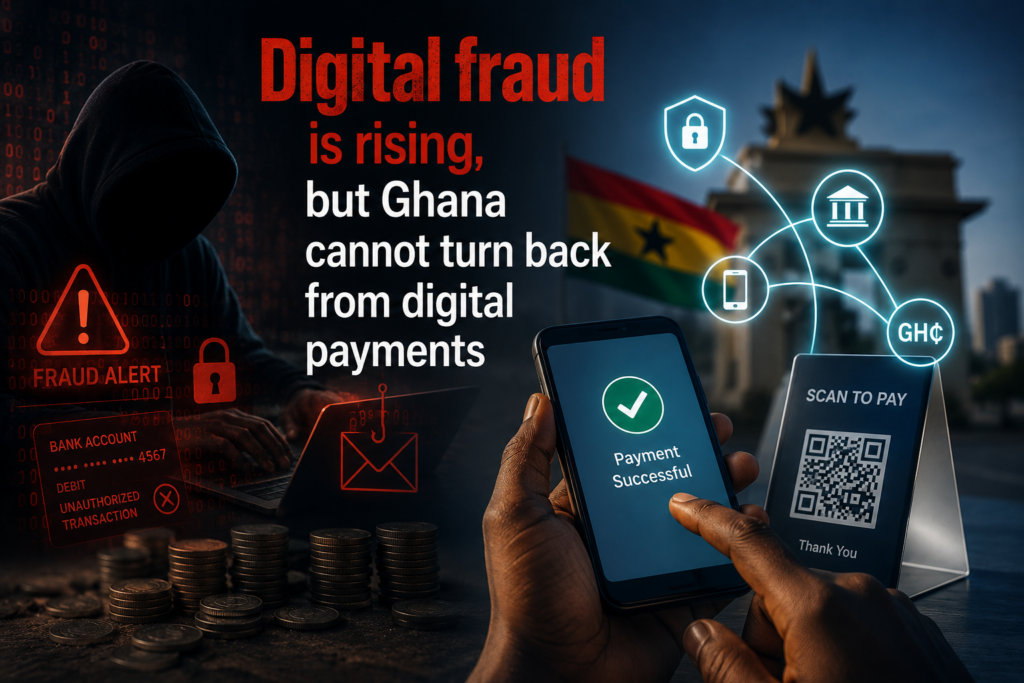
Payment service providers processed about 8.1 billion transactions valued at approximately GH¢3 trillion in 2024, compared with 6.8 billion transactions valued at GH¢1.9 trillion in 2023.
Prof. Bokpin said the expansion of digital finance is particularly important for countries like Ghana, where many people still operate in the informal sector.
“For a country like Ghana, with a huge informal sector and a huge unbanked population, these avenues allow the economy to rope in the unbanked,” he said.
He said digital payments and fintech platforms can reach people who may struggle to meet traditional banking requirements. According to the economist, increased uptake of digital payments can also lower transaction costs over time.
“These days, when you want to open a bank account, they still ask you for certain documents that the average Ghanaian in the informal sector may not be able to provide. So, digital payments, digital apps and fintech open up the market and rope in all these people. Once there is increased uptake, transaction costs will come down and volume will also increase. If there is greater uptake, then it means that transaction costs will also come down. Once the volume comes through, the average cost will come down, and the benefit can be passed on to consumers overall,” he said.
But Prof. Bokpin said the same growth that makes digital finance attractive also draws criminals.
He said fraudsters are watching the direction of financial flows and adjusting their operations accordingly.
“It is not surprising when you find criminals, who follow the money and the trend, also doing their analysis and projections, seeing where the flow is going, and preparing towards that as well When it comes to technology, it is not only available to those who want to use it for good. It is also available to those who want to use it for fraud,” he added.
The Bank of Ghana’s 2024 fraud report shows that banks, specialised deposit-taking institutions and payment service providers recorded 16,733 fraud cases in 2024, up from 15,865 in 2023. The report covers attempted and successful fraudulent activities recorded between January and December 2024.
The total value at risk rose from GH¢88 million in 2023 to GH¢99 million in 2024.

In the payment service provider sector, fraud cases increased to 15,673 in 2024, with the value at risk rising to GH¢19 million.
Prof. Bokpin said the movement from cash to digital payments has also shifted the pattern of crime. He said this is because many people now carry less cash but conduct more financial transactions digitally.
The finance professor indicated that, “If you look at the trend, from reports by the Bank of Ghana and also from the UN, you realise that with increasing digitisation and digital payments, you see a switch from physical crime, in terms of physical theft and cash, moving more online.”
“These days, it is easier for criminals to meet people online than in physical locations. People are not carrying much cash today, but they are heavily involved in cash transactions online. So, given that online presence is increasing, you should expect that digital fraud will also increase because criminals also follow the money.”
Prof. Bokpin said fraud must be managed across the entire digital-payment value chain.
He said financial institutions, fintech companies and other market participants must treat fraud control as part of their core business.
“Anyone participating in that market, including fintechs and others, is essentially in the business of managing risk, including fraud. Their whole business model is also designed to manage fraud and risk, because it is all about risk management. Banks are essentially in the business of managing risk. They take risks when they accept deposits, they take risks when they lend, and across the channels and platforms they use, digital or otherwise, there is a fraud risk,” he held.
He added that banks also operate within the same risk environment. Prof. Bokpin said consumers also have a role to play. He said users must learn basic risk-management practices and should not leave fraud prevention only to regulators or service providers.
“There are basic tips that you should know as a participant, as a customer and as a beneficiary of the system. We cannot outsource that only to regulators or fintech organisations. Users must also understand certain basic risk management issues within that same context. I would choose digital payments. I would put in place my own risk management strategy. I want to understand the system. At the end of the day, we do not want to be left out. The world is increasingly becoming digital. The future of currency is increasingly being digitised,” he explained.
He said he would still choose digital payments despite the risks. Prof. Bokpin said Ghana cannot afford to be left behind as the future of finance becomes increasingly digital.
He further added that the conversation now should focus on how to protect users, strengthen systems and preserve public confidence, rather than whether Ghana should slow down its digital transition.
Digital fraud he believes is a serious threat, but it is not a reason to abandon digital payments. The answer is to manage the risk better while protecting the benefits of inclusion, convenience and economic growth.
Latest Stories
-
UK lawmakers demand new law to address AI threat to human rights
1 minute -
WAFU B U-17 Girls Cup: Black Maidens depart Accra for tournament in Yamoussokro
1 minute -
Sweden’s center-left bloc narrowly ahead as election remains too close to call
12 minutes -
GPL 2026/27: ‘We won ugly’ – Kotoko head coach unimpressed after Lions victory
15 minutes -
7 out of 10 human trafficking cases in Ghana never reach prosecution — JoyNews Research
31 minutes -
Music, football to converge at Music Meets Football Summit 2026 in Lusaka
36 minutes -
Putin invites young global leaders to partner with Russia in shaping future world order
36 minutes -
Putin calls for ‘just world’, says every nation must be free to choose its own path
44 minutes -
IFY 2026 food festival to serve 20,000 meals showcasing global cuisines in Russia
55 minutes -
Ghana has a Domestic Violence Act: But can a victim afford to use it?
59 minutes -
Young artists from 100 countries showcase works at IFY 2026 in Russia
1 hour -
Russia opens neo-Nazism exhibition at International Festival of Youth 2026
1 hour -
‘Let’s change the world together’ – Putin tells young people
1 hour -
VC inaugurates three committees ahead of UG’s 80th anniversary celebration
1 hour -
Today’s Front pages: Monday, September 14, 2026
2 hours