

Audio By Carbonatix
An economist at the Kwame Nkrumah University of Science and Technology (KNUST), Professor Eric Oteng-Abayie, has called on Ghana to adopt resilient, long-term economic policies capable of transforming the economy instead of relying on repeated support from the International Monetary Fund (IMF).
He observes that the country’s repeated return to the International Monetary Fund(IMF) has always been about finding short- and medium-term solutions rather than lasting remedies for economic stability.
Ghana is currently under the Policy Coordination Instrument (PCI) of the IMF after
successfully concluding its $3 billion Extended Credit Facility (ECF) program.
The PCI allows the country to commit to economic policies that would prevent crises and ensure macroeconomic stability.
Prof Oteng Abayie believes an economic turnaround is only possible if the government institutes resilient policies that create jobs, increase labour productivity, and foster inclusive growth.
“It looks like the IMF is looking at the short and medium term but not economic transformation. If we are not stable and we are not building resilience into our policies, we will always go back and never take off into economic transformation - which is where real development, sustainable job creation, labour productivity increasing, economic growth leading to economic development that is inclusive will happen,” he noted.
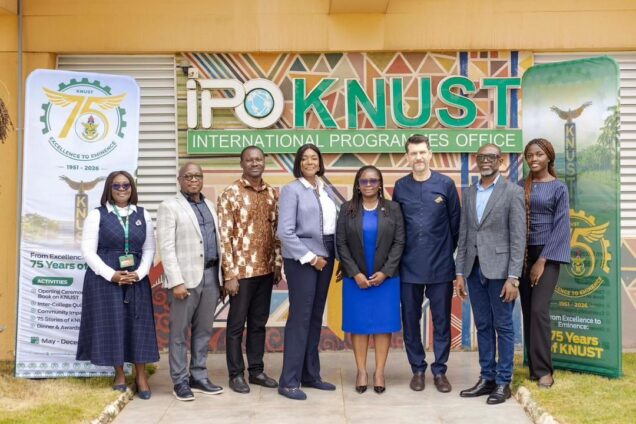
He spoke in an interview with the media after a session with the Resident Representative of the IMF, Dr Adrian Alter and the Department of Economics - KNUST’s faculty and students.
Prof. Oteng-Abayie identified low labour productivity, limited adoption of technology and inefficiencies in public spending—particularly in infrastructure, education and healthcare—as major constraints to Ghana’s economic progress.
The economist further highlighted the need for a coordinated national effort to integrate Artificial Intelligence into Ghana’s educational system, warning that failure to prepare students for an AI-driven economy could deepen graduate unemployment.
“Students are going into a world driven by artificial intelligence. If we are not upskilling them in AI, we risk a mismatch. Those who can match up will get the jobs, and those who cannot may remain unemployed for years,” he noted.
The engagement with the IMF discussed the detailed presentation on the economic outlook for the Sub-Saharan African region, providing insights into Ghana's specific economic reform efforts.
It underscored the IMF's commitment to involving local stakeholders in economic policy dialogues.
Country Representative of the IMF, Adrian Alter, believes that streamlining tertiary education to meet job market demands and relaxing certain financial policies for SMEs are key to building a stronger economy.
“What is key is to match graduates with the demand for jobs in the labour market. Tertiary education should be tailored to the job demands from the private sector. Diversifying the economy is crucial. Start-ups are required to provide collateral when seeking financial aid. Relaxing some of these financial constraints is key for developing startups and job creation,” he said.
Latest Stories
-
US judge strikes down policy suspending immigrant visa processing for 75 nations
6 minutes -
MCEs collecting fees from galamseyers are facilitating illegality – Ken Ashigbey
8 minutes -
Developer LMI Holdings commits to completing first 700 Saglemi housing units
31 minutes -
Africa’s next chapter will be built by institution-builders, not idea-havers
34 minutes -
Wenchi Traditional Council suspends Twafohene indefinitely
56 minutes -
Kpassa-Merimeri road undergoes filling and levelling works to improve accessibility
58 minutes -
9 Blue Water Guards arrested over alleged bribery, impersonation
1 hour -
Wildlife guard shot dead during Kakum patrol
2 hours -
‘I reject them without qualification’ — Afenyo-Markin hits back over Sammy Gyamfi’s claims
2 hours -
GoldBod must appear before a parliamentary inquiry to answer for gold-trade losses — Appiagyei
3 hours -
GoldBod row: Afenyo-Markin threatens legal remedies over “defamatory” attacks
3 hours -
GH¢22bn gold loss: Afenyo-Markin pushes for full parliamentary inquiry
3 hours -
GoldBod row: Afenyo-Markin refuses to back down
4 hours -
Swedish sword attack victim was 17-year-old girl, police say
4 hours -
VALCO rolling mill opens new frontier for Ghana’s aluminium industry
5 hours