

Audio By Carbonatix
As climate change, soil degradation and rising food insecurity place increasing pressure on Ghana's agricultural sector, a growing coalition of scientists, policymakers and development partners is calling for a fundamental rethink of how the country produces food.
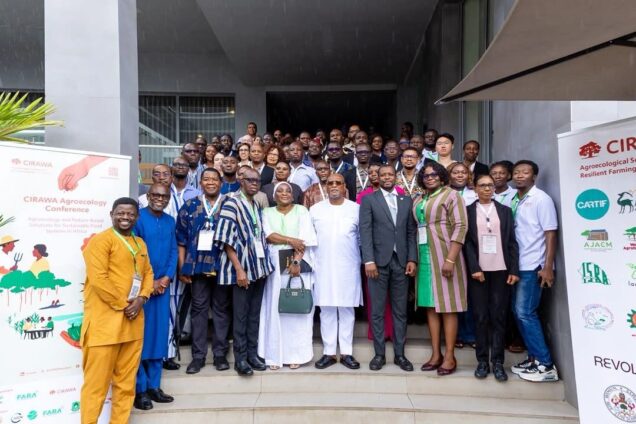
That debate came into sharp focus at the three-day CIRAWA Agroecology Conference in Accra, where government officials, researchers, farmers and international organisations gathered to discuss whether agroecology, rather than greater dependence on genetically modified organisms (GMOs) and external agricultural inputs, offers Ghana a more sustainable future.
While participants shared a common vision of building resilient food systems, discussions also exposed deeper questions about who should shape Ghana's agricultural future, what role science should play, and how much influence foreign funding should have over national food policies.
A Government Endorsement of Agroecology
Opening the conference, Ghana's Vice President, Professor Naana Jane Opoku-Agyemang, reaffirmed the government's commitment to integrating agroecological principles into national agricultural development.
In a statement delivered on her behalf by Chief of Staff Alex Segbefia, she said Ghana could no longer depend on agricultural systems that were failing to deliver sustainable outcomes.
Instead, government intends to promote practices such as crop diversification, agroforestry, composting, improved soil fertility management, biofertilisers, biopesticides, farmer-led irrigation, simple mechanisation and locally produced improved seed varieties.
The Vice President also endorsed calls for the development of a national agroecology strategy that would provide long-term policy direction while supporting Ghana's commitments under the Sustainable Development Goals.
Her remarks reflect a broader recognition that food production must increasingly work with nature rather than against it.
Why GMOs?
Among the conference's strongest voices was Agricultural Development and Food Systems Economist at the University for Development Studies, Professor Saa Dittoh, who questioned the growing emphasis on genetically modified crops in Ghana.
"The question has always been, why GMOs?" he asked. "We have alternatives. Why must we do it? There is actually no reason."
His criticism was not directed at biotechnology itself, but at what he described as an unnecessary dependence on technologies that may not address Ghana's real agricultural challenges.
Using beans as an example, Prof. Dittoh argued that Ghana has not experienced production shortages significant enough to justify genetically modified varieties.
Producing substantially more food without creating corresponding market demand, he warned, could simply decrease prices and reduce farmers' incomes rather than improve livelihoods.
The Hidden Cost of Losing Indigenous Seeds
Beyond the GMO debate, Prof. Dittoh warned that Ghana risks losing an irreplaceable agricultural heritage through the gradual replacement of indigenous crop varieties with imported high-yielding alternatives.
He recalled experiences from farming communities in the Volta Region, where many farmers abandoned traditional rice varieties in favour of improved seeds.
Years later, many have begun to regret that decision.
According to him, local varieties often possess qualities that cannot easily be measured by yield alone, including superior taste, nutritional value, adaptability to local conditions and cultural significance.
"People are now beginning to realise they lost something valuable when they abandoned those traditional varieties," he said.
Who Sets Ghana's Agricultural Agenda?
One of Prof. Dittoh's most pointed observations concerned agricultural research itself. He argued that limited domestic investment has left many researchers dependent on externally funded projects, allowing donor priorities to shape national research agendas.
"When researchers do not have funding, they naturally follow the priorities of those providing financial support," he said.
While acknowledging the important role international development partners play, he argued that Ghana must substantially increase domestic investment in agricultural research if it wishes to retain ownership of its long-term food strategy.
"Food is too important for us to leave its direction entirely to others," he said.
"Government must take ownership of agricultural policy and investment, while development partners complement, not dictate, our priorities."
The comments reflect a longstanding concern across many African countries, where donor-funded agricultural programmes often influence research priorities and policy directions.
Nature as Infrastructure
For Prof. Dittoh, agroecology extends far beyond farming practices. He argued that Ghana's environmental challenges, from illegal mining to wetland destruction and mangrove degradation, illustrate the consequences of neglecting nature's own protective systems.
Rather than relying solely on expensive engineered infrastructure, he said ecosystems themselves provide vital public services.
"Nature has already provided many of the solutions we are trying to replace with expensive infrastructure. When we destroy mangroves and wetlands, we remove the country's natural defence systems," he said.
Wetlands reduce flooding, mangroves protect coastlines from erosion, while healthy soils improve water retention and agricultural productivity.
Protecting these ecosystems, he argued, should become a central component of Ghana's climate adaptation strategy.
Building Food Sovereignty
The conference also heard broader reflections on Africa's place within global food systems. Edmond Moukala, Head of UNESCO's Office in Accra, described agroecology as more than an agricultural technique.
"Africa remains on the frontline of a climate crisis it did little to create. Agroecology is not just a farming method; it is an act of resistance," he said.
He argued that strengthening local food systems would improve food sovereignty while reducing dependence on increasingly fragile global supply chains disrupted by climate shocks, conflict and economic instability.
From Discussion to Action
The CIRAWA Agroecology Conference brought together participants from Ghana, Senegal, The Gambia, Cape Verde and several European countries through keynote lectures, technical workshops and policy dialogues.
Organisers say the discussions will inform practical recommendations aimed at helping governments, researchers and farming communities accelerate the transition towards more sustainable food systems.
It highlighted a growing consensus that agriculture can no longer be viewed solely through the lens of increasing production. Instead, future food systems must also restore ecosystems, strengthen biodiversity, empower farmers, protect indigenous knowledge and build resilience against a changing climate.
But the discussions in Accra suggest that the country's agricultural future is increasingly being framed around a central question: how to produce enough food while working with nature rather than against it.
Latest Stories
-
The more gov’t invests in ECG, the greater its losses become – Ben Boakye laments
1 minute -
JoyNews–Republic Bank Habitat Fair final day event comes off today at Marina Mall
6 minutes -
Scrap 15% priority placement quota for SHS admissions – GNAPS
6 hours -
IFC Managing Director Makhtar Diop to visit Ghana for investment talks
6 hours -
GPRTU opposes auctioning broken-down vehicles after 21 days
7 hours -
Nigerian Goodnews Aina crowned J30 Accra champion as Ghana’s Gwendolyn Duvor Klu retires in final
9 hours -
WACCE urges gov’t to declare state of emergency in galamsey-prone areas
9 hours -
NACOC boss calls for practical cross-border action against drug trafficking
9 hours -
Ghana calls for stronger regional cooperation to combat drug trafficking
10 hours -
Ablakwa presents bicycles to 100 North Tongu day students
10 hours -
Ablakwa supports 2,269 North Tongu SHS students with essential items
10 hours -
Dr Bawumia expresses sympathy with farmers over their inability to sell their produce even at reduced prices
10 hours -
Constitutional review: Govt must keep discussions open – Dr Tandoh
10 hours -
GPL 2026/27: David Gyamfi hat-trick fires Ashantigold to historic first victory
10 hours -
Ericsson celebrates 150 years of global innovation, 30 years of partnership and digital transformation in Ghana
11 hours