

Audio By Carbonatix
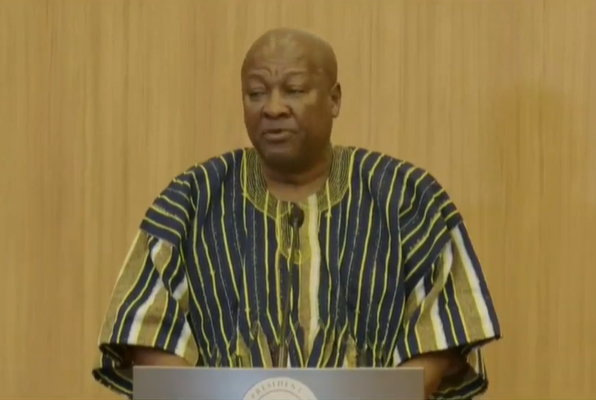
President John Mahama has said the true measure of any government should not be the number of projects it announces, but the number it completes and delivers to the people.
Speaking during a courtesy call by the Upper West Regional House of Chiefs, President Mahama said governance must be judged by results on the ground rather than promises, saying that development should be measured by projects that are finished and put to use by communities.
“The true measure of governance is not projects announced, but projects completed,” he told the chiefs.
In his remarks, the President pointed to changes his administration has made in the management of the District Assemblies Common Fund, saying the decision was aimed at giving local authorities greater control over development in their own communities.
According to him, when he assumed office, more than half of the Common Fund meant for district assemblies was being held at the centre in Accra and later disbursed from there.
“When we came into office, more than 50% of the District Assemblies’ Common Fund was being kept in the centre in Accra and being disbursed from Accra,” he said.
Mr Mahama said he responded by directing that 80 per cent of the fund should be transferred directly to the districts so assemblies could decide how best to use the money for local development.
“When I came, I gave a directive that 80% of the District Assemblies’ Common Fund should be transferred directly to the districts so that you can use it for the development that you want; you can determine what you want to do,” he said.
He said reports from across the country suggest that the funds are already being put to practical use, with visible projects beginning to emerge in many communities.
“And all over the country, we are receiving reports that it is being very effectively used, and CHPS compounds, 24-hour economy markets, and so on and so forth are quickly springing up,” the President said.
President Mahama said traditional authorities should not stand aside from local development issues, especially when district assemblies are receiving more direct access to public funds.
He said that chiefs have an important role to play in following how resources are used in their areas and ensuring that projects reflect the real needs of the people.
“I think that it’s an important thing that our traditional authority should also take an interest in what is happening in the districts."
“The true measure of governance is not projects announced, but projects completed,” the President said.
To support that, the President proposed a more structured relationship between the Upper West Regional House of Chiefs and state institutions at the regional and district levels.
“I therefore propose a more structured partnership between the Regional House of Chiefs and the Regional Coordinating Councils, MMDAs, Members of Parliament and the relevant ministries,” he said.
Under that arrangement, he said chiefs should be regularly updated on development projects in their regions and given the opportunity to monitor implementation and provide feedback.
He explained that the goal would be to ensure that chiefs are “periodically briefed on development projects and empowered to monitor implementation and provide feedback”.
President Mahama also suggested that each Metropolitan, Municipal and District Assembly should hold an annual meeting to brief stakeholders on how the District Assemblies Common Fund is being used.
He said such meetings should bring together chiefs, local political leaders, and other stakeholders so that district chief executives and municipal chief executives can account for the use of public funds and listen to local concerns.
“So I believe that in every MMDA once a year, you should bring all the stakeholders together and the district chief executives and municipal chief executives should brief them on how the District Assemblies’ Common Fund is being utilised,” he said.
He added that the assemblies should also use those meetings to gather proposals on what local people actually need, rather than imposing projects from above.
“They should also take suggestions from them on the things that are actually the felt needs of the people,” he said.
According to the President, such a system would improve transparency and help communities feel a stronger sense of ownership over development projects.
“This will strengthen transparency, public confidence, and community ownership of the projects,” he said.
President Mahama told the chiefs that the transformation of the Upper West Region should be seen as a collective national responsibility, requiring collaboration between government, the private sector, traditional authorities and local communities.
“The transformation of the Upper West Region is a shared national enterprise,” he said.
He said the government would provide direction and policy leadership, but lasting development would also depend on private investment, entrepreneurship, and stronger support for women and young people.
“Government will provide the visionary leadership and strategic purpose. The private sector must seize the opportunities that are created, and our youth must embrace entrepreneurship and hard work,” he said.
He also stressed the need to improve support for women through better access to finance, markets and leadership opportunities.
“Our women must be supported with greater access to finance, to markets and leadership opportunities,” he said.
At the same time, he urged traditional authorities to continue playing their role in maintaining peace and social cohesion.
“Our traditional authorities must continue as custodians of peace, unity, and moral leadership,” he added.
President Mahama said the Upper West Region is entering a period of opportunity and can become a stronger driver of national prosperity if its potential is properly harnessed.
He described the region as one with strategic importance and a hardworking population capable of contributing significantly to national development.
“The Upper West Region stands at the threshold of a new era in which its potential, its strategic location, and industrious people can drive prosperity,” he said.
He ended with an assurance that the region would not be left behind in the distribution of national resources.
“I promise you Upper West will always get its fair share of the national cake,” President Mahama told the chiefs.
Latest Stories
-
Ghana pays $3.5m to University of Memphis over scholarship debt
23 minutes -
People don’t remember style of play – GFA Comms Director defends Quieroz appointment
58 minutes -
Finance Ministry needs ‘refresher course’ in own records over GES recruitment – Adutwum’s spokesperson
1 hour -
Techiman 24-hour market project on course as Regional Minister inspects work, hails construction quality
1 hour -
Bono East Regional Fire Command engages master artisans in fire safety drive
1 hour -
Hitz FM’s Mr Haglah earns 2026 Ghana Entertainment Awards USA nomination
1 hour -
Accra Turf Club to hit the streets over Race Course demolition
2 hours -
Ashanti GJA launches 2025 regional media awards to celebrate excellence in journalism
2 hours -
From doubt to delight: Prang mother who thought GH¢1m win was a scam now celebrates
2 hours -
Energy Ministry says proposed private sector participation in ECG is not privatisation
2 hours -
Sparrow Studios, OldFilm Productions launch three movies for Ghana at 70
2 hours -
Mahama is doing well – UT Bank founder Prince Kofi Amoabeng pledges support
2 hours -
All 6,300 GES staff recruited without clearance have been paid – Finance Ministry
2 hours -
Akwaboa chiefs decry health and economic impact of deplorable roads in the area
2 hours -
Local Government Minister inspects Aayalolo buses at Madina, Achimota and Kinbu
2 hours