

Audio By Carbonatix
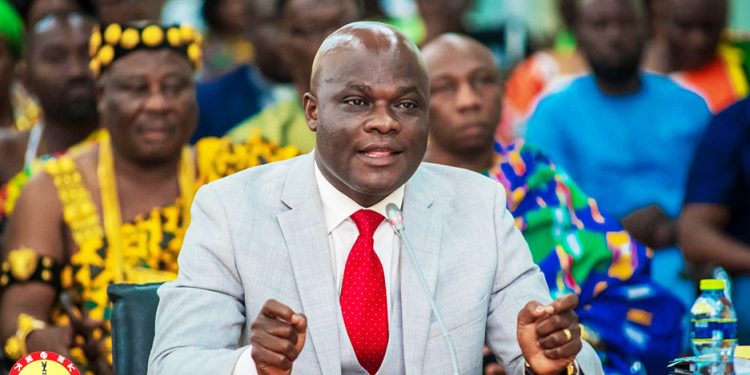
The Minister for Local Government, Chieftaincy and Religious Affairs, Ahmed Ibrahim, has disclosed that a committee has been established to develop a comprehensive database on shrines and other religious sites across the country.
According to him, the initiative is aimed at identifying and documenting the number of shrines in Ghana while establishing a clearer definition of what constitutes a shrine.
Mr Ibrahim made the disclosure when he appeared before Parliament’s Committee on Assurances, explaining that the exercise will be carried out by a multi-sectoral working group drawn from key departments within the Ministry.
The committee comprises officials from the Chieftaincy and Religious Affairs Directorate, Policy, Planning, Monitoring and Evaluation Directorate, as well as the Research, Statistics and Information Management units.
He added that the exercise will also be supported by the various Regional Coordinating Councils.
“The Ministry of Local Government, Chieftaincy and Religious Affairs has set up a working group comprising officers from Chieftaincy and Religious Affairs, Policy, Planning, Monitoring and Evaluation, Research, Statistics and Information Management directorates to create the database on shrines and other religious sites in the country,” he stated.
Mr Ibrahim explained that documenting shrines across the country requires careful consideration due to the complex nature of traditional religious practices and the different forms shrines may take.
“This is simply because a shrine is not just one thing. Even as we sit here, if I want to count a shrine, I need to be given the power. When I see you, I’ll remove your shirt and check you and do a body check. So clearly it is not simple and straightforward,” he said.
The Minister noted that some individuals may claim to operate shrines within communities, making it necessary to develop a proper framework to guide the identification process.
“You go to certain communities, somebody will come there and say he has a shrine and maybe begin to be doing things. No, that is another form of religion, but we are in charge of religion,” he added.
Mr Ibrahim said the committee will help establish a clear basis for identifying and classifying shrines, particularly because of the spiritual and cultural considerations involved.
“The nature of shrines will have to be agreed on. That is why a committee with expertise has been put in place,” he explained.
He further indicated that shrines are not always limited to physical structures, stressing that the definition must take into account the diverse ways in which people practise their beliefs.
“A shrine can be a pen. It can be a photo, a picture. It can be anything. And these are spiritual issues. The lawyers may disagree with you. So we need to have a very firm foundation as to what a shrine is,” the Minister stated.
Mr Ibrahim said the outcome of the committee’s work will provide reliable data to support policy decisions and enhance the government’s understanding of religious and traditional practices across the country.
Latest Stories
-
NSA employment summit: Authority targets 70 private placement
2 minutes -
43 suspects arraigned over killing of police officer at Gindabour
3 minutes -
Police identify alleged high-profile sponsors of “Ghana Jollof” online activities
8 minutes -
“I was starstruck” – Actress Aba Arthur recounts Black Panther experience and moment with late Chadwick Boseman
9 minutes -
US$350m Cocaine Bust: Minority caucus questions why key suspects remain unidentified
35 minutes -
Bono East Minister rejects Kajaji SHS dining hall project over shoddy work
36 minutes -
Nilex Corp donates US$259,000 medical equipment to Mahama Cares
50 minutes -
Minority caucus demands parliamentary recall over US$1bn drug seizures linked to Ghana
53 minutes -
Bono FDA seizes 57,000 pieces of unregistered baby diapers at major markets
60 minutes -
World Cup: Kofi Adams rejects claims of visa overstays by Ghana delegates
1 hour -
Residents and chiefs of Jema protest over detention of Techman nurse; demands her release
1 hour -
“Sometimes it’s deliberate to allow the cedi to depreciate a little” – Governor assures of control
1 hour -
One million tonnes of waste to be evacuated from Agbogbloshie in 90 days – Mahama
1 hour -
UCC confers honorary doctorate on Kwesi Pratt Jnr
2 hours -
Inheritance is not succession: REBRAND Masterclass ’26 to challenge founders on legacy
2 hours