

Audio By Carbonatix
The Union of Professional Nurses and Midwives Ghana (UPNMG) has called on the government to urgently replace nurses and midwives who leave the country to work abroad, warning that the growing exodus of health professionals is worsening staff shortages and placing immense pressure on the country's healthcare system.
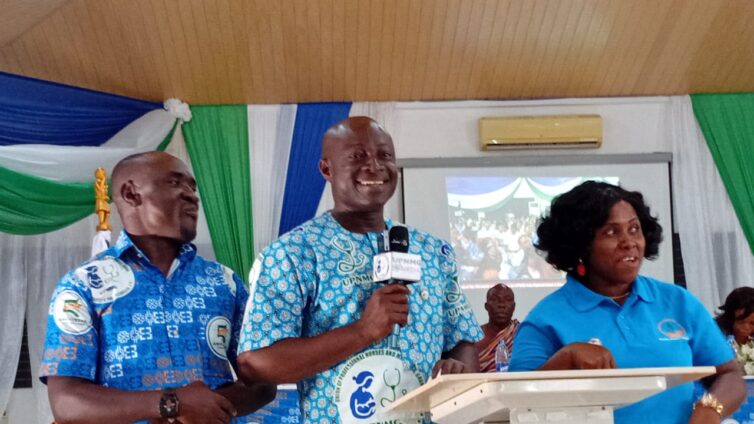
The appeal was made by the Volta Regional President of the Union of Professional Nurses and Midwives Ghana, Hon. Famous Agbenyefia Attipoe, during the union's Volta Regional conference held in Ho under the theme, "Forging a Healthy Employer–Employee Relationship for Optimum Productivity and Job Satisfaction: A Shared Responsibility."
According to Mr Attipoe, although Ghana continues to release experienced nurses and midwives to support healthcare systems in other countries, the government has failed to recruit enough personnel to replace those leaving, creating significant gaps in health facilities across the country.
"We actually want the government to give listening ears to us. As we speak now, the brain drain is so much. We have nurses and midwives almost every day leaving the country. We are talking about replacements, not even new employment," he said.
He urged the government to use the salaries of departed staff to recruit newly qualified nurses and midwives who remain unemployed.
"At least the government should consider replacing those who are leaving so that the salaries that would have been paid to them can be used to employ new people. A principal nursing officer who leaves earns much more than a staff nurse who would be recruited, so the government can easily fill those vacancies," he explained.
While welcoming bilateral arrangements that allow Ghanaian nurses to work overseas, Mr Attipoe said such programmes must not come at the expense of healthcare delivery at home.
"We are happy that nurses are getting opportunities to work outside the country, but why can't we recruit those who are sitting at home to fill the gaps? We are always sending our experienced professionals because other countries need them, but we also need to train more specialist nurses to bridge the gap," he added.
He further noted that delays in reviewing the conditions of service for nurses and midwives continue to fuel migration and dissatisfaction within the profession.
"It has been far too long since we were invited to discuss our conditions of service. The earlier we look at them, the better before the nursing front starts heating up again," he cautioned.
The concerns were echoed by the National President of UPNMG, Maxwell Oduro Yeboah, who said hundreds of trained nurses and midwives leave Ghana every month because they do not feel adequately valued despite their dedication.
"Every single month, hundreds of trained nurses and midwives carry their certificates to the airport. Today many of our own nurses and midwives are keeping other countries' health services alive while our wards here are short. Did they stop loving Ghana? No. But love flows both ways. A nurse or midwife who is paid fairly, kept safe and respected does not queue to leave."
Mr Yeboah stressed that improving job satisfaction was essential to retaining skilled health workers.
"Job satisfaction is not a favour to nurses and midwives. It is how Ghana keeps her nurses and midwives. If you want the hen to keep laying eggs, you must feed the hen," he said.
Speaking to journalists after the event, Mr Yeboah attributed many of the challenges facing healthcare delivery to inadequate logistics rather than negligence by health professionals.
He said nurses and midwives remain committed to providing quality healthcare but are often constrained by shortages of equipment and essential supplies.
"When people talk about avoidable deaths, in many cases you find there is a lack of equipment, lack of logistics or something necessary for the professionals to work with. Nurses and midwives are always ready to perform their duties, but if the tools they need are unavailable, it becomes the employer's problem."
He cited the country's recurring "no bed syndrome" as an example of systemic challenges beyond the control of frontline health workers.
"Nurses and midwives do not have the capacity to purchase beds or equipment for hospitals. Yet many of them go beyond their means, sometimes caring for patients on the floor. If the necessary logistics and equipment are provided, many of these unfortunate situations can be avoided."
Mr Yeboah also called for stronger collaboration among government, healthcare workers and patients to improve service delivery.
"We need the workers, we need the employer, and we need the clients. It is only when we meet each other halfway that this relationship will survive. Our nurses and midwives are ready to provide the services they were trained for. If employers provide the needed support, Ghanaians will receive the quality healthcare they deserve."
He maintained that the international success of Ghanaian nurses demonstrates that they can deliver excellent healthcare when given the right working environment.
"When our nurses leave Ghana, they are recognised among the best in the world. That tells us something is missing here. If we provide the right conditions of service, we will get the very best from them."
Latest Stories
-
Ghana wastes up to 50% of fruits and vegetables annually – Agrofresh
14 minutes -
CSSPS deploys more personnel to ease delays at resolution centres
30 minutes -
Poor transport and storage systems contribute to post-harvest losses in Ghana – Mathias Yabe
48 minutes -
Partisan MMDCE elections could stifle development – NDC
1 hour -
TUC urges Mahama to keep constitutional reform discussions open
1 hour -
“They showed up with character” – Sampson praises Black Princesses after South Korea win
1 hour -
Free tablets , missed opportunities ? Rethinking Ghana’s one student-one tablet initiative
2 hours -
Mahama has not abandoned Haruna Iddrisu, he is backing him to fix education challenges – Spokesperson
2 hours -
Only Category C schools available for placement resolution – Northern Region parents say
2 hours -
More students benefited under Mahama gov’t than previous 20 years combined – SLTF CEO
2 hours -
Gov’t reviewing policy for stipends, assistive devices for disabled students – SLTF CEO
2 hours -
Israel sets deadline for Britain to close consulate as settlers warn of sanctions hit
2 hours -
Community leaders call for 24-hour operation of African Mall in Ejisu-Kwamo
3 hours -
Bozoma Saint John wedding highlights Ghana’s untapped tourism dividend
3 hours -
Brent crude oil rises above $100 a barrel as Middle East conflict intensifies
3 hours