


Audio By Carbonatix
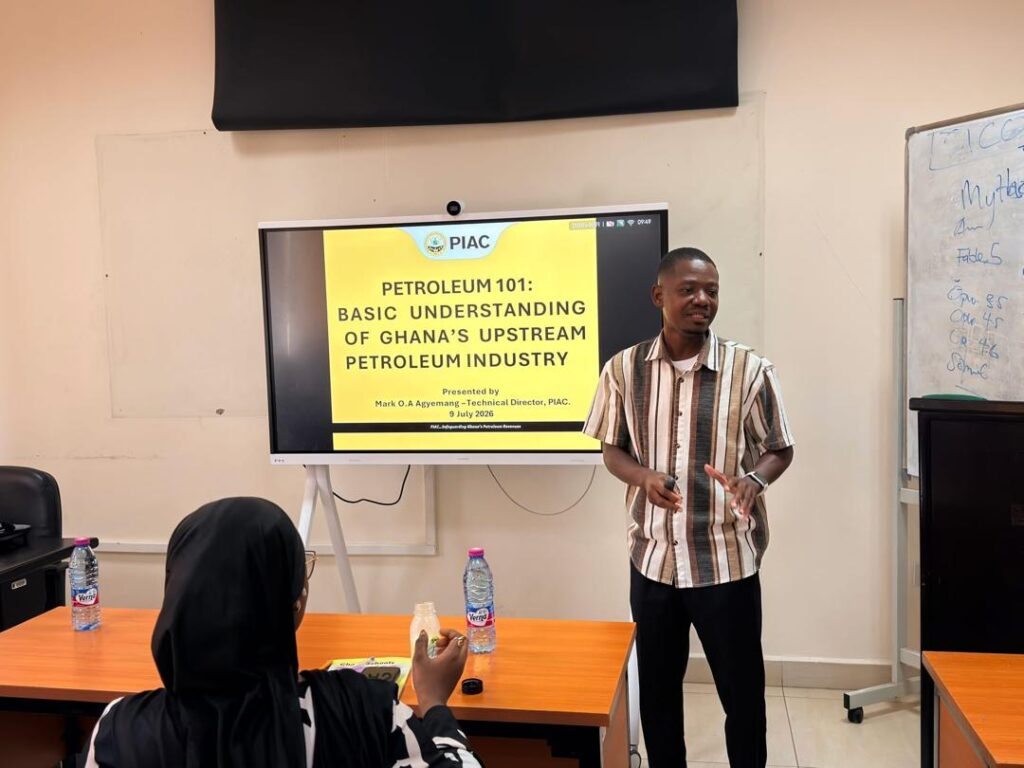
Technical Director of the Public Interest and Accountability Committee (PIAC), Mark Agyemang, has cautioned that adopting uniform global energy transition policies without considering Ghana's unique economic and energy needs could pose significant challenges to the country's petroleum industry.
Speaking during a lecture for the second cohort of the Africa Extractive Media Fellowship, Mr. Agyemang said the global shift towards cleaner energy remains one of the biggest threats to oil-producing countries such as Ghana, stressing that energy transition strategies should not be implemented using a one-size-fits-all approach.
According to him, while the transition to low-carbon energy is necessary, countries differ in their levels of development, energy demand and economic dependence on fossil fuel resources, making a common global implementation framework difficult.
"Energy transition is the main threat to the industry. Adopting a global policy could be problematic because countries could differ in their approaches to implementation," he said.
Mr. Agyemang argued that Ghana must work with other countries in the region to develop coordinated strategies that reflect their shared economic realities while positioning themselves to respond to evolving global climate policies.
He also noted that regional cooperation would enable countries to better safeguard their petroleum industries, strengthen energy security and ensure that the transition to cleaner energy does not come at the expense of economic development.
He said such collaboration would also strengthen the country's negotiating position in international climate and energy discussions, ensuring that Ghana's development priorities are adequately reflected in global policy decisions.
The lecture formed part of the Africa Extractive Media Fellowship, a capacity-building programme that equips journalists with specialised knowledge to report on Ghana's extractive sector, including petroleum governance, mining, energy policy and natural resource management.
Latest Stories
-
Three nights. 28 titles. Ultimate history made
8 seconds -
Ghanaian delegates at IYF 2026 could become bridges for stronger Russia ties – John Aggrey
4 minutes -
Nigeria: Over 30 dead, 50 hospitalised after consuming alcoholic substance in Ondo State
7 minutes -
UK lawmakers demand new law to address AI threat to human rights
16 minutes -
WAFU B U-17 Girls Cup: Black Maidens depart Accra for tournament in Yamoussokro
16 minutes -
Sweden’s center-left bloc narrowly ahead as election remains too close to call
26 minutes -
GPL 2026/27: ‘We won ugly’ – Kotoko head coach unimpressed after Lions victory
29 minutes -
7 out of 10 human trafficking cases in Ghana never reach prosecution — JoyNews Research
45 minutes -
Music, football to converge at Music Meets Football Summit 2026 in Lusaka
50 minutes -
Putin invites young global leaders to partner with Russia in shaping future world order
51 minutes -
Putin calls for ‘just world’, says every nation must be free to choose its own path
58 minutes -
IFY 2026 food festival to serve 20,000 meals showcasing global cuisines in Russia
1 hour -
Ghana has a Domestic Violence Act: But can a victim afford to use it?
1 hour -
Young artists from 100 countries showcase works at IFY 2026 in Russia
1 hour -
Russia opens neo-Nazism exhibition at International Festival of Youth 2026
2 hours