

Audio By Carbonatix
The Member of Parliament for Akwatia, Bernard Bediako Baidoo, has called for stronger enforcement of Ghana's existing environmental and sanitation laws and regulations, arguing that the country’s recurring sanitation and flooding challenges cannot be blamed solely on public indiscipline.
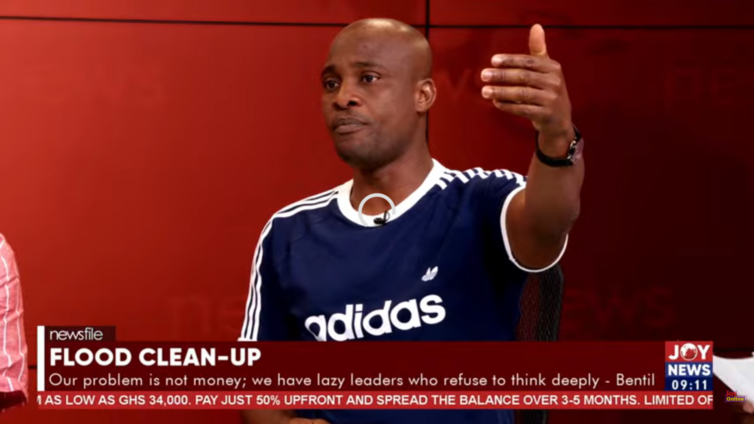
Speaking on JoyNews' Newsfile programme on Saturday, July 11, the legislator acknowledged concerns about indiscipline in the Ghanaian society but maintained that the major failure lies in the inability of state institutions to enforce laws that are already in place.
According to him, unlike many developed countries where compliance with regulations is largely observed, Ghana's challenge has been the weak enforcement of rules governing public behaviour, land use and sanitation.
"The kind of indiscipline, all of us, the kind of indiscipline we have here, the difference between here and there (Western countries) is the indiscipline, because if there is no indiscipline, you don’t talk about enforcement," he said.
However, Mr. Baidoo stressed that Ghana cannot attribute its sanitation and flooding problems entirely to indiscipline, insisting that the country already has sufficient legal frameworks and institutions capable of addressing these challenges.
The Akwatia MP argued that Ghana's inability to effectively manage sanitation and prevent environmental degradation is not because of a shortage of legislation.
"We have our laws, there are law enforcement officers and agencies, there are assemblies, we have so much laws," he stated.
He maintained that introducing more laws would not resolve the country's challenges unless existing regulations are properly implemented.
"In fact, we don’t need further laws, it's all about enforcement, and that is where I come to that we need to enforce it," he added.
His comments come amid renewed national discussions about the causes of recurring flooding and sanitation difficulties, following recent floods that affected several communities and sparked debate over whether the main challenge is public behaviour, weak governance systems or inadequate infrastructure.
Mr. Baidoo acknowledged that indiscipline contributes to environmental challenges, including poor waste disposal practices and disregard for regulations.
He referenced comments made by former President Nana Akufo-Addo during an engagement with Ghanaian residents in Canada, where the former president reportedly highlighted indiscipline as a major challenge facing the country.
"Former President Akufo-Addo conceded when he went to meet the Ghanaian community in Canada and said he will not even continue using our money to cure our indiscipline. He admitted that the problem was indiscipline," Mr. Baidoo said.
However, he argued that while individual responsibility remains important, the state cannot use public indiscipline as a substitute explanation for institutional failure.
Responding to President John Dramani Mahama's comments on the issue, the MP said he agreed with the need to address indiscipline but cautioned against presenting it as the sole reason for Ghana's current situation.
"President Mahama is saying, and I agree with him, but it cannot be said that we are where we are because of indiscipline," he stated.
Mr. Baidoo argued that Ghana's governance system already provides institutions with the authority needed to enforce standards in areas such as sanitation, construction, environmental protection and urban development.
He pointed to the role of law enforcement agencies and Metropolitan, Municipal and District Assemblies (MMDAs), saying these bodies must be empowered and held accountable for ensuring compliance.
According to him, effective enforcement would reduce practices such as illegal dumping, unauthorised developments and disregard for environmental regulations.
Mr. Baidoo urged authorities to move beyond assigning blame and focus on applying existing rules consistently.
He argued that sustainable solutions require a combination of responsible citizen behaviour and firm institutional action.
While acknowledging the importance of addressing societal attitudes towards sanitation and environmental protection, he maintained that laws only become effective when state institutions have the commitment and capacity to enforce them.
Latest Stories
-
Pay me by Sept. 11 or face the court – Kow Essuman demands salary, benefits from Finance Minister
4 minutes -
Bawumia’s destiny lies in the hands of God; not you – Muslim Forum for Peace and Unity replies Rev. Owusu Bempah
6 minutes -
NPP NEC meets today to discuss and approve party’s position paper on Constitution Review proposals
12 minutes -
Today’s frontpages: Thursday, September 10, 2026
19 minutes -
Ghana Garden and Flower Show returns on Sept 11 with focus on green jobs, business and wellbeing
20 minutes -
Titus-Glover camp says Mustapha Salam wasn’t pressured to withdraw from National Organiser race
22 minutes -
Ghana’s acclaimed Christian – Muslim unity bigger than Owusu Bempah’s hatred and bigotry – Muslim Forum for Peace and Unity
24 minutes -
Karpowership lights up young minds on International Literacy Day
34 minutes -
Banking sector NPLs fall to GH¢19.9bn as asset quality improves
38 minutes -
Republic Bank Ghana, UPSA sign strategic MoU to advance professional development and industry-academia collaboration
42 minutes -
MTN 30th Anniversary CEO Invitational Golf Tournament set to tee off at Achimota
46 minutes -
Ghana woos Australian investors into critical minerals
59 minutes -
Akufo-Addo’s former legal counsel Kow Essuman, writes to Finance Minister to demand his ex-gratia payment
1 hour -
NSMQ Final: St Augustine’s get GH¢110,000 motivational package from old boys
1 hour -
AFCON 2027: Ghana has no business doing football if we can’t beat Somalia and The Gambia to qualify – George Afriyie
2 hours