

Audio By Carbonatix
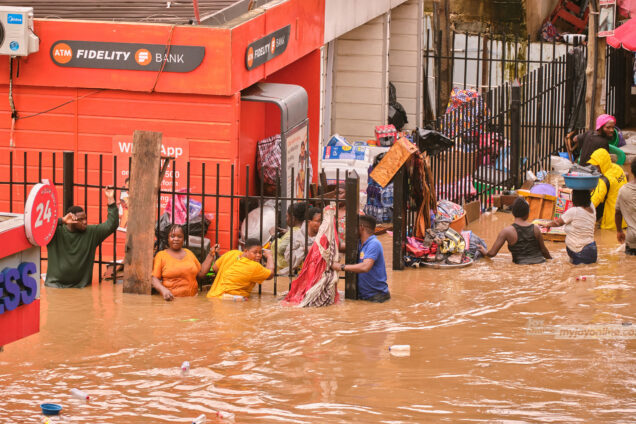
One moment, an elderly woman was desperately fighting for her life as raging floodwaters swept through her neighbourhood. Her cries for help echoed across social media, becoming a heartbreaking symbol of yet another disaster that caught thousands of Ghanaians off guard.
Days later, as floodwaters slowly receded and grieving families counted their losses, the nation watched leaders gather for a National Day of Thanksgiving.
For many Ghanaians, however, one question refused to disappear:
Must every rainy season become another national tragedy before meaningful action is taken?
The recent floods that devastated parts of Accra have once again exposed one of Ghana's most persistent urban challenges. Homes were submerged, businesses destroyed, roads rendered impassable, and lives tragically lost. Beyond the immediate destruction, the disaster has reignited a national conversation about whether Ghana is doing enough to prepare for increasingly frequent and intense rainfall.
As climate change continues to increase the occurrence of extreme weather events across the globe, flooding is becoming a reality that every nation must confront. The difference is not whether heavy rains will fall, but whether cities are prepared to withstand them.
In the aftermath of the floods, many Ghanaians have pointed to one issue that has become impossible to ignore: poor waste management.
Across several communities in Accra, gutters designed to channel stormwater have become clogged with plastic waste, refuse, silt, and other debris. During heavy rainfall, these blocked drains are unable to carry water away efficiently, causing floodwaters to overflow into homes, businesses, and roads.
The scenes are painfully familiar. Every rainy season brings images of submerged vehicles, stranded commuters, collapsed structures, and desperate rescue operations. While heavy rainfall may be unavoidable, many citizens argue that the scale of destruction is not.
Another issue attracting widespread attention is the maintenance of drainage infrastructure.
A drainage system is only as effective as the care it receives. Without regular inspection, cleaning, and repairs, even well-designed storm water systems eventually lose their capacity to protect surrounding communities.
During a recent visit to Toronto, Canada, I observed the Black Creek stormwater channel, one of several flood-control systems that form part of the city's broader stormwater management network. Throughout the year, these channels undergo routine maintenance to ensure water flows freely during periods of heavy rainfall.
No city has completely eliminated flood risk. Toronto itself has experienced severe flooding during extreme weather events. However, consistent investment in drainage maintenance, flood preparedness, and infrastructure planning remains an important component of the city's resilience strategy.
The comparison raises an important question.
Could Ghana benefit from placing greater emphasis on the routine maintenance of drains before the rains arrive instead of responding after disaster strikes?
Urban planning has also become part of the national discussion.
Many modern residential developments in Ghana feature extensive concrete compounds, high perimeter walls, tiled outdoor spaces, and paved surfaces. While these designs are often attractive and practical, they also reduce the amount of rainwater that can naturally soak into the ground.
Instead, water flows rapidly across hard surfaces into drainage systems that are already struggling to cope.
By contrast, many residential neighbourhoods in Canada incorporate green lawns, landscaped open spaces, trees, and permeable surfaces that allow rainwater to infiltrate the soil naturally. These features help reduce surface runoff and lessen pressure on drainage infrastructure.
This does not mean Ghana should simply copy another country's housing model. Every nation has unique environmental conditions, cultural preferences, and urban development needs. Nevertheless, there may be valuable lessons in designing communities that better accommodate stormwater while protecting both property and public safety.
The debate also extends beyond infrastructure.
Environmental laws already prohibit indiscriminate dumping of waste into waterways and drains. Building regulations exist to guide safe urban development. The challenge often lies in enforcement.
Without consistent enforcement of sanitation regulations, proper land-use planning, and responsible construction practices, investments in drainage infrastructure alone may not solve the problem.
Flood prevention requires cooperation between government institutions, local authorities, private developers, environmental agencies, businesses, and individual citizens.
Every plastic bottle thrown into a gutter matters.
Every blocked drain increases risk.
Every illegal structure built across a watercourse can worsen flooding downstream.
Ultimately, preventing future disasters is a shared national responsibility.
The recent floods should not merely be remembered as another unfortunate chapter in Ghana's history. They should become a turning point.
A turning point that inspires cleaner communities.
A turning point that prioritises preventive maintenance over emergency response.
A turning point that encourages smarter urban planning and greater respect for environmental laws.
A turning point that places long-term resilience ahead of short-term convenience.
Climate change is unlikely to make future rainy seasons easier.
Indeed, scientists continue to warn that extreme rainfall events may become more frequent and more intense in many parts of the world.
Ghana cannot control the weather.
But Ghana can control how prepared it chooses to be.
Investment in modern drainage infrastructure, improved waste management, stronger enforcement of environmental regulations, sustainable urban planning, and continuous public education could significantly reduce the impact of future floods.
Every disaster presents a choice.
We can rebuild exactly as before and wait for the next flood.
Or we can learn from today's pain and create safer, more resilient cities for generations yet unborn.
For the families who lost loved ones, homes, businesses, and treasured possessions, the greatest tribute Ghana can offer is not simply sympathy.
It is action.
Because when the next heavy rains arrive, and they surely will, the question should no longer be whether Ghana is ready.
The answer should already be visible in cleaner streets, stronger drainage systems, better planning, and a nation determined never to repeat the mistakes of the past.
Latest Stories
-
Mahama urges investors to comply with Ghana’s laws, prioritise local participation
1 minute -
KNUST, EPA test national air quality data hub ahead of Ghana rollout
13 minutes -
Anidaso Mutual Fund net assets rise 47.7% to GH¢6.31m in 2025
24 minutes -
WFP-Korea programme strengthens local economy and builds resilience in Northern Ghana
28 minutes -
GIIF’s Accra-Kumasi Expressway Ltd. SPV Initiative: A bold blueprint for financing Ghana’s infrastructure development
37 minutes -
From surviving dry spells to building resilience: Alhassan’s Story
37 minutes -
GRA targets over double revenue by 2028
49 minutes -
Black Maidens bring the jama, then bring the goals in WAFU B opener [VIDEO]
53 minutes -
GNPC Explorco showcases Voltaian Basin exploration potential at AOW:Energy 2026
58 minutes -
Black Maidens cruise past Burkina Faso in WAFU B opener
59 minutes -
Dafeamekpor calls for forensic audit after alleged GH¢600m COVID-19 fumigation gap
1 hour -
Minority demands itemised accounts for GHS50m South Africa evacuation, pulls out of closed-door meeting
1 hour -
Black Princesses arrive in Ghana after participating in FIFA U20 Women’s World Cup in Poland [PHOTOS]
1 hour -
Effiduase Asokore MP sues Rev. Owusu Bempah for GH¢10m over alleged defamatory comments
1 hour -
Chris Wilder backs Jordan Ayew to be a success at Sheffield United
1 hour