

Audio By Carbonatix
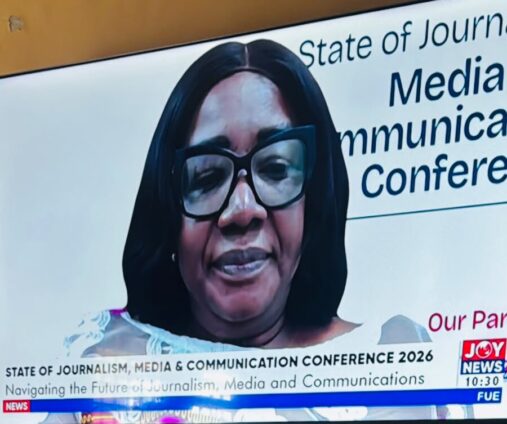
The Rector of the University of Media, Arts and Communication (UniMAC) Institute of Journalism, Prof Christiana Hammond, has urged journalism educators and media professionals to rethink how future journalists are trained, arguing that technical competence alone will no longer be enough in an increasingly complex and technology-driven media landscape.
Delivering her address at the opening of the inaugural State of Journalism, Media, and Communication Conference (SJMCC 2026) on Wednesday, July 15, Professor Hammond said the future of journalism will require professionals who combine technical expertise with ethical leadership, critical thinking, and the ability to adapt to constant change.
The two-day virtual conference, held on the theme "Navigating the Future of Journalism, Media, and Communication in a Dynamic World," is the first international academic conference organised by UniMAC since the merger of the Ghana Institute of Journalism (GIJ), the National Film and Television Institute (NAFTI) and the Ghana Institute of Languages (GIL).
Professor Hammond said although technological advancements continue to reshape journalism and communication, preparing professionals for the future goes beyond equipping them with digital competencies.
"The future is not only about the acquisition of skills or competencies, especially due to technological advancements."
Instead, she said, tomorrow's journalists and communicators must possess broader qualities that will enable them to respond to emerging challenges with sound judgement and integrity.
"The future requires wisdom, soft skills, intercultural competencies, ethical leadership, interdisciplinary collaboration, and the ability above all to learn, backed by evidence-based research capable of informing current trends in media, journalism and communication, education, and practice."
According to Professor Hammond, these qualities are central to the purpose of the conference and will underpin discussions over the two-day event.
"All these, I believe, are inclusive of the package that this conference seeks to serve in the two days of the conference."
She described the conference theme as timely, noting that the pace of change within journalism and communication means the future cannot be taken for granted.
"The theme explicitly articulates the realities confronting journalism, the media and communication, education, and practice. Yes, the future can neither be predetermined nor predicted, and so we need to navigate our ways in this fast-evolving space."
Professor Hammond said journalism institutions have a responsibility to prepare graduates who can respond to these uncertainties while remaining committed to serving the public interest.
She added that the Institute of Journalism remains committed to reviewing its academic programmes, strengthening partnerships with industry, and embracing innovation to ensure its graduates remain globally competitive.
"The Institute of Journalism, UniMAC, remains committed to continuously reviewing its programmes, strengthening partnerships with industry, embracing innovations, and ensuring that our graduates remain globally relevant and competitive."
Professor Hammond encouraged participants to use the conference to exchange ideas, build meaningful networks, and contribute to shaping the future of journalism, media, and communication in Ghana and beyond.
Latest Stories
-
Accra-Kumasi Expressway: Only nation-wreckers will oppose project – Frank Amoakohene
10 minutes -
Emerging agri-journalists gather in Croatia for global event
1 hour -
PPI Ghana congratulates Dr Abdul-Baasit Aziz-Bamba: Ghana needs a proper reset on value for money
1 hour -
Kasise Ricky Peprah writes: GBA’s face must be called out – for the record
1 hour -
Bernice Offei battled dementia for five years before death, former manager reveals
1 hour -
Jordan Ayew’s return offers Ghana timely boost ahead of AFCON qualifiers
1 hour -
De Zerbi raises doubts over Kudus’ availability for Ghana’s AFCON qualifiers
2 hours -
Ghana’s reputation must not be dented by self-centred individuals – Madina MP on cocaine seizure
2 hours -
MTN Ghana pushes digital growth for SMEs as sixth business clinic ends in Accra.
2 hours -
Black Maidens confident of WAFU B title defense ahead of Burkina Faso clash
2 hours -
5 players who deserve a Black Stars call-up for AFCON 2027 qualifiers
2 hours -
Photos: Vice President Jane Naana reviews changing of guard as Ghana Air Force takes over at Presidency
2 hours -
Africa’s richest man launches continent’s biggest share sale
2 hours -
Why Ghana’s MSMEs must rethink human capital investment: Seven strategic benefits
2 hours -
Asutifi South Assembly forms taskforce to stamp out illegal NHIS fees
2 hours