

Audio By Carbonatix
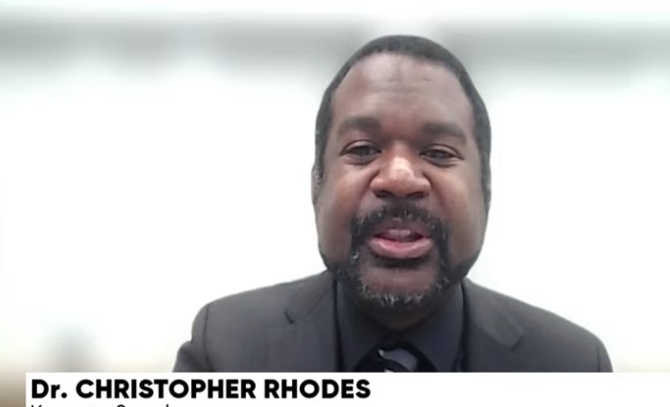
Senior Lecturer in the Social Sciences at Boston University and Lecturer in the Department of Government at Harvard University, Prof Christopher Rhodes, has urged journalists to remain committed to both facts and truth, arguing that journalism's role in promoting democratic accountability extends beyond simply reporting verified information.
Speaking virtually at the opening of the State of Journalism, Media and Communication Conference 2026 (SJMCC 2026) on Wednesday, 15 July, Prof Rhodes reflected on the historic role of newspapers in Africa's independence struggle before challenging journalists to uphold truth in an era marked by democratic backsliding, misinformation and declining public trust.
He noted that newspapers played a pivotal role in Ghana's struggle for self-rule by shaping public opinion and mobilising resistance against colonial rule.
"In Ghana, the proliferation of newspapers came with a growing independence struggle."
According to Prof Rhodes, many of the journalists and newspaper publishers of the colonial era later became prominent figures in Africa's liberation movements.
"Nearly 90 newspapers, mostly created by African journalists and editors, were created in what was then the Gold Coast Colony."
He cited Dr Kwame Nkrumah's Accra Evening News as one of the publications that became closely associated with Ghana's independence movement.
"He referred to the paper as the backbone of the party."
Prof Rhodes, however, observed that the post-independence era also demonstrated how journalism could become influenced by political interests.
"The facts of Nkrumah's life and leadership had not changed, but how they were selectively portrayed during his rule gave way to a new set of selective portrayals after his rule. Throughout it all, these facts were employed to serve particular agendas, rather than a capital T conception of truth."
Drawing on that historical lesson, he challenged journalists to distinguish between factual reporting and the broader pursuit of truth.
"As journalists, we commit to both facts and truth, but we must not confuse one for the other. Our commitment to facts is the most basic. We must report the facts, the whole facts, and nothing but the facts."
He stressed that accurate reporting, while essential, should not be regarded as the ultimate goal of journalism.
"Reporting facts fully, completely, and honestly is the first step of good journalism. Not the last. Reporting facts is a necessary but not sufficient condition for reporting truth."
Prof Rhodes said these principles are especially important at a time when democracies around the world are confronting increasing threats to press freedom, the rapid spread of misinformation and disinformation, and declining public confidence in institutions.
He urged journalists to remain steadfast in their commitment to truth, describing it as fundamental to preserving the credibility of the media and strengthening democratic governance.
Latest Stories
-
Three nights. 28 titles. Ultimate history made
5 minutes -
Ghanaian delegates at IYF 2026 could become bridges for stronger Russia ties – John Aggrey
9 minutes -
Nigeria: Over 30 dead, 50 hospitalised after consuming alcoholic substance in Ondo State
12 minutes -
UK lawmakers demand new law to address AI threat to human rights
21 minutes -
WAFU B U-17 Girls Cup: Black Maidens depart Accra for tournament in Yamoussokro
21 minutes -
Sweden’s center-left bloc narrowly ahead as election remains too close to call
32 minutes -
GPL 2026/27: ‘We won ugly’ – Kotoko head coach unimpressed after Lions victory
34 minutes -
7 out of 10 human trafficking cases in Ghana never reach prosecution — JoyNews Research
50 minutes -
Music, football to converge at Music Meets Football Summit 2026 in Lusaka
55 minutes -
Putin invites young global leaders to partner with Russia in shaping future world order
56 minutes -
Putin calls for ‘just world’, says every nation must be free to choose its own path
1 hour -
IFY 2026 food festival to serve 20,000 meals showcasing global cuisines in Russia
1 hour -
Ghana has a Domestic Violence Act: But can a victim afford to use it?
1 hour -
Young artists from 100 countries showcase works at IFY 2026 in Russia
1 hour -
Russia opens neo-Nazism exhibition at International Festival of Youth 2026
2 hours