

Audio By Carbonatix
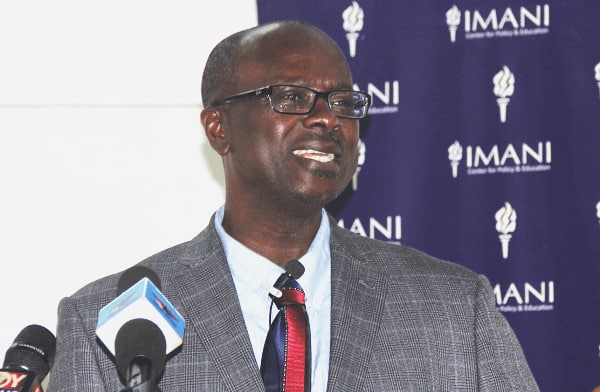
Legal practitioner and governance advocate Professor Stephen Kwaku Asare has criticised the one-year prison sentence handed to TikToker Camilla Alhassan.
The professor, popularly known as Kwaku Azar, argued that while her comments were offensive and false, they should not have attracted criminal prosecution in a constitutional democracy.
In a Facebook post following Alhassan's conviction, Kwaku Azar said the case raises broader constitutional concerns about freedom of expression and the role of the criminal justice system in policing speech.
"The conviction and one-year sentence imposed on a TikToker for insulting the President should concern everyone committed to constitutional democracy," he wrote.
Madam Alhassan was sentenced by an Accra Circuit Court after pleading guilty to charges of offensive conduct and publication of false news over videos in which she made unsubstantiated allegations against President John Dramani Mahama.
Although condemning the content of the TikToker's remarks as "vulgar, irresponsible, and false," Kwaku Azar argued that criminal prosecution was not the appropriate response.
"The real question, however, is whether speech of this nature should attract criminal prosecution in a constitutional democracy. GOGO believes it should not," he stated.
According to him, democracies should not rely on criminal sanctions to enforce civility or regulate political discourse.
"A democracy cannot prosecute its way to civility. Criminal courts should not become arbiters of taste, manners, or political discourse," he said.
He maintained that public officials, particularly the President, must be prepared to endure criticism, ridicule, exaggeration and even offensive speech as part of democratic governance.
"Public office demands broad shoulders, not broad criminal statutes," he wrote, adding that the criminal law should not be used to vindicate "bruised feelings or wounded egos."
Instead, Kwaku Azar argued that offensive speech should be countered through public condemnation, civic accountability and social sanctions rather than imprisonment.
"The appropriate response to bad speech is more speech, public condemnation, and social accountability, not imprisonment," he said.
The legal scholar attributed the increasing use of abusive language in public discourse to a broader decline in civic values, accusing political parties, sections of the media, social media platforms and even some religious leaders of contributing to the deterioration of public conversation.
He argued that society has increasingly rewarded outrage and sensationalism over truth and reason.
"The criminal law cannot repair what civic culture has allowed to decay. It can punish crimes. It cannot manufacture virtue," he wrote.
As part of his recommendations, Kwaku Azar called on Parliament to review and repeal what he described as colonial-era laws that criminalise expression rather than genuine harm.
He also urged law enforcement agencies to focus their efforts on fighting corruption, violent crime, organised crime, fraud and cybercrime instead of prosecuting offensive speech.
"The measure of a professional police service is not how quickly it responds to offensive speech, but how effectively it protects citizens from real crime," he stated.
Kwaku Azar further called on political parties to refrain from promoting individuals whose public profile is built on abuse and vulgarity, while urging schools, families, religious institutions and civil society organisations to strengthen civic education and encourage respectful public discourse.
He concluded by stressing that while society should reject incivility, the Constitution must continue to protect freedom of expression.
"The State should punish crime. Society should punish incivility. Political parties should refuse to reward it.
"The Constitution should protect the freedom to speak, even when society condemns what is said. That is how constitutional democracies cultivate both liberty and civility."
Latest Stories
-
GH¢60k to run 66 Rent Control offices for 3 months? – Acting Commissioner questions Finance Minister
12 minutes -
Who cooked the Ghana Jollof?
13 minutes -
Republic Bank targets 42% mortgage market share by 2026 year-end
15 minutes -
Ghana eyes first astronaut as country sets sights on global space economy
22 minutes -
WAFU B U-17 Girls Cup: Black Maidens primed for Nigeria encounter
27 minutes -
Security agencies won’t chase citizens for insulting President, other officials under my watch – Bawumia
42 minutes -
Europa League: Eddie Nketiah scores first goal of 2026/27 season in Palace win over Lech Poznan
53 minutes -
Bawumia condemns remand of Techiman nurse, demands her release over free speech concerns
1 hour -
Today’s front pages: Friday, September 18, 2026
3 hours -
Prof Kwaku Asare questions legal basis of case against senior nursing officer linked to ‘Ghana Jollof’
3 hours -
Financial inclusion must go hand in hand with investor protection – BoG Governor
3 hours -
Ablakwa rewards six North Tongu WASSCE best performers with MacBooks, scholarships
4 hours -
Gender Ministry touts gains in LEAP, school feeding and disability support
4 hours -
72 vessels, 17,336 fishing hours: The monitoring gap at Ghana’s first Marine Protected Area
5 hours -
Ansa-Asare questions rush to lower presidential age to 30
5 hours