


Audio By Carbonatix
Months after its launch, questions are emerging over whether the Fugu Wednesday campaign is losing momentum, with traders saying the initiative has created awareness but has not yet delivered the expected boost in sales.
The campaign, introduced by the Ministry of Tourism, Culture and Creative Arts, encourages Ghanaians to wear the traditional Fugu smock every Wednesday as part of efforts to promote cultural identity and support local producers.
It was launched following a social media debate over President John Dramani Mahama’s decision to wear a traditional Fugu during a state visit to Zambia, after some online users in the country described the outfit as a “blouse”.
The comments triggered widespread reactions from Ghanaians who defended the smock’s cultural significance and highlighted its importance as a symbol of Ghanaian heritage.
However, some Fugu traders say the attention generated by the campaign has not translated into the level of commercial growth they anticipated.
Aligasa Yussif, a Fugu trader in Accra, said he expected demand for the traditional attire to increase significantly after the campaign was introduced, but sales have recorded only modest improvement.
Another trader, Mohammed Ali, said business has improved compared to the period before the campaign but believes the initial excitement surrounding Fugu Wednesday has reduced.
He explained that some customers still consider traditional handwoven Fugu too heavy for regular use, despite the availability of lighter machine-woven versions.
The concerns among traders reflect wider public opinions about the campaign. While some Ghanaians continue to support Fugu Wednesday as a means of preserving cultural heritage and promoting local textile businesses, others say work conditions, lifestyle choices and the country’s warm climate make regular use of the attire difficult.
Some members of the public have also argued that sustained promotion and stronger support for local producers will be necessary for the campaign to achieve its long-term objectives.
Responding to concerns about declining enthusiasm, Minister for Tourism, Culture and Creative Arts, Abla Dzifa Gomashie, said the initiative was not designed to produce immediate results.
She explained that changing public dressing habits requires consistent engagement and government intends to evaluate the campaign after one year.
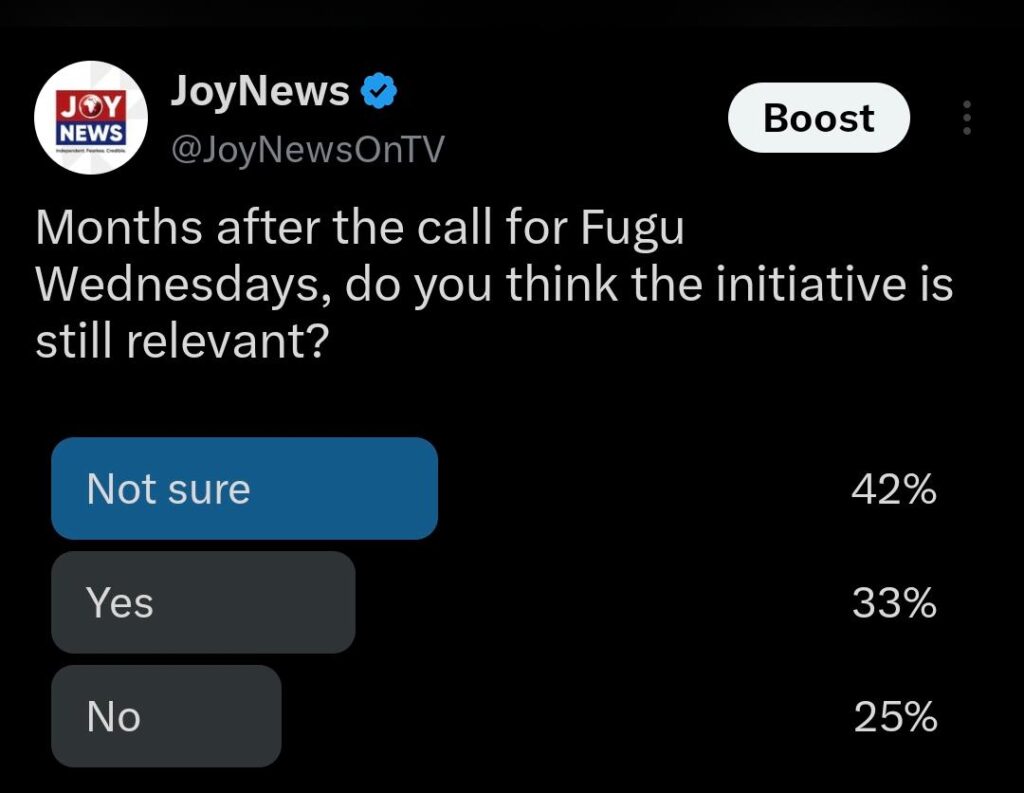
A JoyNews poll showed that 33 per cent of respondents believe the Fugu Wednesday campaign remains relevant, while 25 per cent believe public interest has declined.
Despite concerns about sales, the campaign has kept Ghana’s traditional smock in national conversations, with stakeholders saying its long-term success will depend on whether increased awareness leads to sustained demand for locally produced Fugu.
Latest Stories
-
A Partnership for Progress: Why the ProMark–KPMG collaboration matters for Africa’s digital assets future
6 minutes -
Catholic Bishops pressure gov’t to sign long-delayed mission schools agreement
1 hour -
Cedi under fresh pressure as Christmas import demand drives dollar surge
2 hours -
Ato Forson eyes first-week November for 2027 Budget, promises jobs and major infrastructure push
2 hours -
Catholic Bishops demand probe into ‘protocol admissions’ amid SHS placement challenges
2 hours -
SHS placement: Catholic Bishops demand probe into alleged payments for school places
2 hours -
Facts about Nigeria’s Dangote oil refinery Initial Public Offering
2 hours -
Trump says AI safety fears a ‘hoax’ as he rejects calls for greater safeguards
3 hours -
Oil climbs as Saudi pipeline outage, fresh attacks heighten supply concerns
3 hours -
Donald Trump Jr and Bettina Trump say Putin ally paid for some wedding festivities as a ‘gift’
3 hours -
Farouk Aliu Mahama supports medical student with GH¢10,000 donation
3 hours -
EU is set to propose ban on social media and AI chatbots for under-15s
3 hours -
No SHS space shortage – GES says 800,000 places available for just over 600,000 students
3 hours -
Emmys 2026: The winners and nominees in full
4 hours -
African banks’ foreign subsidiary contributions increasing; Access Bank records fastest cross-border growth
4 hours