

Audio By Carbonatix
5. CONTEMPORARY CRITIQUE AND THE BOTTLENECKS OF JUSTICE DELIVERY (2011)
While the structural fusion under the 1992 Constitution successfully brought the parallel public tribunals under a single judiciary headed by the Chief Justice, it also inherited significant operational challenges. By 2011, public and legal attitudes had grown increasingly frustrated with severe systemic delays across all tiers of the court and tribunal hierarchy.
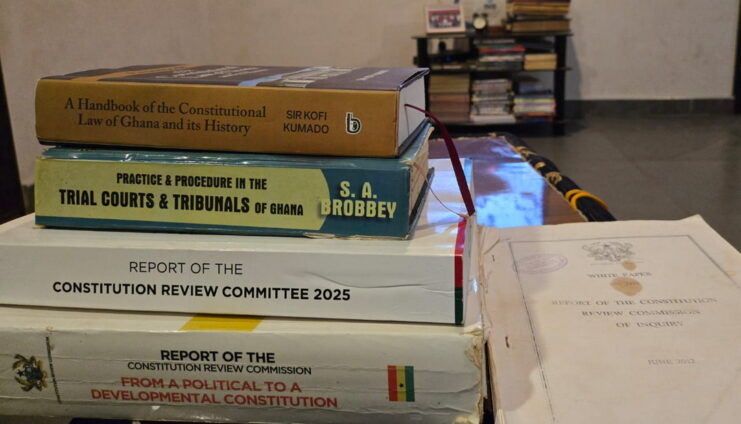
The extensive public consultations conducted by the Constitution Review Commission highlighted this crisis of accessibility. In its landmark volume, Report of the Constitution Review Commission: From a Political to a Developmental Constitution (2011), the Commission observed:
"The thrust of the submissions received by the Commission on this issue centred on the need to address the delays associated with the determination of cases. Cases which should normally take a few months take years for their final disposal."
The debate over strict trial timelines
To counter these delays, strong populist demands arose urging the state to amend the Constitution to enforce rigid, legislated trial timeframes, drawing comparisons to jurisdictions like the United States, Canada, and Nigeria.
However, the policy direction adopted by the Commission favored deep-rooted institutional changes over quick-fix legislative patches. Evaluating the limits of merely changing the text of the law, the Commission stated:
"...while there is immense value in enshrining strict trial timelines in the Constitution as proof of the nation's commitment in stamping out delays... such reforms would only be cosmetic and pious declarations of intent and would have no impact on improving the administration of justice in Ghana if they are not supported by a comprehensive review of administrative procedures in the courts of law."
6. THE SHIFT TOWARD ALTERNATIVE DISPUTE RESOLUTION (ADR)
Recognising that adversarial court and tribunal processes often prolonged litigation needlessly, state policy shifted decisively toward incorporating mediation and arbitration. This policy unfolded over a decade through structured institutional interventions:
- 2001: The National ADR Programme was set up by the office of the Chief Justice following recommendations from a specialised ADR Task Force.
- 2009: The Judicial Service established a dedicated ADR Directorate to systematically coordinate ADR activities across all courts.
- 2010: Parliament enacted the landmark Alternative Dispute Resolution Act, 2010 (Act 798), providing full legislative backing to reinforce the use of mediation and arbitration.
The Commission strongly advocated for making pre-trial ADR processes compulsory at all trial levels, noting that these mechanisms:
"...are typically less formal and adversarial and many use a problem-solving approach to help the parties reach agreement as well as increase access to justice for social groups that are not adequately or fairly served by the judicial system. The process will also reduce the cost and time for resolving disputes and complement the efforts of the regular courts."
Pre-trial ADR has since been provided for in the amended High Court civil procedure rules for all cases, but while it is available in all cases, it is compulsory only for commercial cases.
7. EXECUTIVE ACTION: THE 2012 GOVERNMENT WHITE PAPER
Following the 2011 Commission Report, the executive arm of government took a formal, definitive policy stance regarding the remaining specialized tribunals. In the official White Paper on the Report of the Constitution Review Commission of Inquiry (2012), the state formally moved to dismantle the Regional Tribunals.
Policy directives on restructuring
- Abolition: The Government explicitly accepted the recommendation that the specialised tribunals be abolished and their caseload handled within the regular judicial tracks, stating that "Government accepts the recommendation that Regional Tribunals be abolished and matters handled by them incorporated into the regular courts' schedule."
- Absorption of Chairmen: To manage the institutional transition smoothly, the White Paper directed that "the Chairmen of the Regional Tribunals (if any) should be absorbed into the Judiciary as High Court judges."
- Removal from the Judicial Council: Highlighting this policy of total de-establishment, the Government accepted an amendment to Article 153(g) of the Constitution to replace the "representative of the Chairmen of Regional Tribunals" on the Judicial Council with a representative from the Ghana Prisons Service.
8. ULTIMATE DORMANCY AND CONSTITUTIONAL DIS-ESTABLISHMENT (2025)
By 2025, a comprehensive review by the Constitution Review Committee revealed that while the 2012 White Paper had set a clear policy direction, formal constitutional amendments had lagged, leaving a stark disconnect between law and practice. The Committee’s Proposals for Amendment of the 1992 Constitution (2025) noted that Regional Tribunals were entirely defunct. In practice, their intended criminal jurisdictions and caseloads had been completely absorbed by the specialised criminal divisions of the High Court.
Public attitude and the historical stigma of military rule
The 2025 Committee documented a profound shift in public and professional attitudes toward the tribunal system. Rather than viewing them as useful specialised bodies, the country increasingly associated them with past authoritarian overreach. As the Committee recorded:
"Some submissions... described the Tribunals as largely defunct, institutionally weak, and symbolically associated with Ghana’s period of military rule. These submissions raised concerns that the Tribunals were incompatible with constitutional guarantees of due process and risked subjecting citizens to parallel systems of criminal adjudication..."
The system suffered from permanent credibility deficits. Born out of the PNDC's revolutionary parallel track, the tribunals carried a historical stigma and suffered from chronic internal deficiencies, including inadequate staffing and procedural irregularities that threatened overall public confidence in the judiciary.
Final policy consensus: De-establishment
The final, contemporary consensus of the country is to rationalise the judicial structure by entirely removing obsolete remnants from the text of the Constitution. The Committee recommended a clean break from the parallel tracking experiments of the past:
"Accordingly, reform should proceed on two parallel tracks. First, the Constitution should be amended to remove Regional Tribunals as a permanent feature of the judicial structure, thereby simplifying the constitutional court hierarchy and eliminating redundant institutions."
Rather than keeping dead constitutional structures on paper, modern policy dictates that the jurisdiction of the Circuit and District Courts be expanded, leaving future specialised tribunals to be created dynamically by ordinary Acts of Parliament as regulatory needs arise.
READ the other instalments in the article below:
Click this link to read Part I
Click this link to read Part III
Click this link to read Part IV
Join me on my weekly legal clinic THE LAW every Sunday @ 2 pm on Joynews.
Latest Stories
-
Today’s front pages: Friday, September 18, 2026
1 hour -
Prof Kwaku Asare questions legal basis of case against senior nursing officer linked to ‘Ghana Jollof’
1 hour -
Financial inclusion must go hand in hand with investor protection – BoG Governor
1 hour -
Ablakwa rewards six North Tongu WASSCE best performers with MacBooks, scholarships
2 hours -
Gender Ministry touts gains in LEAP, school feeding and disability support
3 hours -
72 vessels, 17,336 fishing hours: The monitoring gap at Ghana’s first Marine Protected Area
3 hours -
Ansa-Asare questions rush to lower presidential age to 30
4 hours -
Minority challenges claim all 431 government-sponsored World Cup travellers have returned
4 hours -
No evidence linking government, NDC members to cocaine probe – Kwakye Ofosu
4 hours -
Minority demands full breakdown of GH¢58.9m spent on Ghana’s World Cup participation
4 hours -
Stay away from negative peer influences – MP warns SHS students
4 hours -
Mahama to commission Agbogbloshie waste evacuation to Nsawam landfill today
4 hours -
Kwadaso NDC supporters demonstrate to demand removal of MCE
4 hours -
GSA records 18% revenue growth in 2025
4 hours -
2027 Budget to target nine sectors to create jobs – Mahama
4 hours