

Audio By Carbonatix
President John Dramani Mahama has outlined three key pillars that Ghana is proposing to advance the global reparatory justice agenda and move from recognition of historical injustices to concrete action.
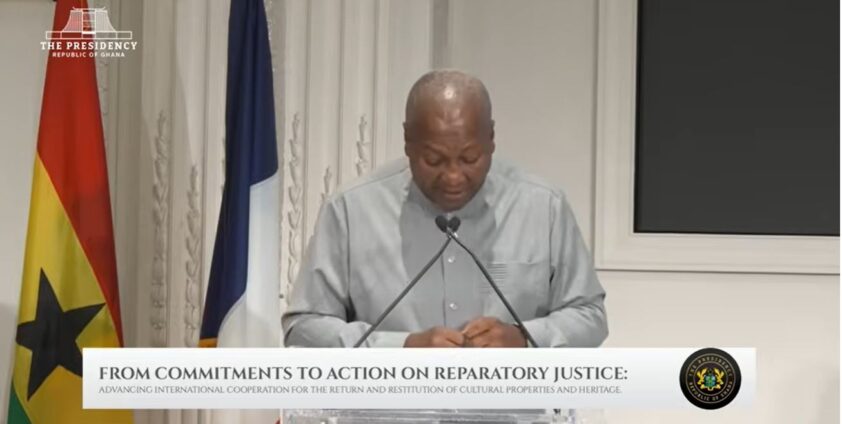
Speaking at a High-Level Side Event on the Next Steps, hosted on the sidelines of the 81st United Nations General Assembly in New York, President Mahama said the next phase must focus on implementation of the Accra Next Steps Commitments on Reparatory Justice.
He said the commitments provide a blueprint for translating the UN’s recognition of the historical injustices associated with the trafficking and enslavement of Africans into practical measures.
“We must move from acknowledgement to action, from commitments to implementation.”
The first pillar, he said, is the creation of a permanent and institutionalised global system for restitution.
President Mahama called on the United Nations and countries holding African cultural property to establish clear and standardised legal and diplomatic mechanisms to facilitate provenance research, improve access to archives and reduce legal barriers to restitution.
He also called for the unconditional return of human remains as an immediate priority.
The second pillar focuses on building Africa’s capacity to receive, preserve and manage its returning cultural heritage.
President Mahama rejected arguments that restitution should be delayed until African countries develop adequate facilities to preserve the artefacts.
“Capacity constraints must never be used as a justification for continued possession. Capacity must serve as a bridge to return, not a barrier to justice.”
He said Africa was already developing the necessary infrastructure through initiatives including the African Union’s Great African Museum and the AU-EU Museum Partnership.
The third pillar is to position cultural heritage as an engine of economic and social development.
President Mahama urged multilateral development banks, international financial institutions, foundations and private-sector partners to invest in Africa’s cultural infrastructure, including regional archives, conservation laboratories, digitisation projects and professional training.
He argued that properly preserved and showcased cultural heritage could contribute to education, national identity, tourism and the creative economy.
President Mahama’s proposals follow the UN General Assembly’s adoption of Resolution 80/250 on March 25, which Ghana has described as a significant step in advancing the global reparatory justice agenda.
Latest Stories
-
Afreximbank, GIIF and 24-Hour Economy Authority pact marks real progress toward 24-hour economy agenda – Amo Agyapong
59 seconds -
IMANI, Local Government Ministry discuss reforms on sanitation, local revenue and urban infrastructure
13 minutes -
Ghana’s international reserves drop to US$11.04 billion in August as BoG pushes for significant build-ups in coming months
13 minutes -
Four years enough for any government to deliver – IEA rejects five-year term
17 minutes -
‘The most important players are here’ – Queiroz shrugs off Ghana’s injury crisis
31 minutes -
Ayariga pledges stakeholder-led approach to Nzema, Kokomba Market redevelopment
35 minutes -
Professional collaboration is key to Ghana’s land and property development – Western Regional Minister
43 minutes -
‘When you play Ghana, it’s a derby’ – Kessié sets tone for AFCON qualifying showdown
44 minutes -
Mahama urges global institutions to invest in Africa’s cultural infrastructure
50 minutes -
Kuami Eugene joins UNICEF Ghana to promote universal birth registration
53 minutes -
Renard warns Côte d’Ivoire against complacency Ahead of Ghana clash
55 minutes -
‘Can the patient feel the difference?’ – GMTF boss challenges health leaders
56 minutes -
Office of the Registrar of Companies marks Risk Awareness Week with push for risk-smart, resilient institution
1 hour -
Full text: Mahama’s speech at high-level side event on return and restitution of cultural properties and heritage
1 hour -
ICU urges Ghanaian smock weavers to scale up production for local and export markets
1 hour