

Audio By Carbonatix
The General Secretary of the Industrial and Commercial Workers’ Union (ICU), Ghana, Morgan Ayawine, has urged smock weavers and leather workers to prepare for mass production as growing interest in Ghanaian crafts creates new opportunities in local and international markets.
He said artisans must move beyond small-scale production and position their businesses to take advantage of the increasing visibility and patronage of smock fabrics and related products.
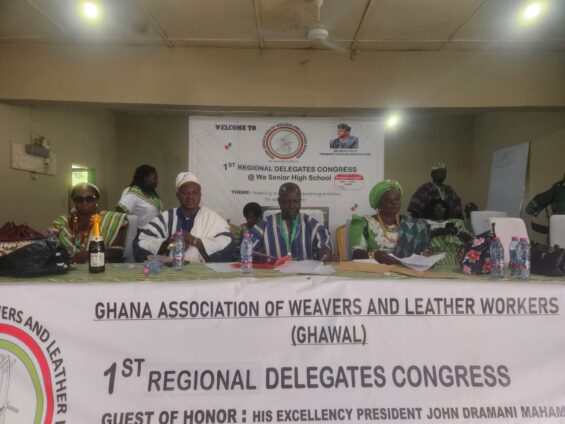
Mr Ayawine made the call in a keynote address at the first national conference of the Ghana Association of Weavers and Leather Workers (GHAWAL) in Wa in the Upper West Region.
The conference, held on Thursday, September 10, 2026, at Wa Senior High School, was organised under the theme, “Weaving for Future: Empowering Artisans for National Growth.”
Mr Ayawine said smock weaving had historically received less attention than other segments of Ghana’s woven cloth industry, with the fabric’s use and patronage largely associated with the cultural traditions of the five northern regions.
He, however, said the craft had gained wider national and international visibility in recent years.
“The smock has now assumed an international image and is being increasingly patronised both locally and in many parts of the world. Kudos to President Mahama,” he said.
Smock gains wider fashion appeal
Mr Ayawine cited a recent fashion display by contestants of TV3’s Ghana’s Most Beautiful as an indication of the changing perception and use of smock fabric.
He said the contestants showcased smock material in a range of contemporary designs, including gowns, frocks, skirts, tops and “pata-pata”.
“This is clear and compelling evidence that smock material has become fashionable and has attained widespread use and acceptance in Ghana. Indeed, it has become sufficiently popular to be recognised as a form of ‘Wednesday wear’ in Ghana,” he said.
He therefore challenged weavers to capitalise on the growing popularity by expanding production of smock fabrics and clothing derivatives for both domestic and export markets.
“With your Association now coming into the limelight, you must project yourselves positively and strategically in order to attract investment and Government support towards the formalisation, modernisation and expansion of the smock weaving and related clothing industries,” he said.
AGOA offers export opportunity
Mr Ayawine also pointed to the African Growth and Opportunity Act (AGOA) as a potential pathway for Ghanaian textile products to access international markets.
He encouraged GHAWAL to work with the Ghana Export Promotion Authority (GEPA) and other relevant institutions to improve its products and ensure they meet international standards.
He said the same approach could be applied to leather and basket products, highlighting the craftsmanship demonstrated in locally made shoes, bags and other leather goods.
According to him, achieving greater market access would require deliberate investment in product quality, packaging, branding, marketing and access to finance.
He also called for artisans to acquire stronger technical and entrepreneurial skills to enable them to operate more competitive businesses.
“As an Association, you must therefore embrace innovation and modern technology without losing the cultural identity and traditional craftsmanship that make your products unique,” he said.
ICU pledges support
Mr Ayawine assured members that ICU Ghana would provide leadership and support towards projecting the industries and highlighting their contribution to employment, poverty reduction and economic development.
He described the conference theme as a call to action and urged artisans to organise effectively, improve quality, embrace innovation and explore new markets.
“If you work together with determination, discipline and unity, I have no doubt that your Association will achieve remarkable success,” he said.
He further urged participants to make the outcome of the conference practical, forward-looking and focused on measurable results.
The conference comes as artisans and producers seek to turn Ghana’s traditional crafts into more commercially viable enterprises.
For the smock, leather and basket sectors, improving production capacity, product standards, branding, financing and access to export markets could help artisans move from largely small-scale operations into more formal and competitive businesses.
The proposed collaboration with GEPA and use of existing trade opportunities such as AGOA could also provide a framework for artisans and their associations to explore markets beyond Ghana.
Latest Stories
-
Afreximbank, GIIF and 24-Hour Economy Authority pact marks real progress toward 24-hour economy agenda – Amo Agyapong
19 minutes -
IMANI, Local Government Ministry discuss reforms on sanitation, local revenue and urban infrastructure
31 minutes -
Ghana’s international reserves drop to US$11.04 billion in August as BoG pushes for significant build-ups in coming months
32 minutes -
Four years enough for any government to deliver – IEA rejects five-year term
35 minutes -
‘The most important players are here’ – Queiroz shrugs off Ghana’s injury crisis
50 minutes -
Ayariga pledges stakeholder-led approach to Nzema, Kokomba Market redevelopment
53 minutes -
Professional collaboration is key to Ghana’s land and property development – Western Regional Minister
1 hour -
‘When you play Ghana, it’s a derby’ – Kessié sets tone for AFCON qualifying showdown
1 hour -
Mahama urges global institutions to invest in Africa’s cultural infrastructure
1 hour -
Kuami Eugene joins UNICEF Ghana to promote universal birth registration
1 hour -
Renard warns Côte d’Ivoire against complacency Ahead of Ghana clash
1 hour -
‘Can the patient feel the difference?’ – GMTF boss challenges health leaders
1 hour -
Office of the Registrar of Companies marks Risk Awareness Week with push for risk-smart, resilient institution
1 hour -
Full text: Mahama’s speech at high-level side event on return and restitution of cultural properties and heritage
1 hour -
ICU urges Ghanaian smock weavers to scale up production for local and export markets
1 hour