

Audio By Carbonatix
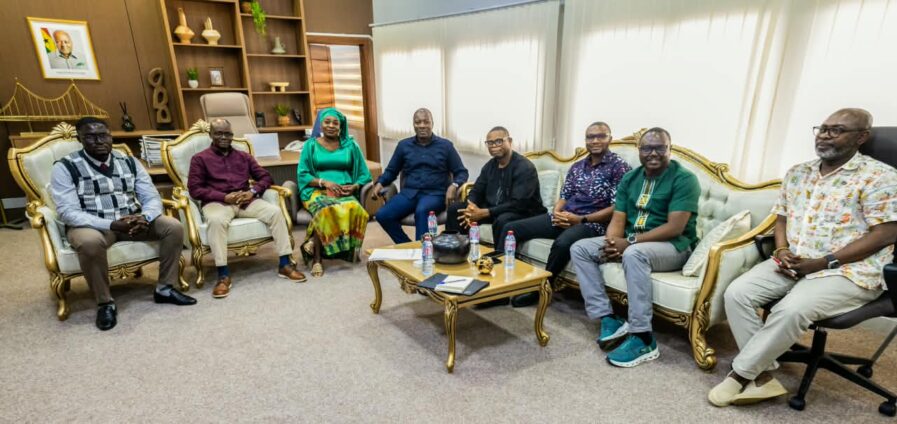
Sanitation reform, local revenue mobilisation, urban mobility and the redevelopment of major markets have featured prominently in policy discussions between policy think tank IMANI Africa and the Ministry of Local Government, Chieftaincy and Religious Affairs.
The discussions took place on September 18, 2026, during an engagement involving the Minister, Chief Director, the Chairperson of Parliament’s Committee on Local Government and representatives of IMANI Africa.
The meeting considered a range of proposed interventions aimed at improving urban management, strengthening local government institutions and increasing internally generated funds for municipal development.
New approach to sanitation and waste collection
On sanitation, the discussions focused on reorganising waste collection in the Greater Accra Region into three operational blocks, with dedicated disposal infrastructure intended to reduce the distance waste collection trucks travel.
The proposals include using geospatial mapping to divide the operational blocks into smaller zones, with transfer stations located within approximately five-kilometre areas.
Under the proposed system, smaller collection vehicles, including tricycles, would deliver waste to the transfer stations, where it could then be loaded onto larger trucks.
A two-bin system was also discussed, with households expected to separate organic and non-organic waste at source.
The proposals envisage digital monitoring of compliance, including possible automated penalties for households that mix waste.
The discussions also included plans to mobilise financing for sanitation infrastructure and procure self-loading and self-tipping electric tricycles to improve residential waste collection.
Another proposal is to restrict the movement of large waste trucks to nighttime hours to reduce their impact on daytime traffic.
The meeting also considered a cashless waste collection system under which fees would be paid through mobile money platforms, with charges potentially linked to the quantity of waste delivered and recorded through weighing systems.
Digital property-rate collection
Local revenue mobilisation was another major focus.
The participants discussed a centralised digital platform for property-rate collection, with the aim of reducing reliance on manual collection and limiting opportunities for leakages and middlemen.
The proposed system would link property and spatial data from several public institutions, including the Electoral Commission, Ghana Statistical Service, Ghana Post and security-related agencies.
The discussions also considered using digital systems to prevent partial payments and automatically capture statutory property rates.
A further proposal is for a substantial proportion of property-rate revenue — between 60% and 70% under the proposal discussed — to be channelled back into municipal infrastructure such as roads, drains, pavements and streetlights.
The approach is expected to strengthen the link between local taxation and visible community development while potentially creating a foundation for future municipal financing instruments.
Contraflow lanes for peak-hour traffic
Urban mobility also featured prominently, with discussions around the use of contraflow arrangements on selected major corridors during peak periods.
The proposal involves temporarily using an opposing lane to give high-capacity public buses a dedicated route through congested areas.
Routes identified for consideration include Madina, Amasaman, Kasoa, Tema and Legon.
The engagement also considered expanding the high-capacity bus fleet, with a proposed pipeline of 120 buses as part of a broader 240-bus target.
Motorbikes for traffic enforcement and security teams were also proposed to help manage the contraflow corridors during peak periods.
The idea follows a proposal publicly raised by Local Government Minister Mahama Ayariga earlier in September to dedicate a peak-hour contraflow lane to Ayalolo buses. He said the proposal would require discussions with the Interior Ministry and the Inspector-General of Police.
Agbogbloshie redevelopment
The meeting further considered the redevelopment of the Agbogbloshie enclave, including the dredging of the lagoon and removal of accumulated waste.
The proposal involves clearing the area over an extended period and relocating unauthorised settlements as part of efforts to restore the environment.
The discussions included the possible use of government machinery, private-sector support and Common Fund resources to support the clean-up operation.
Plans were also discussed for developing industrial and housing zones on recovered land, with a focus on industries such as textiles and garments that could provide employment opportunities for young people.
One of the more unconventional proposals involves using upcycled shipping containers to develop low-cost housing close to employment centres.
The concept would involve working with the Ghana Ports and Harbours Authority and shipping companies to acquire containers that could be converted into housing units.
Technical input from professional bodies, including engineers and surveyors, is expected to inform the designs if the proposal is pursued.
Strengthening local government capacity
The engagement also explored measures to give Metropolitan, Municipal and District Assemblies a stronger economic development role.
One proposal is the appointment of regional economists to support district planning officers and help assemblies track indicators such as economic growth, job creation and infrastructure development.
The discussions also called for stronger collaboration among assemblies, national security agencies and other state institutions on spatial planning, building regulations and community safety.
The deployment of security camera networks along major routes and in selected neighbourhoods was also discussed.
Another proposal is to give local assemblies greater scope to develop or manage local water-distribution systems in areas where national water utilities are unable to adequately meet demand.
Regular regional training sessions and an annual conference for Metropolitan, Municipal and District Chief Executives were also proposed, with sessions focusing on areas including housing, energy, water and economic transformation.
Kejetia Phase II financing
The stalled Kejetia Market Phase II project also featured in the discussions, with the engagement considering ways to reduce costs and secure financing for completion.
The project was originally contracted at €248 million in 2018 and has faced delays following the suspension of work. The Local Government Ministry has previously said the cost has risen because of suspension claims and other associated costs.
Current discussions around the project include exploring alternative approaches to financing and construction, including greater use of locally produced materials where technically feasible.
The meeting also considered concerns about intermediaries benefiting from market spaces at rates significantly higher than the amounts paid to the Kumasi Metropolitan Assembly.
A proposed alternative would involve the state dealing more directly with traders and capturing a greater share of rental and goodwill payments to support the financing of market infrastructure.
Recent discussions by the Local Government Ministry have similarly focused on having traders pay market-value charges directly to the state to help finance completion of Kejetia Phase II.
Next steps
Following the September 18 engagement, IMANI team members are expected to develop thematic policy areas covering urban transport, urban housing, urban water and economic transformation.
Further working sessions are expected to review the proposed policy frameworks, develop data requirements and coordinate possible implementation strategies.
The participants are expected to reconvene in about two weeks for a further briefing and review of the work produced by the respective task teams.
The proposals discussed at the engagement represent areas for further policy development and implementation planning rather than a confirmation that all the measures have been formally adopted by government.
Latest Stories
-
“I don’t see any rational basis” – Inusah Fuseini rejects proposed five-year term
2 minutes -
Constitution shouldn’t be amended simply because years have passed – IEA
2 minutes -
Access Bank, Visa launch ‘Visa Accept’ in Ghana
25 minutes -
‘Our young people must inherit story of what Africa created, not lost’ – Mahama
27 minutes -
Afreximbank, GIIF and 24-Hour Economy Authority pact marks real progress toward 24-hour economy agenda
56 minutes -
IMANI, Local Government Ministry discuss reforms on sanitation, local revenue and urban infrastructure
1 hour -
Ghana’s international reserves drop to US$11.04 billion in August as BoG pushes for significant build-ups in coming months
1 hour -
Four years enough for any government to deliver – IEA rejects five-year term
1 hour -
‘The most important players are here’ – Queiroz shrugs off Ghana’s injury crisis
1 hour -
Ayariga pledges stakeholder-led approach to Nzema, Kokomba Market redevelopment
1 hour -
Professional collaboration is key to Ghana’s land and property development – Western Regional Minister
2 hours -
‘When you play Ghana, it’s a derby’ – Kessié sets tone for AFCON qualifying showdown
2 hours -
Mahama urges global institutions to invest in Africa’s cultural infrastructure
2 hours -
Kuami Eugene joins UNICEF Ghana to promote universal birth registration
2 hours -
Renard warns Côte d’Ivoire against complacency Ahead of Ghana clash
2 hours