


Audio By Carbonatix
The world is facing an "unrelenting march" of diabetes which now affects nearly one in 11 adults, the World Health Organization (WHO) says.
In a major report it warned cases had nearly quadrupled to 422 million in 2014 from 108 million in 1980.
High blood sugar levels are a major killer - linked to 3.7 million deaths around the world each year, it says.
And officials said the numbers would continue to increase unless "drastic action" was taken.
The report lumps both type 1 and type 2 diabetes together, but the surge in cases is predominantly down to type 2 - the form closely linked to poor lifestyle.
As the world's waistlines have ballooned - with one-in-three people now overweight, so too has the number of diabetes cases.

Dr Etienne Krug, the WHO official in charge of leading efforts against diabetes, told the BBC: "Diabetes is a silent disease, but it is on an unrelenting march that we need to stop.
"We can stop it, we know what needs to be done, but we cannot let it evolve like it does because it has a huge impact on people's health, on families and on society."
Failing to control levels of sugar in the blood has devastating health consequences.
It triples the risk of a heart attack and leaves people 20 times more likely to have a leg amputated, as well as increasing the risk of stroke, kidney failure, blindness and complications in pregnancy.

Diabetes itself is the eighth biggest killer in the world, accounting for 1.5 million deaths each year.
But a further 2.2 million deaths are linked to high blood sugar levels. And 43% of the deaths were before the age of 70.
Moving burden
In the 1980s the highest rates were found in affluent countries.
But, in a remarkable transformation, it is now low and middle income countries bearing the largest burden.
Dr Krug told the BBC News website: "That's where we see the steepest increase. Knowing that's where most of the population lives in the world, it does show numbers will continue to increase unless drastic action is taken."
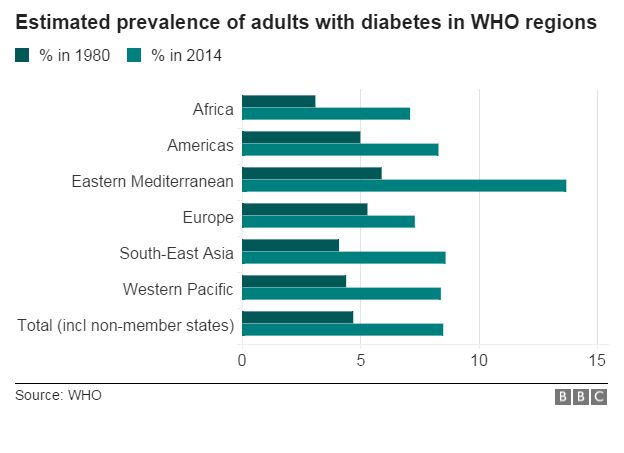
The Middle East has seen the prevalence of diabetes soar from 5.9% of adults in 1980 to 13.7% in 2014.
Dr Slim Slama, a WHO specialist in region, told the BBC News website: "We are the region that has experienced the greatest rise in diabetes, moving from 6 million to 43 million - it is a huge, huge increase.
"In Qatar or Kuwait we have more than 20% of the population with diabetes and when you look at subgroups - people beyond 45 or 60 years old - it's 30-40% and things are even more worrying."
He said growing and ageing populations were behind part of the rise, but diet and inactivity were a major problem.
More than three quarters of teenagers in the region are doing less than the recommended level of exercise, he said.
Latest Stories
-
Government reform efforts yet to translate into improved SOEs financial performance – IMF
9 minutes -
Teacher unions demand apology from Muntaka over WASSCE forgery comments
26 minutes -
NSMQ 2026: From 9 points to ADO9 – PRESEC Legon survive thriller to claim 9th trophy
40 minutes -
Photos: Inside the thrilling NSMQ 2026 Grand Finale as PRESEC, AUGUSCO and Accra Academy battle for glory
1 hour -
Achimota, five other SHSs pilot waste segregation, clean-air initiative
1 hour -
More women attempt suicide, but men die by suicide more often – National Suicide Analysis Report
1 hour -
Three Ghanaian students launch e-commerce platform, Panta, to support small businesses
2 hours -
KMA passes by-law requiring Metropolitan Chief Executives to occupy official residence
2 hours -
Zoomlion rolls out disinfection, disinfestation exercise across Volta Region
2 hours -
Photos: Mahama swears in three new Supreme Court justices
2 hours -
$260 e-Visa fee could make Ghana less competitive – GHATOF
2 hours -
New Supreme Court justices pledge fairness, impartiality and fidelity to Constitution
2 hours -
Mahama urges Supreme Court to communicate decisions with ‘extreme clarity’
2 hours -
Techiman MCE residence abandoned since 2017; Regional Minister sets December deadline
2 hours -
Eni, Vitol sign MoUs with Ghana for two offshore blocks in Tano Basin
2 hours